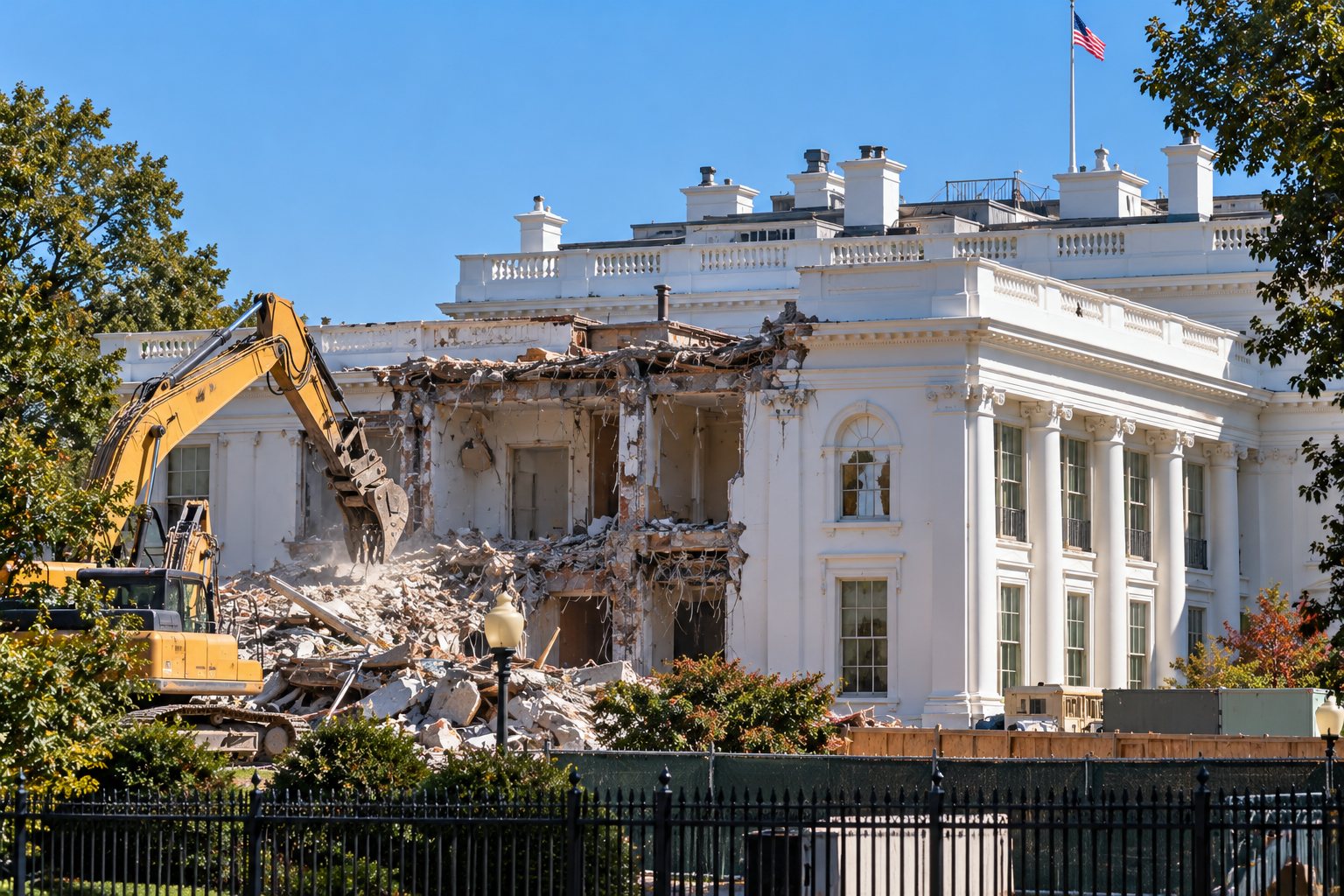
President Donald Trump has begun demolishing portions of the White House East Wing to make way for a massive $250 million ballroom, moving forward with one of the most significant alterations to the presidential residence in generations without first obtaining specific congressional authorization.
Construction equipment began tearing into the historic East Wing on Monday, with photographs showing damaged walls, shattered windows, and debris scattered around the construction site.
The demolition has raised serious questions about whether the president has the legal authority to undertake such a project without approval from Congress and federal planning officials.
The White House belongs to the American people. Yet Trump is proceeding with a major transformation of the historic property without the congressional authorization that critics argue federal law requires.
What Does Federal Law Say?
A central question involves 40 U.S.C. § 8106, a federal statute governing construction on public property in Washington, D.C.
The law states:
"A building or structure shall not be erected on any reservation, park, or public grounds of the Federal Government in the District of Columbia without express authority of Congress."
That language raises an obvious question: Can a president construct a massive new ballroom on White House grounds without first receiving authorization from Congress?
The Trump administration has not obtained specific congressional authorization for the project.
The precise application of the statute to the proposed ballroom remains a legal question, but critics argue that a project of this magnitude cannot simply be treated as routine White House maintenance.
Demolition Begins Before Federal Planning Approval
The National Capital Planning Commission is responsible for reviewing and approving major construction projects involving federal buildings in the Washington area.
However, the White House has begun demolishing the East Wing without obtaining the commission's approval for the ballroom.
Commission Chairman Will Scharf, who also serves as a senior Trump White House official, has argued that the agency's authority applies to construction rather than demolition or site preparation.
That interpretation effectively allows demolition to begin before the proposed replacement structure receives formal review.
The distinction is significant. By the time federal officials consider whether the new ballroom should be approved, portions of the existing White House complex may already be gone.
Trump Previously Promised the Existing Building Would Be Untouched
When Trump announced the ballroom project in July, he insisted the addition would not interfere with the existing White House structure.
He described a project that would be constructed near the presidential residence while respecting the historic building.
Monday's demolition presents a different picture.
Heavy equipment is now tearing into the East Wing, a section of the White House complex that has long housed offices associated with the first lady and her staff.
The proposed ballroom would cover approximately 90,000 square feet and accommodate as many as 999 guests.
Trump argues that the White House needs a larger permanent space for official dinners and receptions.
But the desire for additional entertaining space does not resolve the questions surrounding the project's authorization.
Private Donations Do Not Automatically Replace Congressional Authority
Trump maintains that the ballroom will be funded through private contributions, including donations from wealthy individuals and corporations, rather than taxpayer money.
The administration estimates the project will cost approximately $250 million.
But private financing and legal authorization are two separate matters.
The White House is federal property, and the fact that private donors may pay for construction does not automatically exempt a project from laws governing federal buildings.
The financing arrangement also raises questions about transparency.
Who is contributing money? How much are individual donors providing? And what safeguards exist when companies or individuals with interests before the federal government help finance a major presidential project?
The administration has not publicly provided a complete accounting of the donors and their contributions.
Who Gets to Decide What Happens to the White House?
Presidents have renovated and modernized the White House throughout American history.
Major structural changes, however, have traditionally involved federal oversight, planning reviews, and, where required, congressional authorization.
The White House is not the personal property of whichever president happens to occupy it.
Trump's ballroom proposal is therefore about more than architecture or entertaining foreign dignitaries.
It raises questions about the limits of presidential authority, the role of Congress in overseeing federal property, and whether established approval procedures can be bypassed.
For now, demolition is underway, the ballroom has not received the National Capital Planning Commission's approval, and Congress has not specifically authorized its construction.
The central question is straightforward: If federal law requires congressional authorization for new structures on federal grounds, what authority allows the president to begin transforming the White House before securing it?
Until that question is answered, Trump's ballroom project will remain not merely a construction controversy, but a dispute over the legal limits of presidential power.