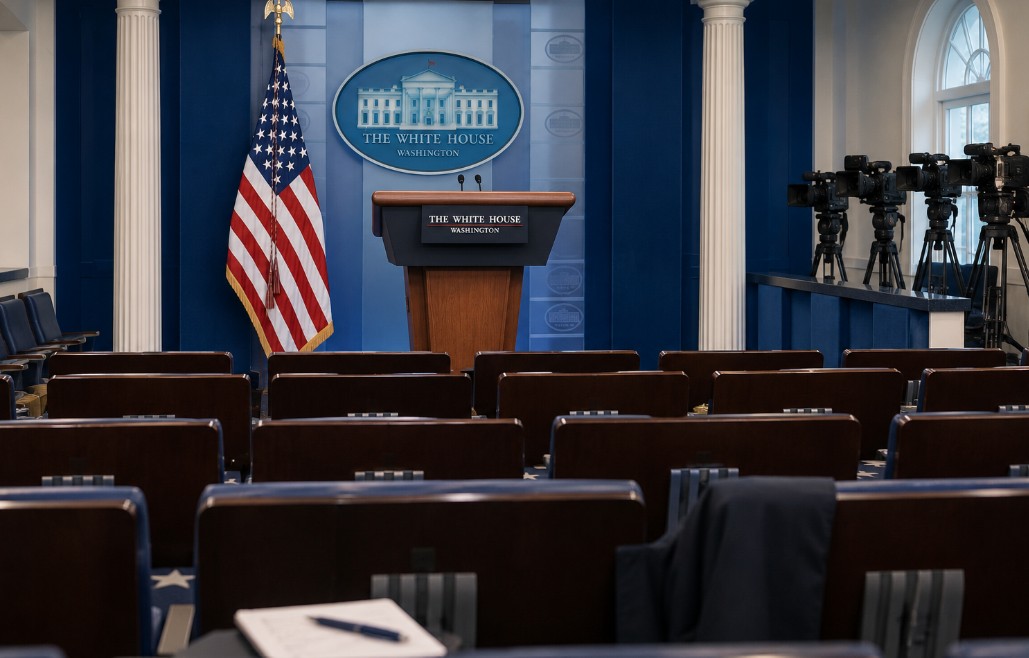
President Donald Trump's long-running confrontation with the American news media escalated this weekend when reporters from CNN, MS NOW and Politico were denied access to the White House after Trump announced that the three organizations were being banned.
Trump announced the decision Friday on Truth Social, accusing the organizations of publishing what he called “fake news” and saying the prohibition would take effect immediately. He also indicated that additional news organizations could face similar treatment.
When questioned about the decision later in the Oval Office, Trump said there was no single report or incident behind it. He described the decision as the result of coverage accumulated over several years and argued that the news organizations had treated his administration unfairly.
By Saturday, the announcement had become an enforced restriction.
CNN senior White House reporter Betsy Klein said her White House credential had been deactivated when she attempted to enter the complex. Her credential was confiscated.
MS NOW White House reporter Akayla Gardner similarly reported that her badge had been disabled. Politico White House reporter Cheyenne Haslett was also denied entry and had her credential taken.
The three reporters had previously been credentialed to work from the White House.
A First Amendment Dispute
The action immediately raised constitutional questions about how much authority a president has to exclude journalists from White House facilities because of their reporting.
The First Amendment prohibits the government from abridging freedom of speech or freedom of the press. Courts have recognized that the White House has considerable discretion over limited-access presidential events, such as small Oval Office meetings. Broader restrictions involving established press credentials and generally available press facilities can present different constitutional and due-process questions.
CNN said it stood behind its journalists and maintained that the Constitution protects its ability to report on the government without interference.
Politico Editor-in-Chief Jonathan Greenberger said the organization would defend its First Amendment rights, while MS NOW said it intended to take whatever steps were necessary to defend its journalists and the role of independent reporting.
The White House Correspondents' Association also called for the reporters' access to be restored. Its president, Jacqui Heinrich, argued that the issue extends beyond the three organizations because a standard permitting exclusion based on coverage could potentially be applied to other news organizations in the future.
Part of a Larger Conflict With the Press
The dispute did not emerge in isolation.
Trump has repeatedly criticized major news organizations throughout his political career, frequently describing unfavorable reporting as “fake news.” During his second administration, disputes over media access have increasingly moved beyond rhetoric into questions involving credentials, access and litigation.
One prominent earlier confrontation involved the Associated Press. The Trump administration restricted AP access to certain presidential events after the organization declined to adopt Trump's preferred terminology for the Gulf of Mexico, instead continuing to use its traditional geographic name while noting Trump's order renaming it the “Gulf of America.” The AP challenged those restrictions in federal court.
Trump has also pursued litigation involving several news organizations.
The latest action therefore represents another stage in a broader dispute over the relationship between the presidency and news organizations whose reporting the president considers unfair.
What Happens Next
The immediate question is whether the restrictions will survive legal scrutiny.
The affected organizations have indicated that they are prepared to defend their access and First Amendment rights, making litigation a possibility. The precise legal issues could depend on exactly what access the White House has revoked and how broadly the restrictions are applied.
There is also a broader institutional question.
Presidents have always had contentious relationships with members of the press, and administrations routinely decide which journalists receive access to particular events. The current dispute goes further because established White House correspondents were denied entry after the president publicly identified their employers and criticized their coverage.
Whether a president can use White House press access in that manner is now likely to become part of the continuing legal and political debate over presidential authority and freedom of the press.
For the historical record, the immediate sequence of events is clear: Trump announced that CNN, MS NOW and Politico would be banned, and the following day journalists representing all three organizations were prevented from entering the White House.