Donald Trump tried to keep three major news organizations away from his presidency.
It didn't work quite the way he apparently expected.
After Trump barred CNN, Politico and MS NOW from the White House, journalists from the organizations simply obtained credentials from the United Nations and showed up in New York to cover him anyway.
Trump couldn't stop them.
The United Nations — not the White House — controls press credentials inside the U.N. complex.
So when Trump arrived in New York for the United Nations General Assembly, some of the very journalists his administration had pushed out of the White House were there waiting for him.
THE BAN
Trump announced Friday that CNN, MS NOW and Politico were being barred from the White House because, he said, the organizations repeatedly produced "fake news."
The threat quickly became reality.
Reporters from the three organizations arrived for work Saturday and discovered that their White House credentials had been disabled.
CNN reporter Betsy Klein and MS NOW reporter Akayla Gardner were turned away. Politico reporter Cheyenne Haslett was also denied entry.
Trump also suggested that additional news organizations could eventually face similar treatment.
The White House has defended the decision by arguing that reporters do not possess an automatic constitutional right to a White House press pass.
"White House access is a privilege — not a right," the administration declared.
The affected news organizations see the situation very differently.
They sued.
THE MEDIA FIGHT GOES TO COURT
CNN, Politico and MS NOW filed a federal lawsuit Monday challenging the administration's decision.
Their argument is straightforward.
The government cannot punish news organizations because the president dislikes their reporting.
The lawsuit argues that selectively removing access because of the content of news coverage violates First Amendment protections and due-process rights.
The White House maintains that the First Amendment protects the organizations' ability to publish but does not guarantee them a hard pass, a seat in the briefing room or membership in the presidential press pool.
A federal judge will now have to consider where that line actually falls.
A hearing on the news organizations' request for emergency relief is scheduled for Wednesday.
THE OTHER NETWORKS REFUSED TO PLAY ALONG
The confrontation quickly expanded beyond the three organizations Trump targeted.
CNN had been scheduled to perform television pool duties covering Trump's trip to New York.
The White House blocked CNN from performing that assignment.
Normally another television network could have stepped in.
Instead, the other major networks refused.
ABC, CBS, Fox News, NBC and CNN suspended the television pool rotation rather than replace CNN.
That decision temporarily deprived the White House of the normal independent television pool coverage that follows an American president.
Other major news organizations joined the protest.
The New York Times and The Washington Post declined for a period Monday to publish photographs supplied through White House-controlled presidential coverage.
The dispute was no longer simply Trump versus CNN.
It had become a broader confrontation between the White House and organizations that compete fiercely with one another but share an interest in maintaining independent access to the presidency.
THEN TRUMP WENT TO THE UNITED NATIONS
There was one problem with Trump's effort to exclude the three organizations.
The White House doesn't run the United Nations.
CNN, Politico and MS NOW obtained U.N. credentials that allowed their journalists to enter the General Assembly complex and continue covering Trump's visit.
The result was an unusual situation.
Journalists considered unacceptable for access to the American president's own White House could stand inside the United Nations and report on that same president.
Trump noticed.
During his visit, he criticized CNN's presence and complained about the network's coverage.
But inside the U.N., the decision wasn't his to make.
THE WHITE HOUSE LAUNCHES ITS OWN CHANNEL
At almost exactly the same time independent television coverage was being disrupted, the White House launched its own 24-hour online video stream.
It is branded "Trump TV: The Essentials Station."
The channel carries presidential speeches, administration announcements, ceremonies and selected highlights.
There are no independent reporters asking questions.
There are no outside editors deciding which stories deserve attention.
The material is produced or selected by the administration itself.
There is nothing inherently unusual about a government broadcasting its own events. Presidents of both parties have used official websites, social media and government video feeds to communicate directly with the public.
The timing, however, is impossible to ignore.
Three news organizations were expelled from the White House.
Major television networks suspended pool coverage in protest.
And the administration simultaneously began promoting its own round-the-clock stream of presidential content.
WHO GETS TO COVER THE PRESIDENT?
That is the larger issue behind this fight.
Presidents have always complained about the press.
Richard Nixon battled newspapers and television networks.
Barack Obama's administration fought bitterly with Fox News.
Joe Biden complained about coverage he considered unfair.
Trump's dispute goes further because his administration has actually removed credentials from news organizations after the president publicly attacked their reporting.
The White House argues that no news organization is automatically entitled to physical access.
The organizations challenging Trump argue that once the government establishes a press-access system, it cannot selectively punish journalists because officials dislike what they publish.
That distinction will now be tested in federal court.
THE REPORTERS DIDN'T DISAPPEAR
Whatever happens in court, this week's confrontation demonstrated something much simpler.
Removing a reporter's White House badge doesn't remove the reporter.
It doesn't erase CNN.
It doesn't shut down Politico.
And it doesn't prevent MS NOW from reporting on the president.
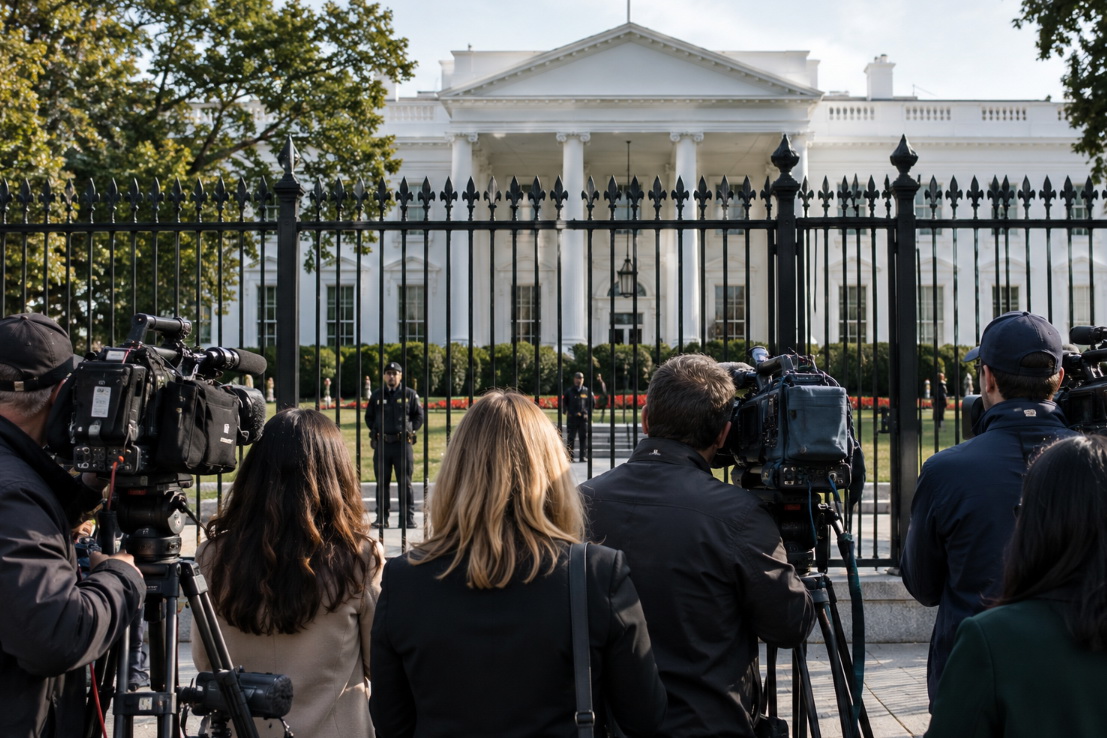
The organizations simply moved outside the White House gates.
Then Trump traveled to New York.
And when he walked into the United Nations, some of the journalists he had tried to leave behind were already inside.
Trump controls access to his White House.
He does not control the press.
And at the United Nations this week, the difference became impossible to miss.