President Donald Trump says American taxpayers will no longer foot the bill for a controversial series of television advertisements centered on himself and his administration, reversing course after the campaign generated mounting criticism from Democrats, Republicans, ethics experts and government watchdogs.
Trump announced Monday that future advertisements would instead be paid for personally or using money raised by his political super PAC, MAGA Inc.
The reversal came after weeks in which the administration defended the commercials as legitimate government-funded public service announcements.
Trump continued to defend the substance of the ads Monday, describing them as positive promotion of the United States. But he said he had decided to use private political money instead of government funds.
The decision leaves another question unanswered: what happens to the millions of taxpayer dollars already spent?
Ads That Looked Remarkably Like Campaign Commercials
The controversy began when a series of Trump-centered television advertisements started appearing on national television in late September.
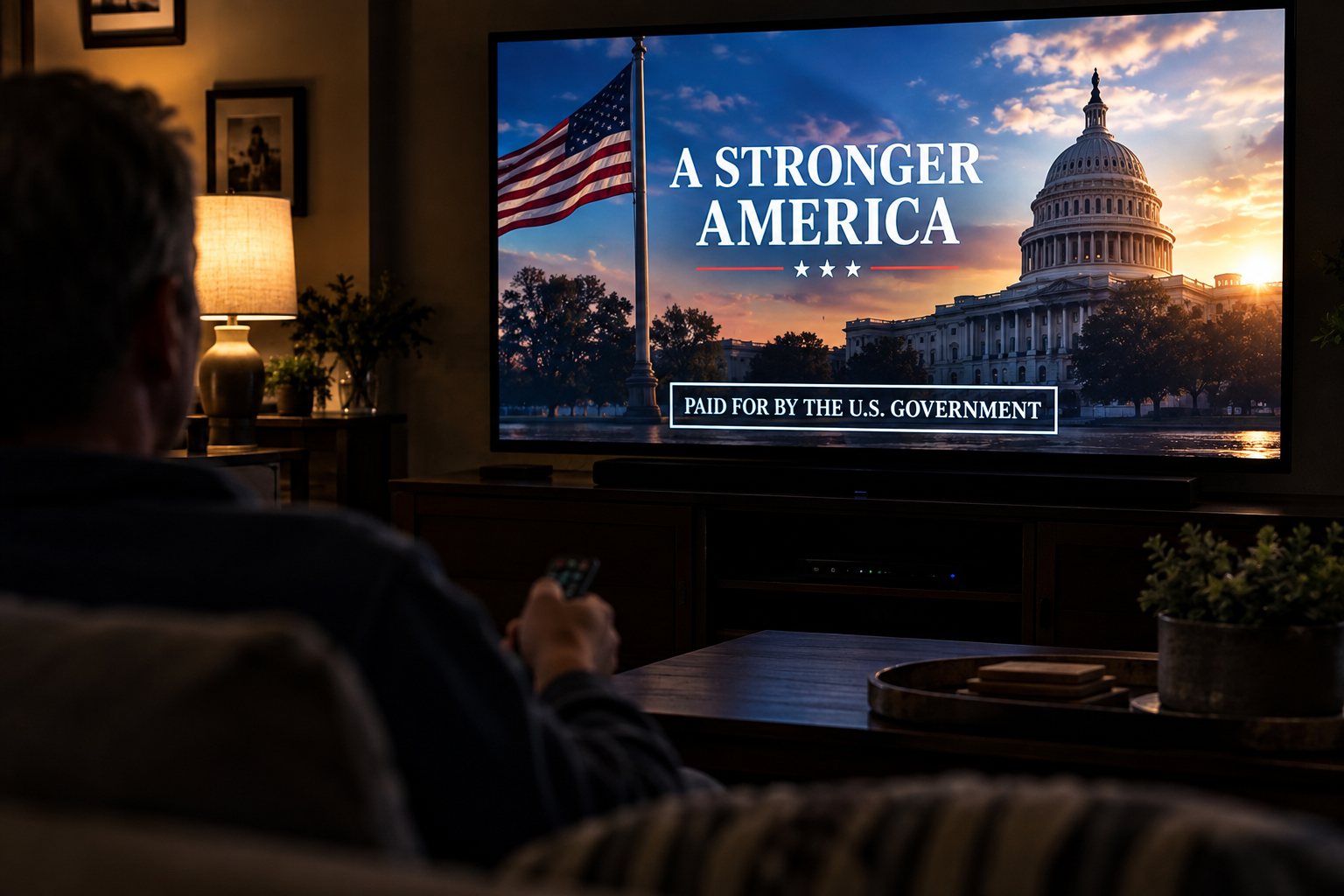
The commercials carried an unusual disclaimer:
“Paid for by the U.S. Government.”
One advertisement featured Trump declaring that America would defeat communism, socialism and Marxism while images from his presidency flashed across the screen.
Another promoted what the administration called America's new “golden age.”
Perhaps most strikingly, another government-funded commercial closely mirrored a video Trump had used during his 2024 presidential campaign.
The campaign logo was gone.
In its place was the disclosure that the advertisement had been paid for by the federal government.
The White House rejected accusations that the advertisements were political.
Administration officials described them as public service announcements intended to promote patriotism and inform Americans about the administration's policies. They also emphasized that Trump himself is not on the ballot in the 2026 midterm elections and that the commercials did not explicitly tell viewers how to vote.
But critics questioned why taxpayers should be paying for television advertisements that prominently celebrated the sitting president.
Millions of Taxpayer Dollars
The financial commitment was substantial.
The Department of Homeland Security committed approximately $20 million for the advertising campaign.
Advertising-tracking estimates indicated that millions of dollars had already been spent airing the commercials across broadcast, cable and streaming platforms.
The advertisements appeared during some of the most expensive and politically valuable television programming available — including college football and NFL games.
That immediately raised questions about whether government resources were effectively being used to promote Trump and, indirectly, the Republican Party shortly before the November midterm elections.
Federal law prohibits congressionally appropriated money from being used for unauthorized “publicity or propaganda.”
Legal experts differed over precisely where the advertisements fell under federal law, but several said the unusually political nature of the commercials raised serious questions.
Republicans Begin Objecting
The criticism soon became bipartisan.
Senate Majority Leader John Thune said taxpayer dollars should not be used to pay for the advertisements.
Republican Sen. Mike Rounds said it was not something he would have done.
Sen. John Kennedy was even more direct, arguing that public officials — whether Trump, Cabinet officials or members of Congress — should not spend public money advertising themselves.
Republican Sen. Thom Tillis also criticized the advertisements, calling them inappropriate as public service announcements and comparing the use of government-funded political messaging to tactics employed by Hungarian leader Viktor Orbán.
Democrats were already demanding investigations.
Senators Patty Murray and Chris Murphy sought information from the Department of Homeland Security about where the money came from and how it was being spent.
California Attorney General Rob Bonta filed complaints with the Government Accountability Office and the U.S. Office of Special Counsel seeking investigations into whether the advertisements violated federal restrictions on partisan government activity and taxpayer-funded propaganda.
Even the Musician Objected
Then came another problem.
One of the advertisements used the song “Love Me” by musician JMSN, whose real name is Christian Berishaj.
Berishaj said he had never authorized his music to be used for the advertisement and would not have approved its use for a political campaign.
His attorneys subsequently sent White House chief of staff Susie Wiles a cease-and-desist letter demanding that the administration stop using the song and provide an accounting of where and how often the advertisement had aired.
The controversy surrounding what the White House called public service announcements was becoming increasingly difficult to contain.
Trump Changes Course
Trump initially defended using government money.
He argued that the advertisements promoted the United States rather than his political campaign and said the practice was legitimate.
But on Monday, he changed course.
Trump announced that taxpayer money would no longer finance the advertisements.
Instead, he said he would pay for them himself and with money raised through MAGA Inc., the super PAC supporting his political operation.
That distinction is significant.
Political committees exist specifically to raise and spend money promoting political messages.
The federal government does not.
Trump's decision therefore addresses one of the central complaints surrounding the advertising campaign: taxpayers who may strongly disagree with the president will no longer be required to finance television advertisements praising him and his administration.
But the reversal does not resolve what has already happened.
Millions of taxpayer dollars have already been spent.
The administration has not announced whether that money will be reimbursed.
And complaints asking federal watchdogs to determine whether the original spending violated federal law remain unresolved.
For weeks, the White House insisted there was nothing improper about the advertisements.
Trump himself defended paying for them with what he called “U.S.A. money.”
Then Democrats complained.
Government watchdogs complained.
Legal experts raised concerns.
Musicians objected.
And eventually, members of Trump's own Republican Party began saying the same thing:
Taxpayers shouldn't be paying for this.
Now they won't.