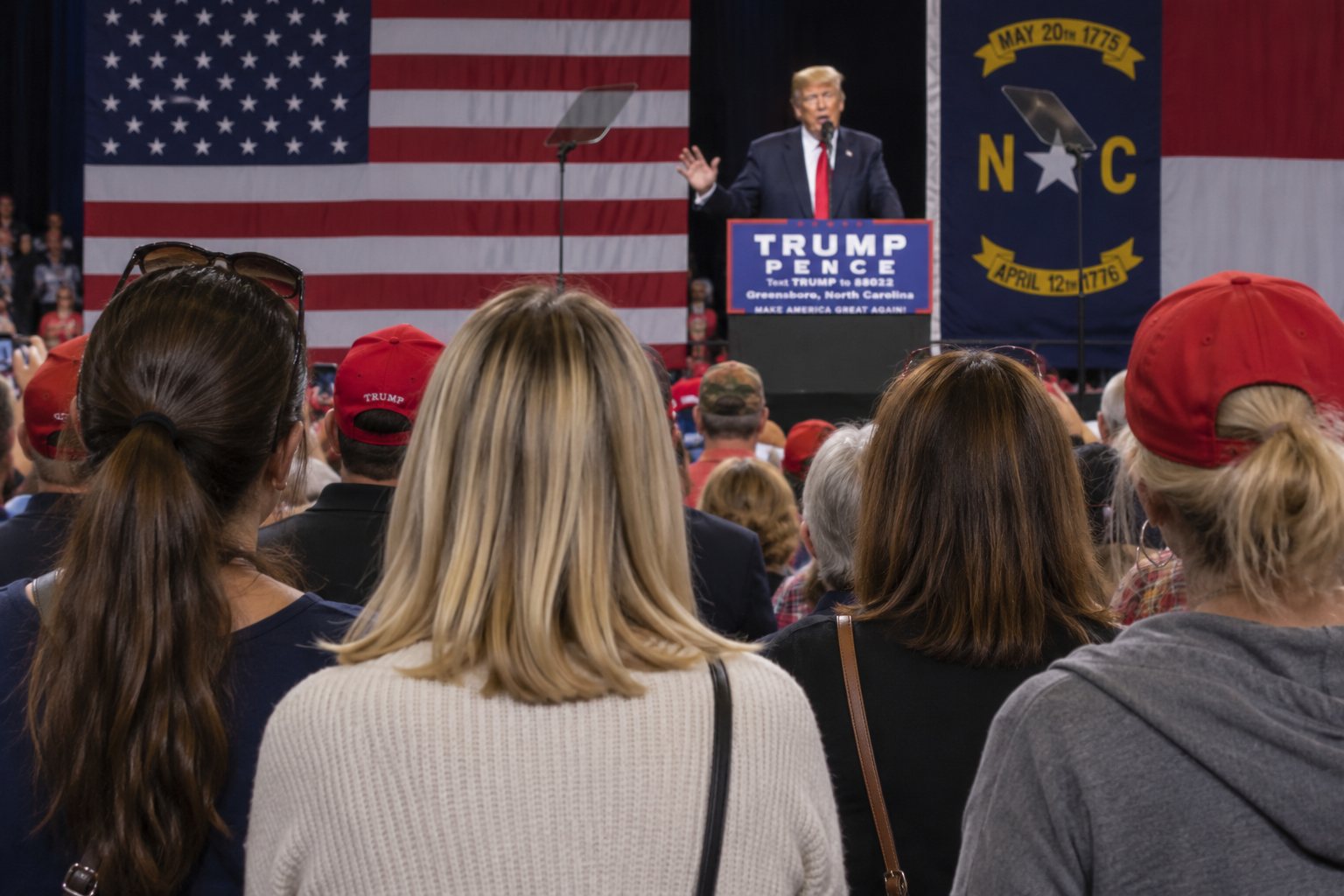
With his presidential campaign engulfed by allegations of sexual misconduct, Donald Trump took the stage in Greensboro, North Carolina, and responded not only by denying the accusations but by personally attacking the women making them. He called accusers “horrible,” “sick” and liars, suggested some were seeking fame and mocked the appearance of Jessica Leeds, who accused him of groping her on an airplane decades earlier: “Believe me, she would not be my first choice.”**
One week earlier, Americans had heard Donald Trump describe—in his own words—what he said he could do to women because he was famous.
Now women were coming forward saying he had done things resembling what he had described.
Trump's response was unequivocal.
They were lying.
And on October 14, 2016, he went further.
He attacked them personally.
The Access Hollywood Tape
The crisis began on October 7.
The Washington Post published a recording from 2005 of Trump speaking with television host Billy Bush while preparing for an appearance on Access Hollywood.
Trump described pursuing a married woman.
Then he talked about approaching women generally.
“When you're a star,” Trump said, “they let you do it.”
He also described kissing women and made his now-infamous remark about grabbing women by their genitals.
The recording exploded across the presidential campaign.
Trump apologized for the language and characterized it as “locker room talk.”
But during the presidential debate two days later, moderator Anderson Cooper pressed him on something much more important.
Had Trump actually done the things he described?
Trump said no.
“I have not,” he answered.
That denial changed the story.
Because women soon began publicly saying otherwise.
Women Come Forward
On October 12, The New York Times published accounts from Jessica Leeds and Rachel Crooks.
Leeds said she had been seated beside Trump in first class on an airplane decades earlier when he began touching her.
She alleged that Trump grabbed her breasts and attempted to put his hand up her skirt.
Leeds described the encounter as an assault.
Crooks described a different incident from 2005.
She said she encountered Trump outside an elevator at Trump Tower while working as a receptionist for another company in the building.
According to Crooks, Trump shook her hand, wouldn't let go, kissed her cheeks and then kissed her directly on the mouth without her consent.
Other allegations followed.
People magazine writer Natasha Stoynoff accused Trump of forcing himself on her while she was interviewing him at Mar-a-Lago in 2005.
Mindy McGillivray alleged that Trump groped her at Mar-a-Lago in 2003.
On October 14 itself, former Apprentice contestant Summer Zervos publicly accused Trump of unwanted kissing and groping during encounters in 2007.
Trump denied the allegations.
“She Would Not Be My First Choice”
At his Greensboro rally, Trump focused considerable attention on Jessica Leeds.
He mocked her account of what happened on the airplane.
Then he appeared to suggest that her physical appearance made the allegation implausible.
“Believe me,” Trump said, “she would not be my first choice.”
The crowd laughed.
Trump continued.
“You don't know,” he said. “That would not be my first choice.”
It was an extraordinary response to an allegation of sexual assault.
Trump wasn't simply saying the incident hadn't happened.
He was suggesting that the woman accusing him wasn't attractive enough for him to have assaulted.
“Check Out Her Facebook”
Trump took a similar approach with Natasha Stoynoff.
Stoynoff had alleged that while she was at Mar-a-Lago preparing a story about Trump and his wife Melania, Trump pushed her against a wall and forcibly kissed her.
Trump denied it.
At Greensboro, he encouraged the audience to look at Stoynoff's appearance.
“Check out her Facebook,” Trump said.
“You'll understand.”
Again, the crowd laughed.
Trump's implication was unmistakable.
Look at the woman.
Then decide whether Donald Trump would have wanted her.
“Horrible,” “Sick” and “Phony”
Trump attacked the broader group of women as well.
He called the accusations false.
He called the women liars.
He described them as “horrible.”
He called one allegation “sick.”
He suggested some of the women might be seeking fame.
And he portrayed the entire wave of accusations as a coordinated political attack engineered by Hillary Clinton and the media to destroy his presidential campaign.
Trump said the timing proved something suspicious was happening.
The election was only weeks away.
But timing alone did not establish that the allegations were fabricated.
Several accusers said they had told friends, relatives or colleagues about their alleged encounters well before Trump entered presidential politics.
The Contradiction at the Center of the Story
Trump's defense also collided with something Americans had just heard directly from Trump himself.
The Access Hollywood recording wasn't an accusation.
It wasn't an anonymous source.
It wasn't a Democratic campaign advertisement.
It was Donald Trump's own voice.
He had described kissing women.
He had described grabbing women.
And he had suggested that celebrity allowed him to get away with behavior other men could not.
Trump maintained that those comments were merely talk and that he hadn't actually engaged in nonconsensual conduct.
The women coming forward were alleging otherwise.
Their accusations did not by themselves prove that every allegation was true.
Trump was entitled to deny them.
But his Greensboro response went beyond denial.
Rather than limit his defense to evidence or factual contradictions, he attacked the women themselves.
Appearance as a Defense
The argument Trump used against Leeds and Stoynoff carried another implication.
Sexual assault isn't determined by whether an alleged victim is attractive to the accused.
It isn't a beauty contest.
Yet Trump's response repeatedly invited his supporters to evaluate the women's appearances.
Leeds wouldn't have been his “first choice.”
People should look at Stoynoff's Facebook page and they would “understand.”
The defense effectively transformed an allegation about consent into a judgment about desirability.
And the crowd laughed along with him.
“Lock Her Up”
At one point while Trump discussed an accuser, some people in the Greensboro audience began chanting:
“Lock her up!”
The chant had normally been directed at Hillary Clinton.
Now it was being shouted while Trump attacked a woman accusing him of sexual misconduct.
The moment illustrated how completely the allegations had been absorbed into the larger political battle.
Trump presented himself as the victim.
The women accusing him became part of the attack against him.
And his supporters responded accordingly.
Trump Said Evidence Was Coming
Trump insisted that he could prove the accusations were false.
The day before the Greensboro rally, he said his campaign had “substantial evidence” disputing the women's accounts and promised that it would be released at an appropriate time.
At the October 14 rally, however, Trump's response centered largely on denials, attacks on the accusers and allegations of a political conspiracy.
He also threatened legal action against news organizations reporting the claims.
The New York Times refused Trump's demand that it retract its reporting.
Three Weeks Before the Election
All of this was unfolding with Election Day rapidly approaching.
Trump was the Republican nominee for president.
Hillary Clinton was the Democratic nominee.
Millions of Americans were already voting or preparing to vote.
And the Republican candidate was standing before cheering crowds responding to women accusing him of unwanted sexual contact by attacking their credibility, their motives and, in some cases, their appearance.
Trump denied the allegations throughout the campaign.
But the accusations did not disappear.
“Believe Me”
The Greensboro rally captured something larger than one campaign controversy.
Trump had several possible ways to respond to serious allegations.
He could deny them.
He could offer evidence contradicting them.
He could allow his attorneys and campaign to address them.
Instead, he also chose ridicule.
Jessica Leeds said Trump had groped her on an airplane.
Trump's response before thousands of supporters wasn't simply:
That never happened.
It was:
“Believe me, she would not be my first choice.”
The audience laughed.
And with just over three weeks remaining before Americans chose their next president, allegations of sexual misconduct had become another spectacle on the campaign trail.