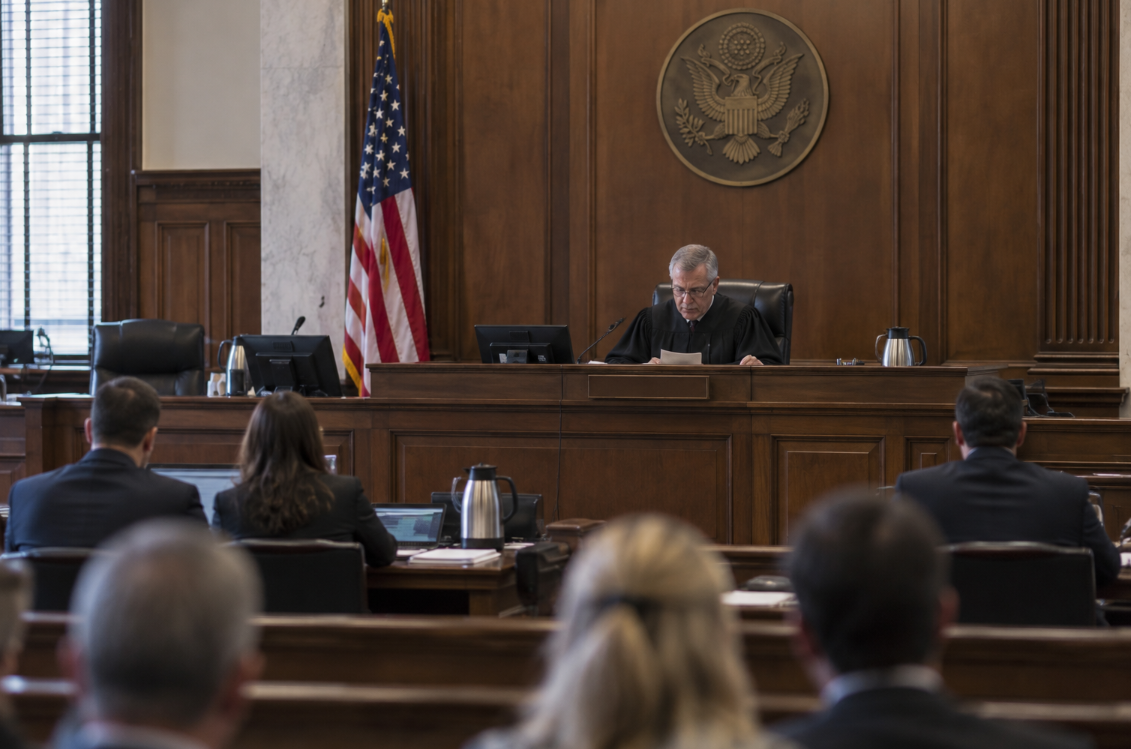
Donald Trump had every right to criticize the judge overseeing the lawsuits against Trump University.
He could criticize the judge's decisions.
He could argue that the lawsuits should have been dismissed.
He could complain that he was being treated unfairly.
Instead, Trump made the judge's ancestry part of his argument.
U.S. District Judge Gonzalo Curiel, Trump argued, couldn't necessarily treat him fairly because Curiel was of Mexican heritage — and Trump was campaigning to build a wall along the Mexican border.
There was one particularly important fact about the judge.
Gonzalo Curiel was born in Indiana.
He was an American federal judge.
The Trump University Connection
Curiel was presiding over federal civil litigation involving Trump University, the now-defunct real-estate seminar business carrying Trump's name.
Former students alleged that the program had misled them and used aggressive sales techniques to persuade customers to spend thousands of dollars on increasingly expensive courses and mentorship programs.
Trump denied wrongdoing and defended Trump University.
As the litigation continued during his presidential campaign, Trump became increasingly critical of Curiel and his rulings.
Criticizing those rulings would have been an ordinary legal and political dispute.
But Trump went further.
“He's a Mexican”
During a May 27 campaign rally in San Diego, Trump spent several minutes attacking Curiel and discussing the Trump University case.
He described the judge as hostile toward him and brought up Curiel's ancestry.
Curiel was born in East Chicago, Indiana, to Mexican immigrant parents.
Trump nevertheless repeatedly emphasized the judge's Mexican heritage while arguing that Curiel had a conflict of interest.
The controversy intensified dramatically over the following days.
Then came Trump's June 3 interview with CNN's Jake Tapper.
“I'm Building a Wall”
Tapper repeatedly challenged Trump to explain why Curiel's ancestry was relevant to whether the judge could perform his job fairly.
Trump responded by connecting the issue directly to one of the central promises of his presidential campaign:
“This judge is of Mexican heritage. I'm building a wall, OK?”
Trump maintained that Curiel had treated him unfairly.
Tapper kept returning to the same issue.
Was Trump saying that a judge's ethnic heritage could prevent that judge from treating him fairly?
Trump continued arguing that there was a conflict.
The exchange became increasingly uncomfortable.
Tapper Keeps Pressing
Tapper pointed out that Curiel was an American.
Trump didn't dispute that.
Instead, he continued focusing on the judge's heritage and Trump's own political position toward Mexico.
Tapper tried repeatedly to separate the two issues.
Trump's political position was that the United States should build a wall along the Mexican border.
Curiel's parents happened to have immigrated from Mexico.
Why should one have anything to do with the other?
Trump's argument was essentially that his political position regarding Mexico created a potential conflict involving a judge of Mexican ancestry.
That argument produced an immediate political backlash.
What About a Muslim Judge?
The controversy soon expanded beyond Curiel.
Trump had also proposed temporarily prohibiting Muslims from entering the United States.
CBS's John Dickerson subsequently asked Trump whether a Muslim judge could similarly have difficulty treating him fairly because of that policy.
Trump answered:
“It's possible, yes.”
That answer made the implications of Trump's argument considerably broader.
This was no longer simply a complaint about one judge's rulings.
Trump was suggesting that a person's background could potentially affect whether that person could fairly judge a case involving him because of Trump's political positions toward the group with which that person was associated.
Republicans Turn Against Trump's Argument
Some of the strongest criticism came from Trump's own party.
House Speaker Paul Ryan had only recently endorsed Trump as the presumptive Republican presidential nominee.
On June 7, Ryan publicly condemned Trump's remarks.
Ryan described the idea that someone couldn't perform a job because of race as “the textbook definition of a racist comment.”
He called the remarks unacceptable and said he disavowed them.
Ryan nevertheless maintained his endorsement of Trump.
Senate Majority Leader Mitch McConnell also rejected Trump's argument, while other prominent Republicans criticized the remarks.
The controversy had become serious enough that Republican leaders were publicly rebuking their own presumptive presidential nominee.
The “Pro-Mexican” Organization
Trump offered another reason for questioning Curiel.
He pointed to Curiel's membership in the San Diego La Raza Lawyers Association and characterized the organization as strongly “pro-Mexican.”
That description was misleading.
The San Diego La Raza Lawyers Association was an organization for Latino lawyers and law students.
It was not the National Council of La Raza, a separate national Latino advocacy organization with which it was sometimes confused.
The president of the lawyers association said the organization had “no pro-Mexico agenda.”
Its purpose was supporting Latino members of the legal profession and community.
Trump nevertheless cited Curiel's association with the group while questioning the judge's impartiality.
Trump Tries to Contain the Controversy
By June 7, the backlash had become difficult for the campaign to ignore.
Trump issued a lengthy statement.
He said his remarks had been “misconstrued as a categorical attack against people of Mexican heritage.”
He also offered an important clarification:
“I do not feel that one's heritage makes them incapable of being impartial.”
But Trump didn't withdraw his criticism of Curiel.
He continued arguing that the judge's rulings gave him legitimate reasons to question whether he was receiving a fair trial.
Trump said he would stop publicly discussing the matter.
He did not apologize.
The Problem Wasn't Criticizing a Judge
The distinction at the center of the controversy was relatively simple.
Politicians criticize judges all the time.
Litigants criticize judges who rule against them.
Trump could argue that Curiel made incorrect decisions.
He could appeal decisions where the law permitted it.
He could have his attorneys challenge rulings through the judicial system.
None of those things required discussing where Curiel's parents came from.
Trump made that relevant himself.
Curiel was born in Indiana.
His parents came from Mexico.
Trump was campaigning to build a wall along the Mexican border.
And Trump repeatedly argued that those facts created reason to question whether the judge could treat him fairly.
Another Boundary Crossed
By June 2016, Trump was no longer an outsider candidate whom Republican leaders expected eventually to disappear.
He was the presumptive Republican nominee for president of the United States.
That made the Curiel controversy substantially different from some of the provocative statements Trump had made earlier in the primary.
Trump was now preparing to lead one of America's two major political parties into a general election.
And Republican leaders found themselves publicly explaining why their own nominee was wrong to suggest that an American federal judge's ancestry could prevent him from doing his job fairly.
Trump eventually said heritage did not inherently make someone incapable of impartiality.
But only after days of controversy.
The original argument was already on the record:
The judge had Mexican heritage.
Trump wanted to build a wall.
And Trump believed that created a conflict.