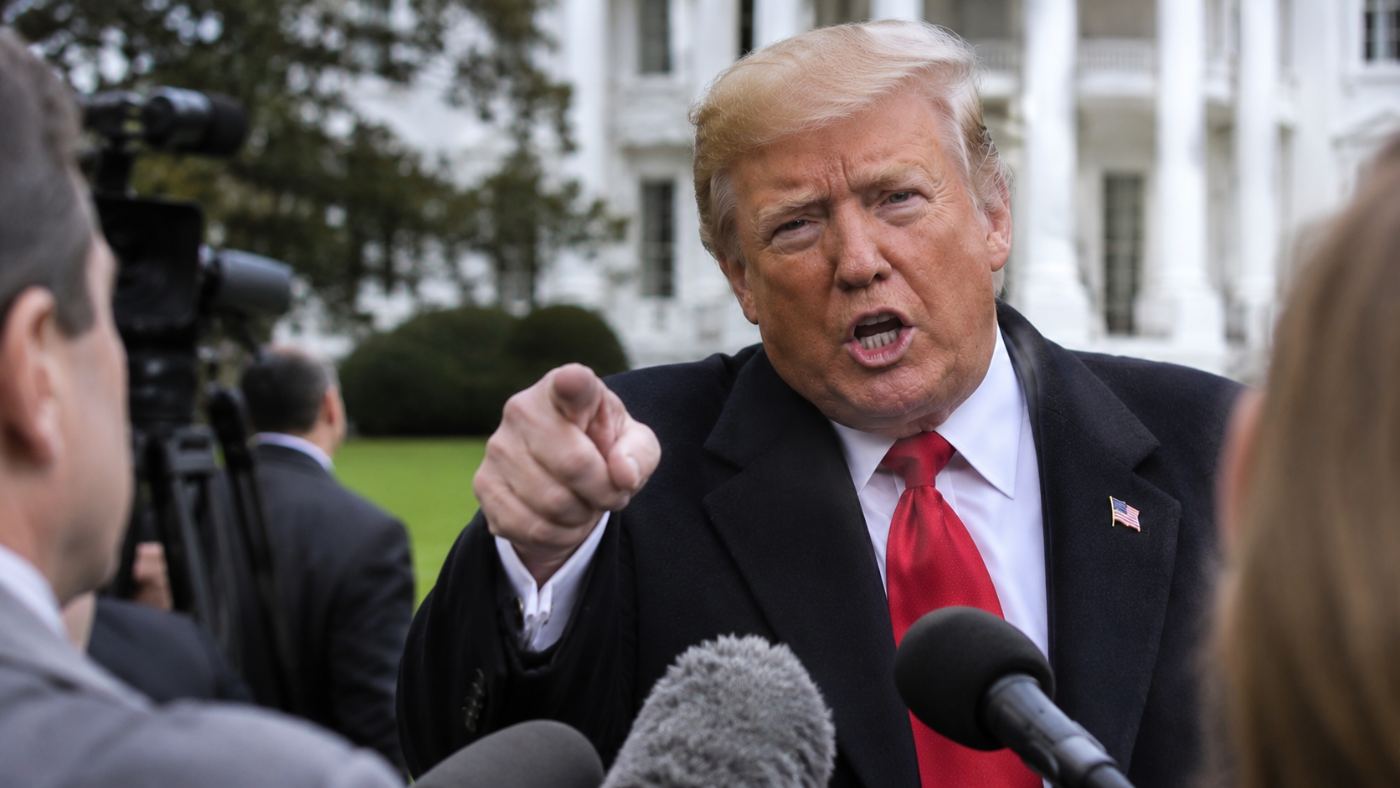
President Donald Trump lashed out at his former personal attorney Michael Cohen on November 29, 2018, after Cohen pleaded guilty to lying to Congress about negotiations for a Trump-branded skyscraper in Moscow.
Speaking to reporters outside the White House, Trump called Cohen a weak person who was lying to obtain a lighter prison sentence. But the president's own explanation of the Moscow business deal raised additional questions about statements he had made during the 2016 presidential campaign.
Cohen had admitted that negotiations for Trump Tower Moscow continued until at least June 2016, months after he previously claimed the project had been abandoned.
That timeline placed the negotiations squarely within Trump's presidential campaign, when the candidate was publicly distancing himself from Russian business interests.
Trump responded by attacking Cohen's credibility.
He accused his former attorney of inventing stories to secure favorable treatment from federal prosecutors and insisted that the proposed Moscow development had been nothing more than a potential business transaction.
Trump also argued that he had been legally entitled to pursue business opportunities while running for president.
On that point, the president was correct. Negotiating a real estate project in Russia was not itself illegal.
The controversy concerned what Trump and Cohen had said about the negotiations, when they occurred, and whether the public had received an accurate account of the candidate's Russian business interests.
Trump maintained that the project had been widely known during the campaign.
However, FactCheck.org subsequently identified problems with that characterization.
Although reports about Trump's previous Russian business interests were publicly available, the specific details and extended timeline of the proposed Trump Tower Moscow negotiations had not been fully disclosed to voters.
In July 2016, Trump had publicly declared that he had nothing to do with Russia.
The newly disclosed negotiations complicated that sweeping statement.
Federal prosecutors established that Cohen had communicated with Russian contacts and sought assistance from the office of Russian President Vladimir Putin while the proposed development remained under consideration.
Cohen also acknowledged discussing the project with Trump and members of the Trump Organization.
The president attempted to minimize the significance of those discussions by emphasizing that the building was never constructed and that no final development agreement had been completed.
Those facts did not eliminate the questions surrounding the negotiations.
The proposed project could have produced substantial financial benefits for Trump's business organization if it had proceeded.
The guilty plea also highlighted the collapse of a relationship that had once been central to Trump's business and political operations.
For years, Cohen had served as Trump's attorney, representative, and public defender.
He handled sensitive matters and frequently confronted critics on Trump's behalf.
By November 2018, however, Cohen was cooperating with federal investigators, while Trump was publicly attacking the man who had once defended him.
The president's accusations created a dispute over credibility.
Cohen had admitted lying to Congress, providing a clear reason to scrutinize his statements carefully.
At the same time, his guilty plea was supported by evidence gathered during the federal investigation, including communications concerning the Moscow project.
Trump's description of the negotiations therefore had to be evaluated against the documented timeline rather than accepted solely on the basis of his criticism of Cohen.
The confrontation unfolded during Special Counsel Robert Mueller's investigation into Russian interference in the 2016 election.
Investigators were examining contacts between individuals associated with Trump's campaign and Russian interests, along with efforts to obstruct or mislead federal inquiries.
The Moscow negotiations became significant because they revealed that Trump's business organization had continued pursuing a Russian opportunity while he was seeking the presidency.
The disclosure did not establish that Trump had participated in Russia's election interference operation.
It did, however, provide new information about business contacts that had previously been minimized.
Trump's November 29 remarks demonstrated how the administration responded when a former insider began cooperating with investigators.
Rather than focusing exclusively on the documentary evidence, the president publicly challenged Cohen's motives, character, and reliability.
The episode also exposed a broader issue involving political transparency.
American voters had been told that Trump had no meaningful business dealings with Russia during the campaign.
Cohen's guilty plea established that negotiations for a potentially lucrative Moscow development had continued much longer than previously acknowledged.
The dispute was no longer simply about an abandoned real estate proposal.
It concerned the accuracy of statements made during a presidential election and the credibility of those involved in explaining the business relationship.
Cohen was sentenced to three years in federal prison in December 2018 for offenses arising from his federal criminal cases.
Mueller's final report, released in 2019, documented the Moscow negotiations and the false statements Cohen had made to Congress.
The report did not establish a criminal conspiracy or coordination between the Trump campaign and the Russian government in its election interference activities.
Nevertheless, Cohen's admitted deception and the documented business negotiations remained part of the historical record.
On November 29, 2018, Trump attempted to discredit his former attorney while defending his own account of the Moscow project.
The confrontation illustrated the difference between attacking a witness's credibility and addressing the underlying evidence.
Cohen had lied about the negotiations. His guilty plea established that fact.
But the corrected timeline also showed that Trump's organization had continued exploring a Russian business opportunity during the presidential campaign, contradicting the impression created by earlier public statements.
That distinction remained central to understanding the controversy surrounding Trump's former fixer and the Moscow business deal.