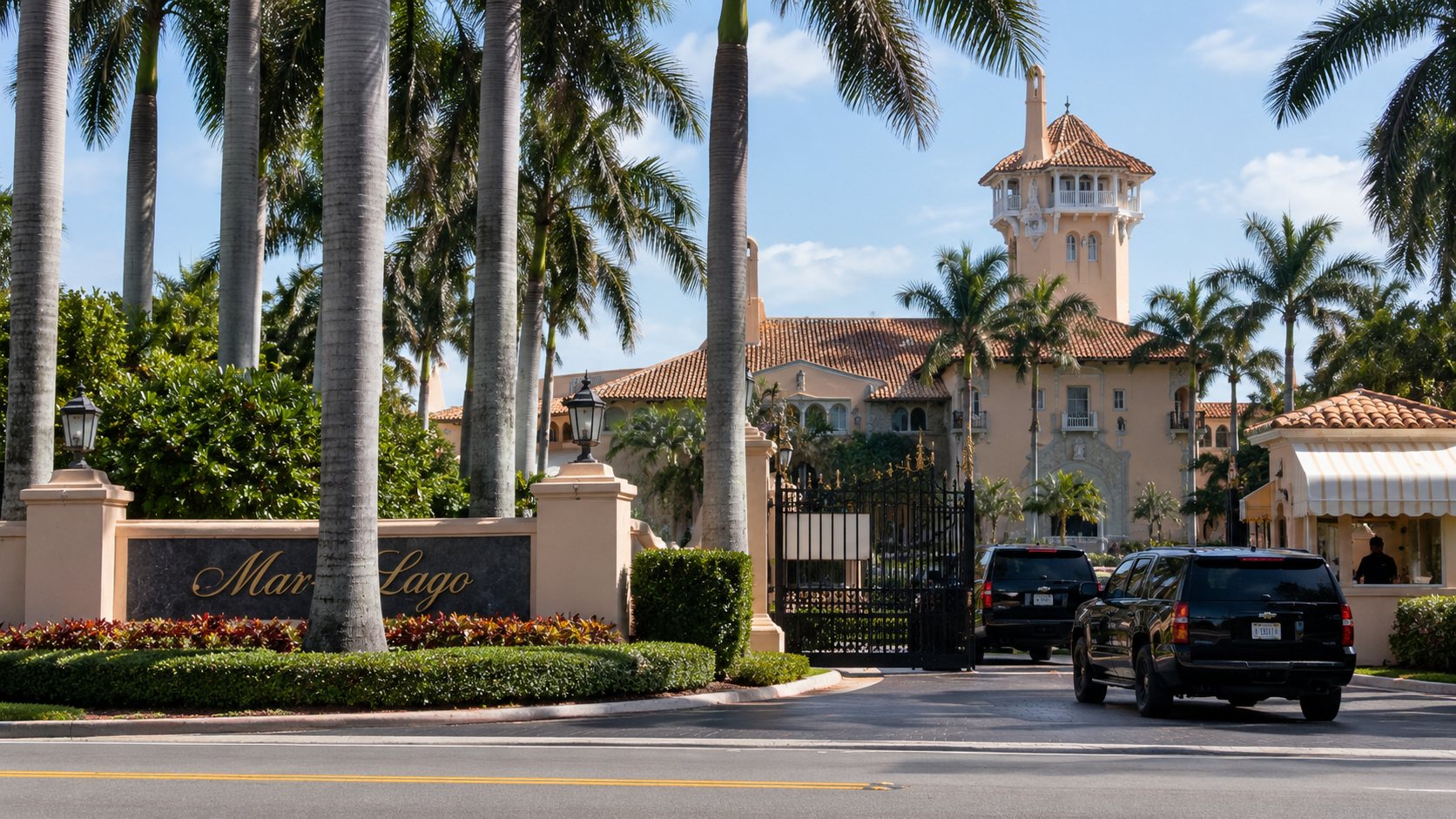
Former President Donald Trump has asked the U.S. Supreme Court to intervene in the escalating legal battle over documents seized from his Mar-a-Lago estate, bringing a dispute involving highly sensitive government records before a court that includes three justices he appointed.
Trump's attorneys filed an emergency application Tuesday asking the Supreme Court to overturn part of a federal appeals court ruling involving approximately 100 documents bearing classification markings recovered during the FBI's August 8 search of Mar-a-Lago.
The request represents another escalation in a legal fight that began after federal agents searched Trump's Florida residence as part of an investigation into the handling of government records.
The FBI recovered thousands of documents during that search, including records marked classified.
Some carried markings indicating particularly sensitive national-security information.
The dispute has since expanded into a complicated battle involving executive privilege, presidential records, classified information and the authority of a former president over documents removed from the White House.
What Trump Is Asking the Supreme Court to Do
Trump's request to the Supreme Court is narrower than some descriptions of the dispute may suggest.
His attorneys are not currently asking the justices to prevent the Justice Department from using the documents bearing classification markings in its criminal investigation.
Instead, Trump wants those documents returned to the review being conducted by a court-appointed special master.
U.S. District Judge Aileen Cannon appointed veteran federal judge Raymond Dearie as special master after Trump sued following the Mar-a-Lago search.
Dearie's job is to independently examine seized materials and determine whether any should be withheld from investigators because of attorney-client privilege or other legal protections.
But the Justice Department objected to allowing that process to interfere with its examination of the classified materials.
The U.S. Court of Appeals for the 11th Circuit agreed.
Trump now wants the Supreme Court to partially reverse that decision and allow Dearie to examine the documents bearing classification markings.
Appeals Court Rejected Trump's Position
The September appeals court ruling represented a significant setback for Trump.
A three-judge panel unanimously concluded that the Justice Department should be permitted to continue using the classified documents in its criminal investigation and that the special master did not need access to them.
Two members of that panel were appointed by Trump himself.
The judges questioned what legitimate personal interest Trump could claim in government documents bearing classification markings.
They also addressed Trump's repeated public suggestions that he had declassified documents before leaving office.
Trump has claimed publicly that presidents possess broad authority to declassify information.
But his attorneys have not produced evidence in court demonstrating that the disputed documents were actually declassified.
The appeals court noted that distinction.
Even if the documents had been declassified, the court said, that would not necessarily transform government records into Trump's personal property.
Classified Documents at a Private Club
The underlying investigation concerns documents removed from the White House after Trump's presidency ended and taken to Mar-a-Lago, his private residence and club in Palm Beach, Florida.
The National Archives spent months attempting to recover presidential records from Trump.
Trump eventually returned 15 boxes of material in January.
The Archives discovered classified materials among those records and referred the matter to the Justice Department.
Investigators subsequently sought additional documents.
In June, Trump representatives turned over another group of classified records after receiving a grand jury subpoena.
According to the Justice Department, one of Trump's attorneys also signed a certification stating that a diligent search had been conducted for documents responsive to the subpoena.
But when FBI agents searched Mar-a-Lago on August 8, they discovered additional records bearing classification markings.
That discovery raised obvious questions.
Why were government records still at Mar-a-Lago after months of requests?
Why were classified materials still there after a subpoena?
And were investigators given accurate information about whether all responsive documents had been returned?
Those questions are now part of a federal criminal investigation.
Trump's Declassification Claims
Trump has repeatedly argued publicly that he possessed broad authority as president to declassify government information.
In one television interview, he suggested that a president could declassify documents simply by deciding to do so.
But there is a critical difference between making that argument publicly and establishing it in court.
Trump's lawyers have been considerably more cautious in legal filings.
They have not presented evidence establishing that Trump formally declassified each of the records at issue before leaving office.
Special Master Raymond Dearie has also challenged Trump's attorneys over the issue.
When Trump's legal team suggested that some records might have been declassified without explicitly saying that they were, Dearie pressed them to substantiate the claim.
The distinction matters because Trump's attorneys cannot rely solely on public statements when litigating the status of the documents before federal judges.
A Supreme Court Trump Helped Shape
Trump's decision to appeal to the Supreme Court adds another unusual dimension to the case.
During his four years in office, Trump appointed three of the Court's nine justices: Neil Gorsuch, Brett Kavanaugh and Amy Coney Barrett.
Those appointments helped establish the Court's current conservative majority.
But Trump's previous attempts to obtain favorable Supreme Court rulings in cases involving him personally have not necessarily succeeded.
The Court rejected challenges seeking to overturn the results of the 2020 presidential election.
It also rejected Trump's effort to prevent presidential records from being provided to the House committee investigating the January 6 attack on the Capitol.
Trump's latest application was submitted to Justice Clarence Thomas, who handles emergency matters arising from the 11th Circuit.
Thomas can rule on certain procedural matters himself or refer the application to the full Court.
The Justice Department has been ordered to respond by October 11.
Broader Appeal Moves Quickly
While Trump turns to the Supreme Court over the classified documents, the Justice Department's broader challenge to the special-master process is also moving forward.
On Wednesday, the 11th Circuit agreed to expedite the government's appeal.
The Justice Department has argued that Judge Cannon should never have exercised jurisdiction to appoint a special master in the first place.
That means the entire special-master arrangement could eventually be overturned.
For Trump, the legal strategy has already provided an independent review of thousands of documents seized at Mar-a-Lago.
For the Justice Department, however, delays involving national-security documents create concerns that extend beyond an ordinary dispute over property seized during a search.
More Than a Records Dispute
The Mar-a-Lago investigation is not simply about whether Trump improperly kept presidential papers.
The presence of records bearing classification markings raises national-security concerns about how some of the government's most sensitive information was stored and who might have had access to it.
The investigation also concerns what happened after the government attempted to retrieve those records.
That makes the sequence of events particularly important.
The government sought records.
Trump returned some.
A subpoena sought additional classified documents.
More were returned.
An attorney certified that a diligent search had been conducted.
Then the FBI searched Mar-a-Lago and found additional documents bearing classification markings.
Investigators are now trying to determine why.
The Fight Reaches the Nation's Highest Court
Trump has repeatedly portrayed the Mar-a-Lago investigation as politically motivated and maintains that he has been treated unfairly.
The Justice Department argues that it is investigating the handling and retention of government records and must be allowed to examine potentially classified material without unnecessary interference.
The Supreme Court now has Trump's emergency request before it.
The immediate question is procedural: whether the special master should be permitted to examine approximately 100 documents bearing classification markings.
But behind that narrow legal dispute is a much larger investigation.
A former president left office with government records.
Some of those records were marked classified.
The government spent months trying to recover them.
And now a legal battle that began inside Donald Trump's Florida residence has reached the Supreme Court of the United States.
Source: U.S. Supreme Court filings, U.S. Court of Appeals for the 11th Circuit records, Justice Department court filings and contemporary reporting.