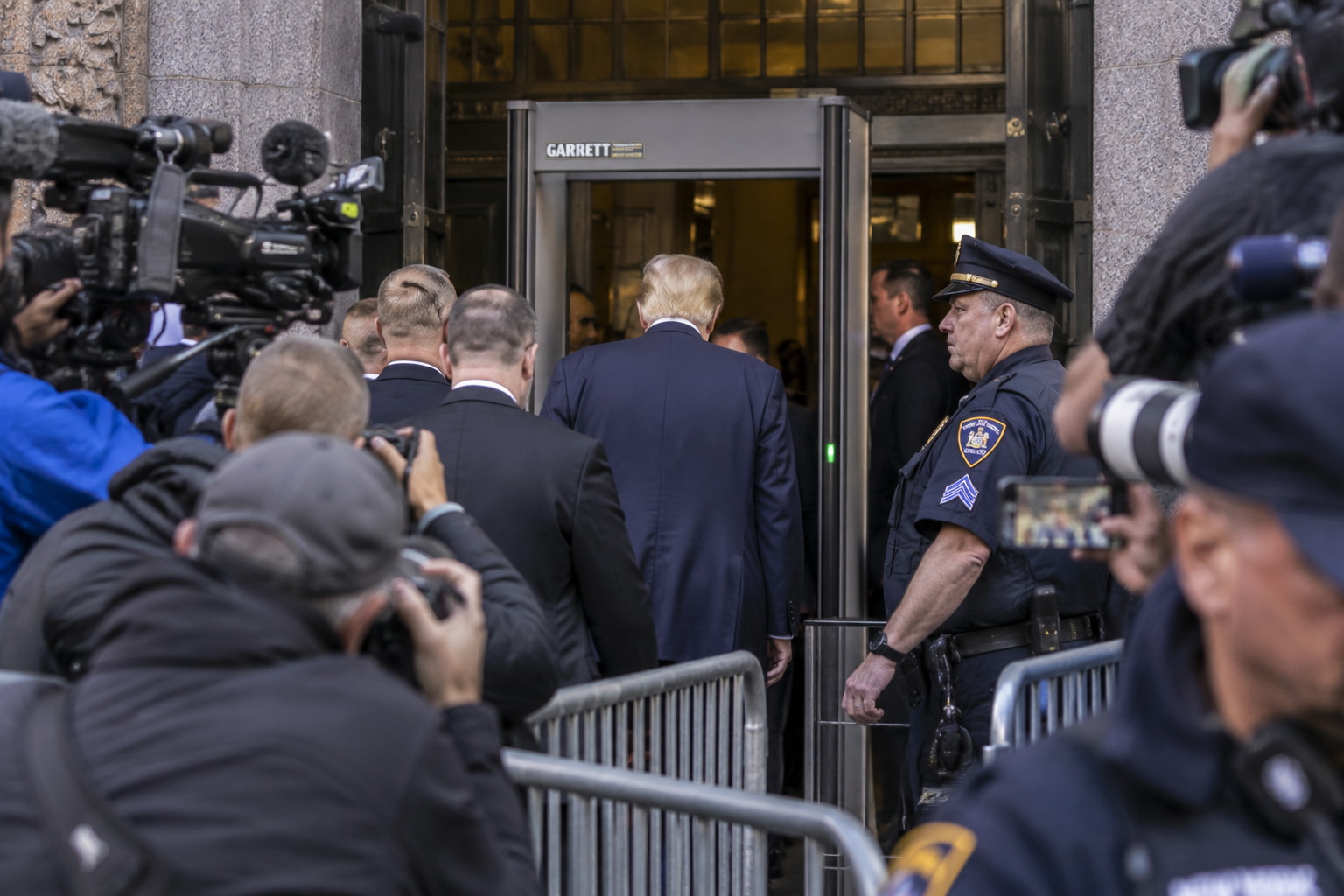
Former President Donald Trump returned to a Manhattan courthouse on October 4, 2023, for the third consecutive day of a civil-fraud trial that threatened his New York business empire.
Trump was not required to attend the proceedings.
Nevertheless, he spent three straight days inside and outside the courthouse, repeatedly stopping before television cameras to denounce the case brought by New York Attorney General Letitia James.
On October 4, Trump complained that the proceedings were taking him away from the presidential campaign trail.
"I'd rather be right now in Iowa. I'd rather be in New Hampshire or South Carolina or Ohio or a lot of other places," Trump told reporters.
He again attacked James and portrayed the lawsuit as politically motivated.
James rejected Trump's characterization of the case and said his courthouse appearances amounted to a political stunt.
The Fraud Case Against Trump
The civil case originated with a lawsuit James filed against Trump, the Trump Organization, Donald Trump Jr., Eric Trump and other defendants.
The attorney general alleged that Trump and his company had repeatedly provided banks, insurers and other institutions with financial statements containing inflated valuations of Trump's assets.
Those financial statements presented estimates of Trump's net worth and the value of properties in his real-estate portfolio.
James alleged that the defendants manipulated those values to obtain financial benefits, including favorable loan and insurance terms.
Trump denied wrongdoing.
He maintained that his financial statements contained disclaimers, that banks conducted their own evaluations and that his properties were worth as much—or more—than the figures attributed to them.
Judge Had Already Ruled That Trump Committed Fraud
The October trial began after Judge Arthur Engoron had already issued a major pretrial ruling against Trump.
On September 26, Engoron found Trump and other defendants liable for persistent fraud in financial statements.
That meant the trial beginning October 2 was not being held to determine whether the judge believed fraud had occurred on that claim.
The trial instead addressed additional claims in James' lawsuit and what penalties should ultimately be imposed.
Trump appealed Engoron's ruling.
Among the valuations questioned in the litigation was Trump's triplex apartment in Trump Tower.
For years, financial statements listed the apartment as approximately 30,000 square feet even though its actual size was roughly 10,996 square feet.
That discrepancy contributed to substantially higher valuations of the property.
Accountants Take Center Stage
While Trump attracted most of the cameras outside the courtroom, much of the actual testimony during the opening days was considerably less dramatic.
The case focused heavily on accountants, spreadsheets and Trump's annual statements of financial condition.
On October 4, testimony continued from Donald Bender, a former partner at the accounting firm Mazars USA who had worked on Trump's financial statements.
Trump's lawyers sought to emphasize the role outside accountants played in preparing the statements.
Attorneys for James sought to demonstrate that the accountants depended on financial information supplied by Trump and the Trump Organization.
The question of who supplied, reviewed and ultimately bore responsibility for the numbers was central to the proceedings.
Trump Turns the Courthouse Into a Media Stage
Outside the courtroom, Trump repeatedly spoke with reporters.
He attacked James, criticized Engoron and characterized the case as an effort to interfere with his presidential campaign.
His presence guaranteed extensive television coverage even though he was under no obligation to attend.
Trump said on October 4 that he was "stuck" at the courthouse instead of campaigning.
But his decision to remain there was voluntary.
Trump's courthouse appearances effectively became another venue for his presidential campaign, allowing him to address television cameras before entering court and during breaks in the proceedings.
A Gag Order Had Just Been Imposed
The third day of the trial also came one day after Engoron imposed a limited gag order on Trump.
Trump had posted an attack on social media targeting the judge's principal law clerk, Allison Greenfield.
Engoron ordered the post deleted and prohibited the parties from publicly posting, emailing or speaking about members of his staff.
The order did not prohibit Trump from criticizing Engoron or James.
It represented an early example of Trump's public commentary colliding with restrictions imposed by a judge overseeing one of his cases.
Letitia James Responds
James also spoke publicly during the proceedings.
She rejected Trump's claims that the case was politically motivated and maintained that her office had brought the lawsuit because its investigation uncovered evidence of financial fraud.
After Trump left the courthouse on October 4 and headed back to Florida, James characterized his three-day appearance as a political and fundraising exercise.
Trump continued to deny the allegations and maintained that the case was an improper attack on him and his business.
Three Days in a Manhattan Courthouse
Trump's October 4 appearance illustrated the unusual intersection of his legal problems, business interests and presidential campaign.
He was simultaneously defending the business empire that had made him famous while campaigning to return to the White House.
The courtroom testimony centered largely on accounting practices and financial statements.
Outside the courtroom, the proceedings became something entirely different.
Television cameras waited each day as Trump delivered remarks about the case, the judge, the attorney general and the presidential election.
On October 4, 2023, Donald Trump returned for the third day of his New York civil-fraud trial—and used the courthouse itself as a platform to argue his case before the American public.