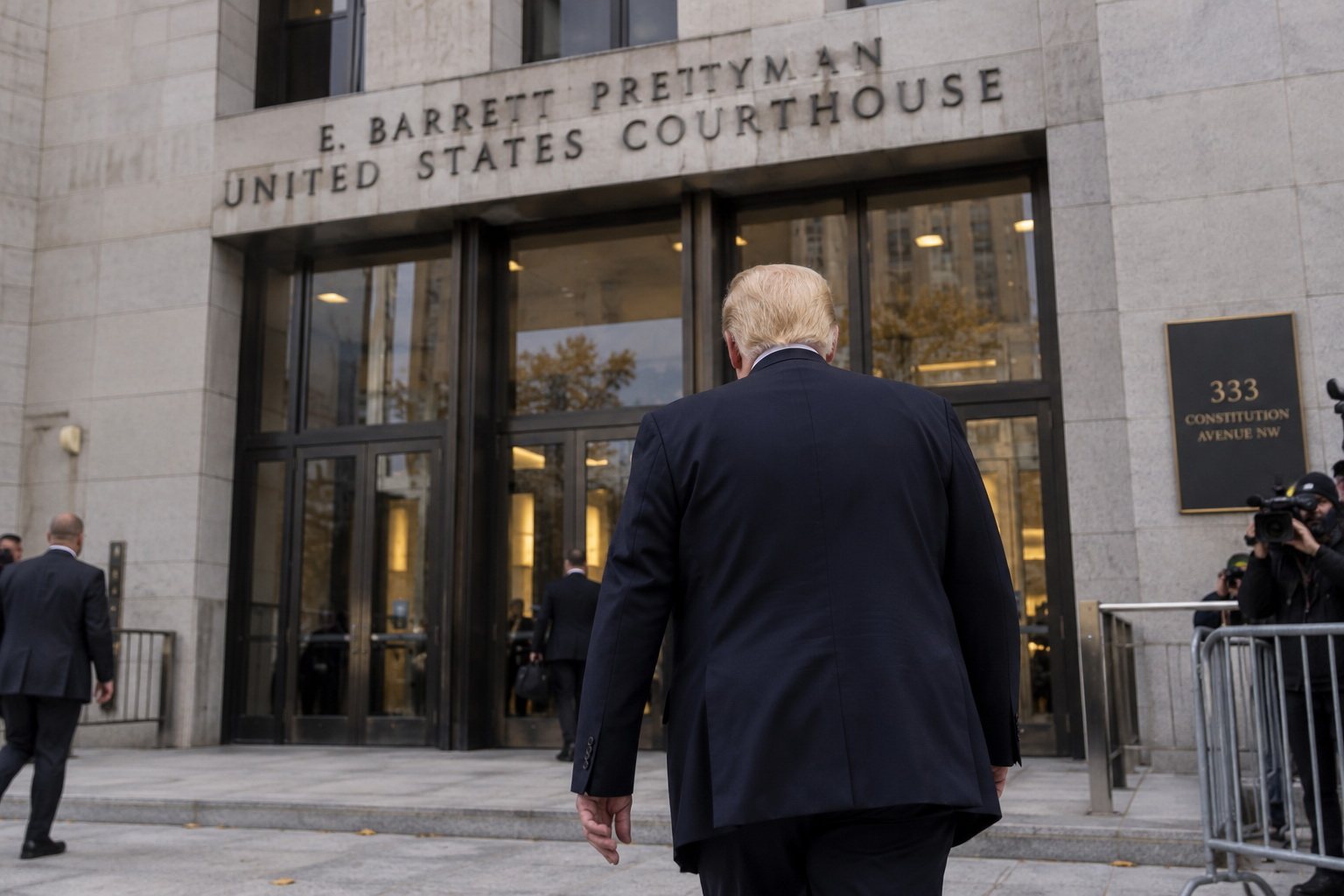
Former President Donald Trump filed a notice of appeal on October 17, 2023, challenging a federal judge's order restricting his ability to publicly attack prosecutors, potential witnesses, and court personnel involved in his criminal election interference case.
The legal confrontation came just one day after U.S. District Judge Tanya Chutkan announced a limited gag order intended to protect the integrity of proceedings against the former president, who was accused of attempting to overturn the results of the 2020 presidential election.
Trump, then the leading contender for the 2024 Republican presidential nomination, argued that the restrictions violated his First Amendment rights and interfered with his political campaign.
Federal prosecutors maintained that Trump's repeated public attacks on people connected to the case created risks of harassment, witness intimidation, and interference with the judicial process.
The dispute presented an unusual constitutional question: How should a federal court protect a criminal proceeding when the defendant is a former president, a major political candidate, and one of the most influential public speakers in the country?
The Criminal Case Behind the Gag Order
The controversy arose from the federal criminal case brought by Special Counsel Jack Smith, who had charged Trump in August 2023 with crimes related to his efforts to remain in power after losing the 2020 election to Joe Biden.
The four-count indictment accused Trump of conspiracy to defraud the United States, conspiracy to obstruct an official proceeding, obstruction of an official proceeding, and conspiracy against rights.
Prosecutors alleged that Trump and his associates pursued a series of efforts to reverse the election outcome, including promoting false claims of widespread voter fraud, pressuring state officials, attempting to organize fraudulent presidential elector certificates, and urging Vice President Mike Pence to interfere with Congress's certification of the electoral vote.
The indictment described a campaign that continued even after courts, election officials, and members of Trump's own administration rejected claims that widespread fraud had changed the election result.
Those efforts culminated in the events surrounding January 6, 2021, when a mob of Trump supporters attacked the U.S. Capitol as Congress met to certify Biden's victory.
Trump pleaded not guilty to the federal charges and maintained that the prosecution was politically motivated.
The allegations had not been proven at trial when the gag-order dispute arose.
Judge Chutkan Imposes Restrictions
On October 16, 2023, Judge Tanya Chutkan announced that she would impose a limited gag order on Trump.
The written order was entered the following day.
Chutkan concluded that certain public statements by Trump threatened the fair administration of justice, particularly when they targeted individuals involved in the criminal proceedings.
The order restricted public statements attacking prosecutors, court staff, and reasonably foreseeable witnesses in connection with their participation in the case.
It applied to Trump and his attorneys, as well as the prosecution.
Importantly, the restrictions did not prohibit Trump from discussing the criminal case altogether.
He remained free to criticize President Biden, challenge the Justice Department, argue that the prosecution was politically motivated, and campaign for the presidency.
What the order sought to prevent were public attacks directed at specific people whose participation was essential to the legal proceedings.
The distinction was central to Chutkan's reasoning.
The judge was attempting to preserve Trump's ability to engage in political speech while preventing statements that could compromise the fairness of a criminal trial.
Trump's Public Attacks Become a Courtroom Issue
Before the gag order, Trump had repeatedly used campaign appearances, interviews, and social media posts to criticize prosecutors and people who could become witnesses.
He had attacked Special Counsel Jack Smith and portrayed the criminal investigations as efforts by his political opponents to prevent him from returning to the White House.
Some of Trump's statements also targeted former administration officials whose testimony or cooperation could be relevant to the prosecution.
Among the figures discussed during the proceedings was former Vice President Mike Pence, who had publicly rejected Trump's efforts to persuade him to interfere with the electoral certification process.
Pence was also competing against Trump for the Republican presidential nomination.
That created a difficult distinction for the court.
Trump had a legitimate right to criticize Pence as a political opponent. But prosecutors argued that attacks on Pence concerning his potential testimony or involvement in the criminal case could have a different effect.
Chutkan's order sought to distinguish ordinary political criticism from statements directed at a person's participation in the judicial process.
Federal prosecutors warned that Trump's rhetoric could discourage witnesses from cooperating or expose participants in the case to threats and harassment.
The concern was not limited to whether Trump explicitly instructed anyone to threaten a witness.
Prosecutors argued that repeated public denunciations by a figure with Trump's reach could have consequences even without a direct command.
Trump Announces His Appeal
On October 17, Trump's attorneys formally notified the court that they intended to appeal Chutkan's ruling.
The former president had already denounced the restrictions during campaign appearances.
Speaking in Iowa on October 16, Trump described the order as unconstitutional and suggested that he was prepared to face imprisonment rather than surrender what he characterized as his right to speak freely.
His legal team argued that the restrictions interfered with protected political expression during a presidential campaign.
They maintained that Trump needed to be able to respond publicly to accusations made against him and criticize people involved in the prosecution.
The defense also questioned whether the government had demonstrated a sufficient threat to justify restricting a defendant's speech.
Trump's position rested on a fundamental constitutional principle: Criminal defendants do not lose their First Amendment rights simply because they have been charged with a crime.
But the prosecution and the judge emphasized another principle: Courts have an obligation to protect witnesses, jurors, court employees, and the fairness of proceedings.
The legal dispute centered on where the boundary between those principles should be drawn.
A Former President Is Still a Criminal Defendant
One of the central questions raised by the case was whether Trump's status as a former president and active presidential candidate entitled him to greater freedom to comment on a pending criminal prosecution.
Chutkan rejected the idea that a presidential campaign automatically exempted a defendant from restrictions necessary to protect a trial.
In her written ruling, she emphasized that political candidacy could not justify statements that would otherwise seriously endanger the proceedings.
The judge's reasoning reflected the broader principle that criminal courts must apply procedural safeguards regardless of a defendant's public prominence.
Trump's attorneys, however, argued that his political circumstances made the restrictions especially consequential.
Unlike an ordinary defendant, Trump was campaigning for the presidency while facing charges brought by the administration of his likely general-election opponent.
The defense maintained that preventing him from discussing individuals associated with the case could limit his ability to respond to political criticism and communicate with voters.
Chutkan's order did not resolve every possible conflict between those competing interests.
Instead, it attempted to draw a narrow line around statements that could affect the legal proceedings themselves.
Why Prosecutors Wanted the Restrictions
The Justice Department's concerns extended beyond public criticism of the prosecution.
Federal prosecutors argued that attacks on witnesses and court personnel could create a climate in which individuals feared becoming targets of harassment.
Such concerns are particularly significant in criminal cases involving political violence or attempts to interfere with government proceedings.
Witnesses must be able to provide testimony without fear that their participation will expose them to retaliation.
Jurors must also be able to consider evidence without improper pressure from outside the courtroom.
Prosecutors argued that Trump's public statements could undermine both objectives.
The government did not seek a complete prohibition on Trump's public discussion of the case.
Instead, it asked the court to restrict certain statements that prosecutors believed threatened the administration of justice.
Chutkan granted the request in part, adopting restrictions narrower than those prosecutors had originally sought.
The resulting order became the subject of Trump's October 17 appeal.
The First Amendment Versus the Right to a Fair Trial
The legal controversy highlighted a difficult balance between two constitutional protections.
The First Amendment safeguards political expression, including criticism of government officials and the justice system.
The Sixth Amendment guarantees criminal defendants the right to a fair trial.
Courts also have an independent responsibility to protect the integrity of judicial proceedings.
A criminal defendant may publicly deny allegations, criticize the government's case, and assert innocence.
But courts can impose certain restrictions when statements threaten witnesses, interfere with jurors, or otherwise create serious risks to the proceedings.
The challenge is ensuring that those restrictions do not become broader than necessary.
Trump's appeal placed that question before the federal appellate courts.
The case was especially unusual because Trump's public statements served multiple purposes simultaneously: defending himself against criminal charges, communicating with supporters, and advancing his presidential campaign.
A statement that appeared to be ordinary political rhetoric to one audience could be viewed by prosecutors as an attack on a potential witness.
Determining when such speech crossed the legal boundary became one of the most closely watched disputes surrounding the prosecution.
The Court Battle Continues
The October 17 appeal did not immediately resolve the controversy.
On October 20, Chutkan temporarily paused enforcement of the order while considering Trump's request for a longer stay during the appeal.
On October 29, she declined to suspend the restrictions for the duration of the appellate proceedings and restored the order.
The dispute continued through the federal courts.
In December 2023, a federal appeals court largely upheld the authority to restrict certain statements but narrowed aspects of Chutkan's original order.
The appellate proceedings demonstrated that the case involved genuine constitutional questions about the scope of permissible restrictions on a criminal defendant's public speech.
At the same time, the courts continued to recognize the government's interest in protecting witnesses and the judicial process.
An Unprecedented Legal and Political Conflict
The October 17, 2023, appeal illustrated the complications created when a former president facing federal criminal charges simultaneously sought to return to the presidency.
Trump maintained that the prosecution was politically motivated and that the gag order improperly limited his ability to defend himself.
Prosecutors argued that his public statements created risks that courts could not ignore simply because he was a candidate for office.
Judge Chutkan attempted to preserve both political expression and the integrity of the trial by restricting attacks on specific participants rather than prohibiting broader discussion of the case.
The dispute ultimately concerned a principle extending beyond Trump himself.
A criminal defendant has the right to criticize the government and defend against charges. But that right must be balanced against the ability of witnesses, court employees, and jurors to participate in proceedings without intimidation or improper influence.
On October 17, 2023, that balance became the subject of a formal appeal, adding another constitutional confrontation to the federal prosecution arising from Trump's efforts to overturn the 2020 election.