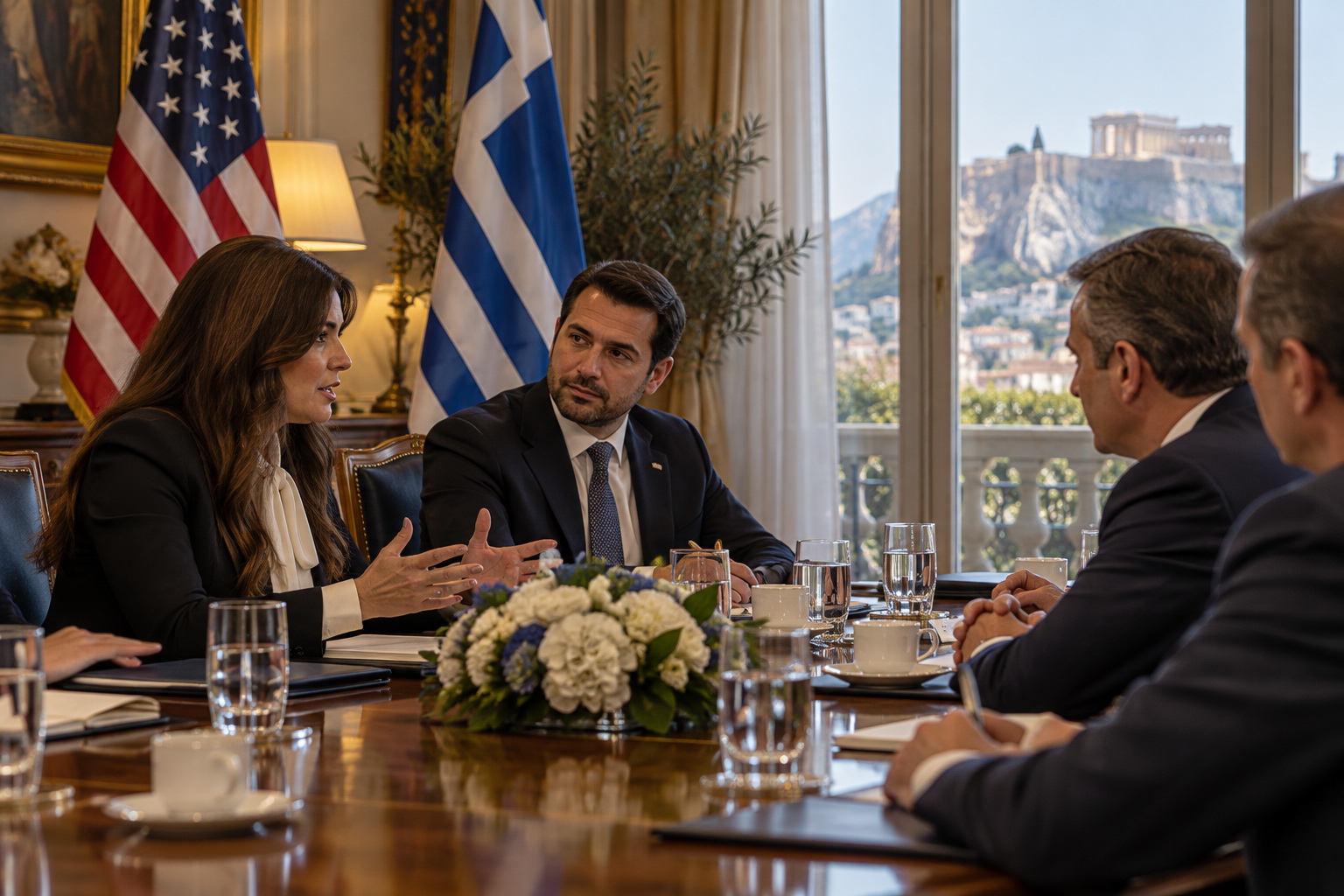
U.S. Ambassador to Greece Kimberly Guilfoyle is facing new scrutiny after reporting revealed that a registered lobbyist for a Greek company has repeatedly accompanied her to high-level meetings with foreign officials while she promoted energy deals involving that same company.
The Wall Street Journal reported that Christos Marafatsos, a 39-year-old businessman and lobbyist, has become a frequent presence alongside Guilfoyle as the ambassador travels through southeastern Europe promoting American liquefied natural gas.
Marafatsos is not a U.S. diplomat or embassy employee.
Instead, he is a registered lobbyist for Aktor Group, a Greek construction and infrastructure company that has recently expanded into the natural gas business.
Federal lobbying records cited by the Journal show that Aktor paid Marafatsos $160,000 through June to help establish connections with the White House, State Department and Department of Energy.
According to the Journal, Marafatsos has attended so many meetings alongside Guilfoyle that some foreign officials reportedly assumed he worked for the ambassador.
Several officials who participated in meetings with Guilfoyle and Marafatsos told the newspaper that Marafatsos did not disclose his financial relationship with Aktor.
At the same time, Guilfoyle has reportedly encouraged governments in the region to work with the company.
During a trip to Bulgaria this spring, Guilfoyle reportedly told officials that their government should work with Aktor. Marafatsos was present when Guilfoyle met with the Bulgarian president.
The Journal also reported that Aktor CEO Alexandros Exarchou provided a private jet used by Guilfoyle for travel to Bulgaria.
The relationship has drawn attention because Aktor stands to benefit substantially from the expansion of American natural gas exports into southeastern Europe.
Aktor and Greek state-backed energy company DEPA formed Atlantic-SEE LNG, a venture designed to bring American liquefied natural gas into Europe through Greece.
The venture has reached agreements or memorandums involving several countries in the region.
One of the largest is a proposed 20-year arrangement involving Albania that has been valued at approximately $6 billion. Guilfoyle traveled to Albania and participated in the announcement of the agreement.
The broader American policy behind the initiative is not itself unusual. The Trump administration has been encouraging European nations to purchase more American natural gas while reducing their reliance on Russian energy.
The questions concern the unusually prominent role of a private lobbyist whose client could profit from those policies.
Robin Brooks, a former State Department foreign service officer who served as National Security Council director for the Balkans and Central Europe during the Biden administration, told the Journal that having a registered lobbyist participate in such meetings raises questions about whether government discussions are advancing American interests or private commercial interests.
The U.S. Embassy has rejected suggestions that Guilfoyle acted improperly.
An embassy official said her travel was intended to advance American interests by increasing sales of U.S. liquefied natural gas and reducing European dependence on Russian energy. The embassy said Guilfoyle was in full compliance with State Department guidance.
Guilfoyle's attorney, Jesse Binnall, also disputed suggestions that the ambassador had favored Aktor, saying she has worked with companies throughout the energy industry and that her official meetings are coordinated through embassy channels.
Marafatsos has defended his activities as well, saying he is proud to support commercial initiatives that advance American interests and create economic opportunities in Greece and southeastern Europe.
Secretary of State Marco Rubio has praised Guilfoyle's performance as ambassador and described her as an effective advocate for President Donald Trump's agenda.
But the disclosures add another layer of scrutiny to an administration in which the boundaries between government officials, political allies and private business interests have repeatedly drawn attention.
Guilfoyle, a former Fox News personality and former fiancée of Donald Trump Jr., was nominated by President Trump to serve as ambassador to Greece in December 2024.
Now, questions surrounding the private businessman repeatedly appearing beside her illustrate a much larger issue: when an American ambassador promotes a foreign company while that company's paid lobbyist participates in diplomatic meetings, determining where American foreign policy ends and private business interests begin becomes increasingly important.