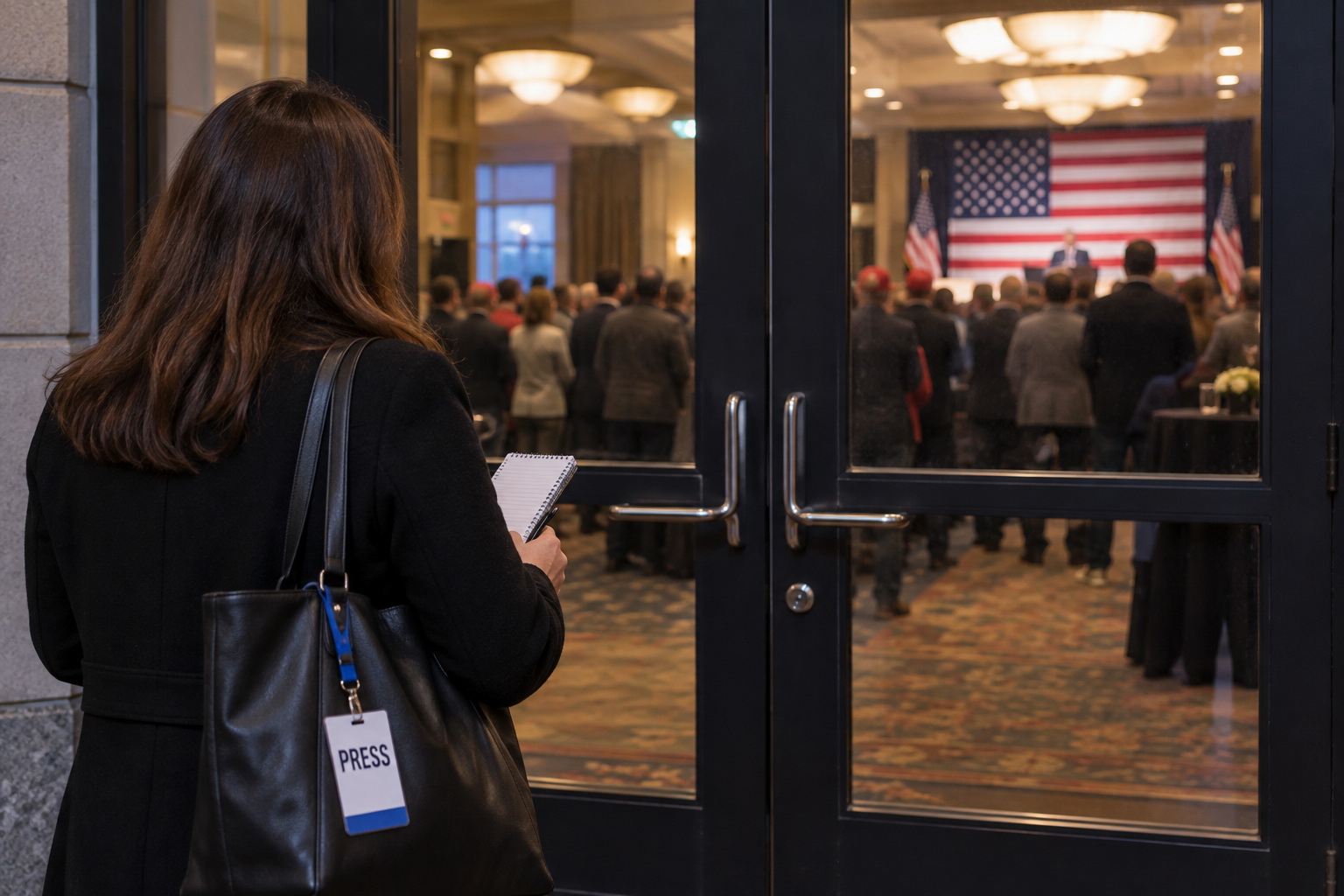
Wisconsin gubernatorial candidate Tom Tiffany barred a Milwaukee Journal Sentinel reporter from attending a campaign event after she investigated questions surrounding his property taxes, adding another dispute over press access to an increasingly contentious election season.
A Wisconsin congressman running for governor has barred a newspaper reporter from covering one of his campaign events.
Rep. Tom Tiffany, a Republican closely aligned with President Donald Trump, prevented Milwaukee Journal Sentinel reporter Mary Spicuzza from attending a campaign stop in Milwaukee on Thursday.
Spicuzza isn't an unknown political activist trying to enter a private event.
She's a veteran journalist and Pulitzer Prize finalist working for one of Wisconsin's largest newspapers.
And she has recently been investigating Tiffany.
That makes the decision to exclude her particularly notable.
A Reporter Investigating the Candidate
Spicuzza has covered Tiffany's campaign and political record, including his positions on voting and his campaign's financial backing.
More recently, she investigated allegations involving Tiffany's property taxes.
Tiffany's campaign disputes accusations of wrongdoing.
But after that coverage, Spicuzza attempted to cover another Tiffany campaign event.
She wasn't allowed in.
The sequence immediately raised questions about whether a political campaign was deciding which journalists could cover its candidate based on whether their reporting was favorable.
There is an important distinction, however.
The fact that Spicuzza investigated Tiffany and was subsequently barred does not by itself establish that the investigation was the reason she was excluded.
Unless Tiffany's campaign says so—or evidence establishes that connection—it remains a question rather than a proven motive.
What is established is that a reporter who had recently produced critical coverage of the candidate was denied access to his campaign event.
Tiffany Is Running for Governor
This isn't simply a dispute involving a member of Congress.
Tiffany is campaigning to become Wisconsin's next governor.
The Republican congressman has represented Wisconsin in the House since 2020 and has been closely associated with the Trump wing of the Republican Party.
That makes press access particularly relevant.
Campaign reporters aren't simply spectators at political events.
They ask candidates questions.
They document what candidates tell voters.
They compare campaign promises with previous statements and voting records.
And sometimes they investigate things candidates would rather not discuss.
That last function is precisely why independent press access matters.
Campaigns Can Control Private Events
There is also an important legal distinction.
A political campaign isn't automatically required to admit every journalist to every campaign event.
Private campaigns generally have considerably more authority to control access to their events than government officials have to exclude journalists from official government proceedings.
That means the central issue here isn't necessarily whether Tiffany's campaign had the legal authority to exclude Spicuzza.
It is what the exclusion says about how a candidate for governor intends to deal with reporters asking uncomfortable questions.
Politicians have always complained about journalists.
That isn't new.
Barring them is different.
The Trump Era Changed the Relationship With the Press
Tiffany's decision comes during a much larger confrontation between political officials and news organizations.
Trump has repeatedly attacked news outlets and individual journalists he considers unfair.
His administration has fought with media organizations over access to government institutions and presidential events.
Those battles have increasingly spread beyond Washington.
Political candidates have learned that excluding journalists can itself become part of the political message.
Instead of simply disputing a story, a politician can attack the organization that published it.
Instead of answering the reporter, the campaign can deny the reporter access.
That may appeal to supporters who already distrust mainstream news organizations.
But it also removes one of the primary mechanisms voters have for seeing candidates questioned by someone other than their own campaign staff.
The Question Tiffany Still Has to Answer
Tom Tiffany doesn't have to agree with Mary Spicuzza.
He doesn't have to like her reporting.
His campaign can dispute every allegation she publishes.
It can release documents.
It can demand corrections when something is wrong.
It can publicly challenge her conclusions.
Those are ordinary parts of political journalism.
But excluding the journalist prevents the questioning from occurring in the first place.
And that's what makes this story larger than one Wisconsin campaign event.
A candidate for governor was confronted with reporting he may not have liked.
The journalist responsible subsequently attempted to cover his campaign.
She was kept outside.
The campaign may have controlled the door.
But it didn't make the questions disappear.