President Donald Trump acknowledged Tuesday that he has no evidence supporting his claim that people from the Middle East have infiltrated a caravan of Central American migrants traveling toward the United States.
The admission came just one day after Trump publicly warned Americans that unidentified Middle Eastern individuals were traveling among thousands of migrants, suggesting the group posed a serious national security threat.
With the November midterm elections just two weeks away, the president has made immigration a central campaign issue, repeatedly warning about criminals, gangs, and dangerous outsiders attempting to enter the country.
But when reporters demanded evidence for his latest allegations, Trump had none to offer.
'There's No Proof of Anything'
During an exchange with reporters in the Oval Office, Trump was asked to substantiate his claim that Middle Eastern individuals were traveling with the migrant caravan.
The president initially insisted that he had received information from Border Patrol and immigration officials about people from the Middle East being intercepted at the border.
However, those general claims did not establish that any such individuals were traveling with the caravan currently moving through Mexico.
Pressed specifically about evidence involving the caravan, Trump acknowledged the problem.
"There's no proof of anything. There's no proof of anything. But there could very well be," Trump said.
The statement represented a significant retreat from his earlier assertions.
Rather than providing intelligence reports, law enforcement findings, or other documentation, the president defended his warning on the grounds that it was possible.
A Presidential Warning Without Evidence
On Monday, Trump posted a message on Twitter claiming that criminals and unidentified Middle Eastern individuals were mixed into the caravan.
The statement suggested that the United States faced a threat extending beyond unauthorized immigration.
The president also repeatedly invoked the MS-13 gang, warning that dangerous criminals could be among the migrants.
Yet journalists traveling with the caravan have reported no evidence supporting the president's claims about Middle Eastern infiltrators.
The Associated Press reported Monday that its journalists, who had accompanied the migrants for more than a week, had seen nothing verifying Trump's assertion.
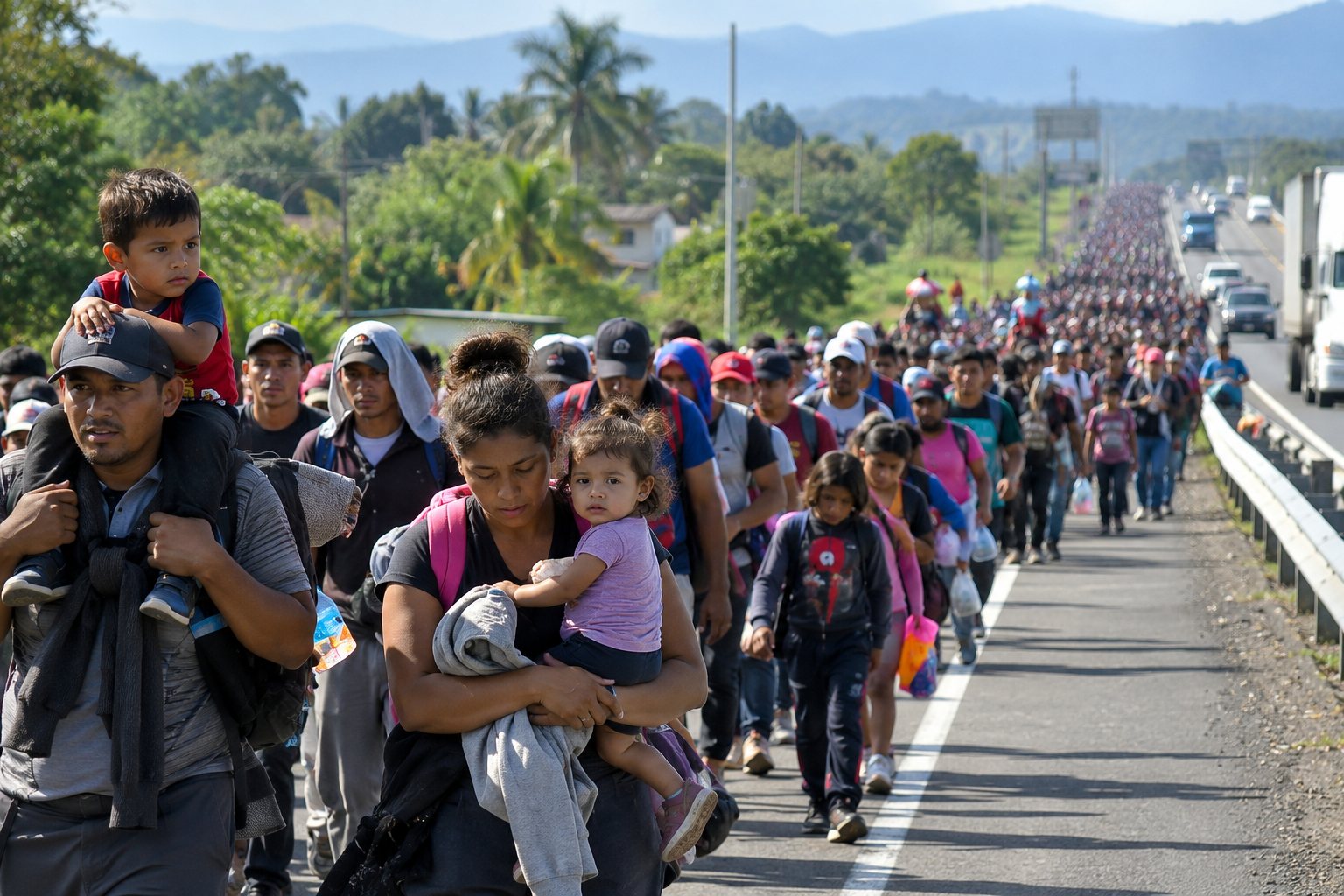
The caravan consists largely of people fleeing poverty, violence, and instability in Central America, including families traveling with children.
While individuals traveling in large groups cannot automatically be assumed to have identical backgrounds or intentions, the administration has not publicly established the specific threat Trump described.
The White House Defends the Claims
Vice President Mike Pence and White House Press Secretary Sarah Huckabee Sanders have attempted to defend the president's statements.
Administration officials have pointed to broader concerns about border security and the possibility that individuals from countries outside Central America could attempt to enter the United States.
The Department of Homeland Security has also made general assertions about individuals with criminal backgrounds and people from the Middle East traveling through Mexico.
However, those statements do not establish that terrorists or Middle Eastern infiltrators are traveling with this particular caravan.
Trump has repeatedly blurred the distinction between a possible security risk and a documented threat.
His comments Tuesday exposed that distinction when he admitted he had no proof of his specific allegation.
Immigration Dominates the Midterm Campaign
The timing of Trump's statements is significant.
Americans will vote in congressional elections on November 6, with Republicans fighting to maintain control of the House and Senate.
Trump has increasingly focused his public appearances and campaign rallies on immigration, portraying the migrant caravan as a major threat to American security.
He has accused Democrats of supporting weak border policies and suggested that Republican victories are necessary to prevent dangerous individuals from entering the country.
The president has also threatened to reduce foreign assistance to Central American countries over the caravan.
Critics argue that Trump's repeated warnings are intended to heighten public anxiety about immigration ahead of the election.
The White House maintains that the president is responding to legitimate border security concerns.
But the administration's inability to provide evidence for some of its most alarming claims has become an issue of its own.
Migrants Become the Focus of Political Attacks
Thousands of migrants have been traveling north from Honduras and other Central American countries, many hoping to seek asylum in the United States.
The journey is difficult, dangerous, and uncertain.
Families are traveling long distances, often with limited food, water, and transportation.
Under American law, people who arrive at the border may request asylum, although their claims must be evaluated through the legal process.
Trump has repeatedly characterized the caravan as a threat rather than emphasizing the circumstances that caused people to leave their homes.
His allegations about Middle Eastern individuals and gang members have added another layer of suspicion to an already contentious immigration debate.
When Possibility Is Presented as Fact
There is an important difference between warning that a security threat might exist and publicly claiming that it does exist.
Trump's original statement asserted that Middle Eastern individuals were mixed into the caravan.
His explanation Tuesday was that they could be.
Those are not equivalent claims.
The president has access to federal intelligence agencies, immigration authorities, and national security officials. When he makes allegations about potential threats to the United States, the public has reason to expect supporting evidence.
In this case, the president has not provided it.
A Campaign Built Around Border Security
Trump continues to insist that the United States must strengthen its southern border and prevent dangerous individuals from entering the country.
Those are legitimate subjects for national debate.
But the president's claims about the migrant caravan raise a separate question about the accuracy of the information being presented to Americans.
With the midterm elections approaching, Trump is asking voters to treat the caravan as an urgent national security concern.
Yet when challenged to substantiate one of his most alarming accusations, the president acknowledged that he had no proof.
For thousands of migrants making their way through Mexico, the consequences of such rhetoric are immediate: their journey has become the centerpiece of an American political battle.
For the American public, the issue is equally straightforward.
A president's warnings carry enormous weight.
And on Tuesday, Donald Trump admitted that one of his warnings was not supported by evidence.