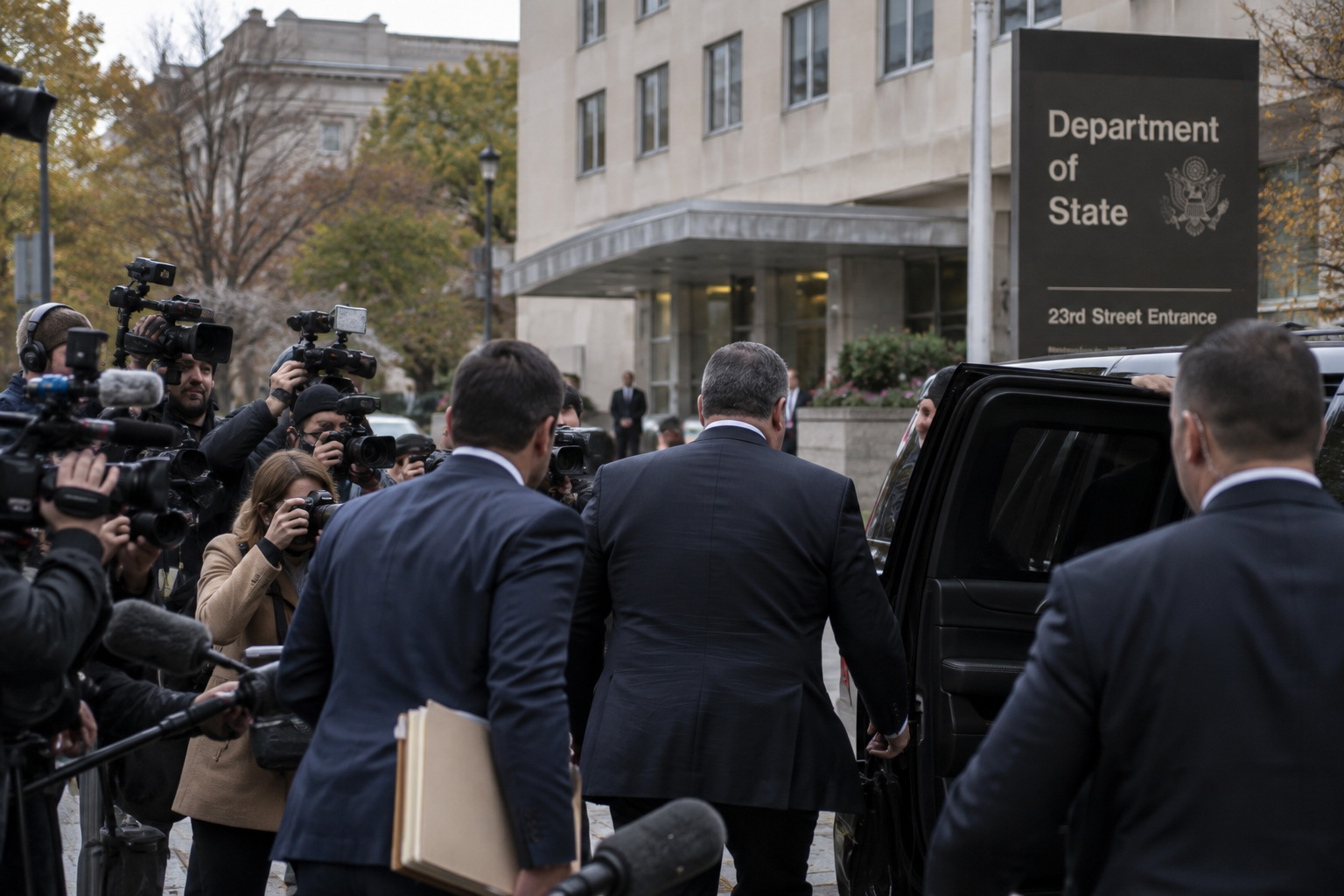
One week after House Speaker Nancy Pelosi announced a formal impeachment inquiry into President Donald Trump, the confrontation between the administration and Congress intensified dramatically.
On October 1, Secretary of State Mike Pompeo objected to House investigators' plans to question State Department officials as part of their investigation into Trump's dealings with Ukraine.
At the same time, Trump was escalating his attacks on the intelligence-community whistleblower whose complaint had helped ignite the inquiry.
What had begun as questions about a telephone call with the president of Ukraine was rapidly becoming a broader constitutional confrontation over presidential power, congressional oversight and the administration's willingness to cooperate with an impeachment investigation.
The Ukraine Call
At the center of the controversy was Trump's July 25 telephone conversation with Ukrainian President Volodymyr Zelensky.
During the call, Trump asked Zelensky to look into matters involving former Vice President Joe Biden and his son Hunter, as well as a theory concerning Ukrainian involvement in the 2016 election.
Joe Biden was seeking the Democratic presidential nomination and was a potential opponent for Trump in the 2020 election.
A whistleblower complaint subsequently raised concerns about the call and other administration actions involving Ukraine.
After the controversy became public, the White House released a memorandum describing the July 25 conversation.
The complaint and call record intensified questions in Congress about whether Trump had used the powers of the presidency to seek assistance from a foreign government that could benefit him politically.
Trump maintained that his conversation with Zelensky was appropriate and repeatedly characterized the impeachment investigation as politically motivated.
Pompeo Challenges the House Investigation
By October 1, House investigators were preparing to interview a series of State Department officials as they attempted to reconstruct the administration's dealings with Ukraine.
Pompeo pushed back.
In a letter to congressional investigators, the secretary of state objected to the manner in which lawmakers were seeking testimony from State Department employees and accused the committees of attempting to intimidate department officials.
Pompeo argued that State Department employees deserved appropriate legal protections and that Congress could not dictate the conditions under which executive-branch officials would participate.
The dispute immediately raised questions about how much cooperation Congress would receive from the Trump administration.
Pompeo would later explain that his objection was not necessarily to congressional oversight itself, but to what he considered improper demands placed on State Department employees and restrictions on the department's ability to have its lawyers involved.
The House committees saw the matter differently.
Democratic investigators warned that efforts to prevent witnesses from cooperating could themselves become evidence relevant to the impeachment inquiry.
Trump Targets the Whistleblower
While Pompeo battled Congress over witnesses, Trump increasingly focused his attention on the whistleblower.
Trump publicly demanded more information about the person's identity and questioned the sources behind the complaint.
The whistleblower's identity was protected under procedures designed to allow intelligence-community employees to report potential wrongdoing without exposing themselves to retaliation.
Trump argued that he deserved to confront his accuser and repeatedly questioned the credibility and motivations of the person who filed the complaint.
The president's critics countered that the whistleblower's identity was becoming less important because the White House had already released its own account of the July 25 call, allowing lawmakers and the public to evaluate significant portions of the underlying allegation directly.
Pompeo Was on the Call
Another important fact was emerging at virtually the same time.
Pompeo had personally listened to Trump's July 25 conversation with Zelensky.
That placed the secretary of state much closer to the events under investigation than had initially been publicly understood.
Pompeo later defended the conversation, arguing that Trump's discussion of corruption in Ukraine was consistent with legitimate American foreign-policy objectives.
He rejected the characterization that Trump had improperly pressured Zelensky.
The administration also emphasized that the United States had provided Ukraine with military assistance to defend itself against Russian aggression.
Those arguments would become central to Trump's defense as the impeachment investigation progressed.
A Fight Over Congressional Oversight
The October 1 confrontation was about more than a single telephone call.
Congress was attempting to determine what had happened before and after Trump's conversation with Zelensky, including the roles played by State Department officials, White House personnel and Trump's personal attorney Rudy Giuliani.
The administration, meanwhile, challenged aspects of the investigation's legitimacy and procedures.
That conflict would grow considerably during the following days.
Some administration officials eventually testified despite White House objections, while others refused to participate.
The House investigation ultimately produced testimony from diplomats and national-security officials describing an unusual channel of diplomacy involving Ukraine and Giuliani.
The Impeachment Battle Takes Shape
October 1, 2019, marked an important early turning point.
Only a week earlier, Pelosi had formally announced the impeachment inquiry.
Now the administration and Congress were fighting over witnesses, documents and the boundaries of congressional investigative authority.
Trump was attacking the whistleblower.
Pompeo was challenging congressional demands involving his department.
And investigators were beginning the process of questioning officials who had direct knowledge of the administration's dealings with Ukraine.
The confrontation would consume Washington for the remainder of 2019.
In December, the House of Representatives impeached Trump on charges of abuse of power and obstruction of Congress.
The Senate acquitted him on both charges in February 2020.