President Donald Trump's administration is considering a sweeping change to federal civil rights policy that could eliminate legal recognition of transgender identities and significantly weaken protections against discrimination for more than one million Americans.
The proposal, revealed in a report by The New York Times, would establish a narrow federal definition of sex based on biological characteristics at birth, disregarding gender identity.
The move represents another escalation in the administration's efforts to reverse protections established under President Barack Obama, and it has sparked protests and condemnation from civil rights organizations and medical professionals.
Defining Transgender Americans Out of Federal Policy
According to an internal Department of Health and Human Services memorandum obtained by The New York Times, the administration is considering defining sex as either male or female, determined at birth and legally unchangeable.
The proposal would establish a uniform definition under Title IX, the federal civil rights law prohibiting sex discrimination in federally funded education programs.
The memorandum reportedly proposes using original birth certificates as evidence of a person's sex, with genetic testing potentially used to resolve disputes.
If adopted across federal agencies, the change could have significant consequences for transgender Americans seeking protection from discrimination in education, health care, and other government programs.
Critics warn that the administration is attempting to erase transgender identities from federal policy through a bureaucratic definition.
Another Republican Battle Against Transgender Rights
The proposal is not an isolated action.
Since taking office, Trump and his Republican administration have repeatedly moved to restrict protections for transgender Americans.
In 2017, the administration withdrew Obama-era guidance protecting transgender students' access to school bathrooms consistent with their gender identity.
Trump also announced restrictions on transgender military service, prompting legal challenges and condemnation from civil rights organizations.
The administration has additionally reconsidered federal policies addressing discrimination based on gender identity.
These decisions reflect a broader political conflict within the Republican Party, where social conservatives have strongly opposed expanding federal recognition and protections for transgender people.
Supporters of the restrictions argue that federal policies should rely on biological definitions of sex and that the Obama administration exceeded its authority.
Opponents argue that the policies expose transgender Americans to discrimination while using government power to deny recognition of their identities.
Psychologists Condemn the Proposal
The American Psychological Association issued a strongly worded statement Monday condemning the reported plan.
APA President Jessica Henderson Daniel said the administration was disregarding decades of established scientific research.
"We are appalled at this apparent attempt by the administration to remove protections based on gender identity or expression," Daniel said.
She explained that gender identity is not necessarily determined by the sex assigned to a person at birth and that human biology is more complex than the proposed definition acknowledges.
The association warned that removing protections could increase discrimination, psychological stress, and other difficulties already experienced by transgender people.
The APA called on the administration to abandon the proposal.
Protests Outside the White House
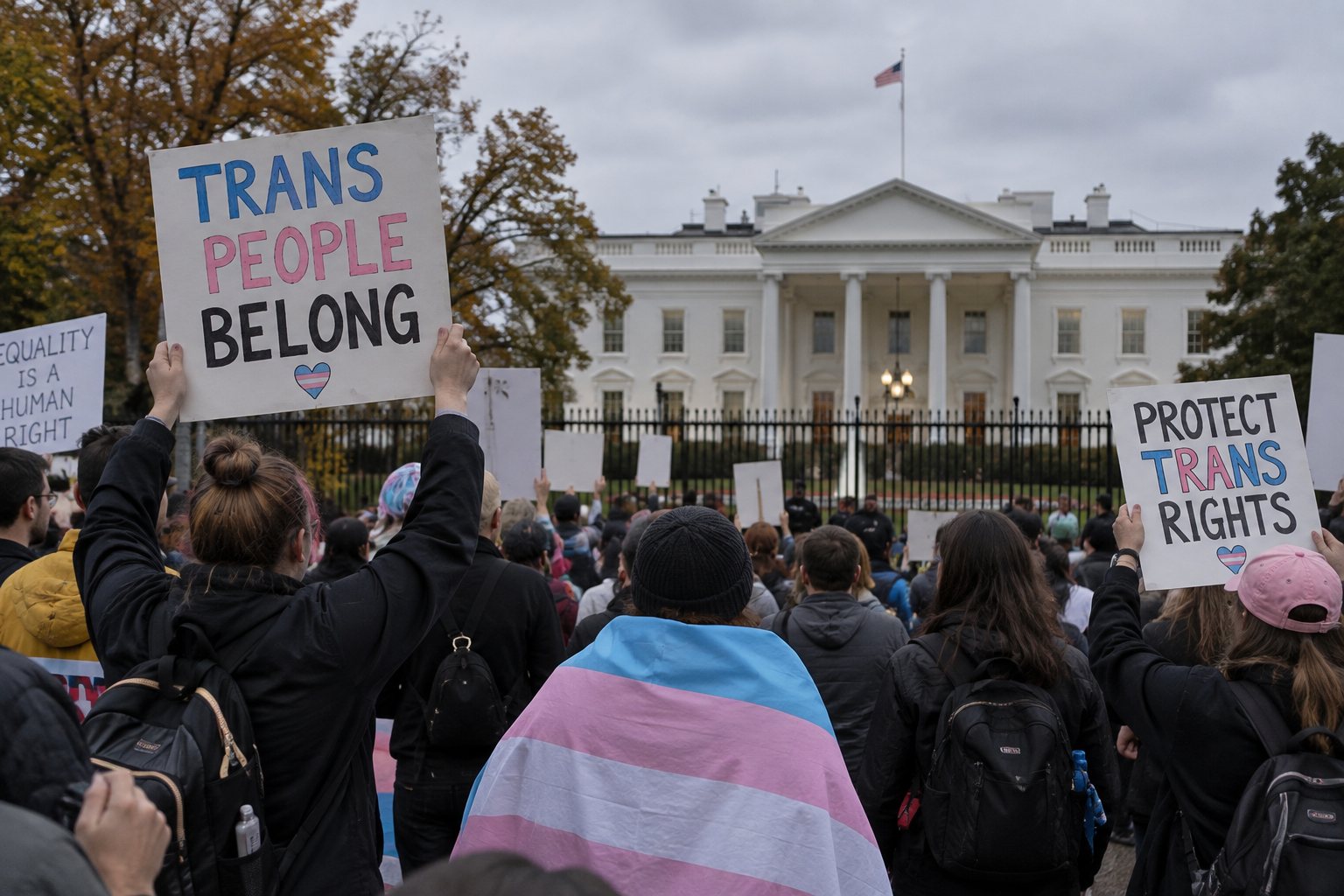
Transgender rights advocates gathered outside the White House Monday to protest the reported policy.
Demonstrators carried signs declaring that transgender Americans would not be erased and demanded that the federal government preserve existing civil rights protections.
Similar protests followed the initial reports over the weekend.
Advocacy organizations argue that transgender people should not have to fight for government recognition of their identities or fear losing access to equal treatment under federal programs.
For many transgender Americans, the controversy is not an abstract disagreement over terminology.
It concerns access to education, health care, government services, and legal protections against discrimination.
Trump Says Administration Is Looking at the Issue
Asked about the reports Monday, Trump acknowledged that his administration was examining transgender policy.
"We're looking at it," the president told reporters before departing the White House.
He did not provide details about the proposed definition or explain how transgender Americans would be affected.
The administration has not formally adopted the reported proposal, and its ultimate legal implications remain uncertain.
Nevertheless, the memorandum has raised serious concerns about the direction of federal civil rights enforcement.
A Question of Equal Protection
The Trump administration maintains that its approach seeks clearer and more consistent definitions under federal law.
But civil rights advocates and medical professionals argue that reducing gender identity to an immutable classification at birth ignores established research and threatens protections relied upon by transgender Americans.
The controversy also highlights a recurring political divide: Republican officials pursuing restrictions on transgender recognition, and advocates arguing that the government should protect people from discrimination regardless of gender identity.
The administration's proposal has not yet become federal policy.
For transgender Americans, however, the prospect of losing legal recognition and civil rights protections is already creating uncertainty.
The question now is whether the federal government will use its authority to protect transgender Americans from discrimination—or narrow the definitions used to determine who receives those protections.