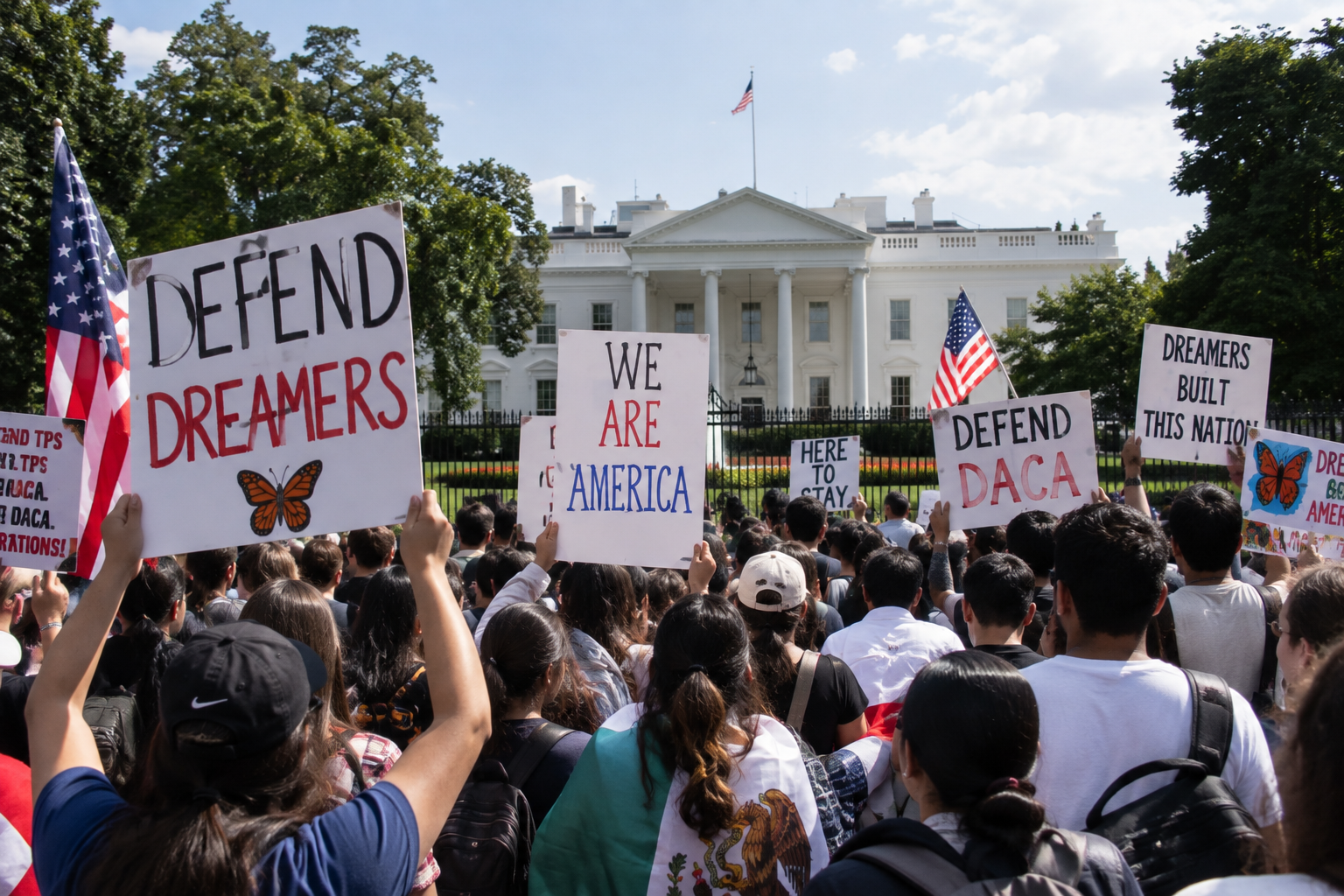
For nearly 800,000 young immigrants who had built their lives in the United States, the Trump administration delivered the news they had feared.
On September 5, 2017, Attorney General Jeff Sessions announced that the administration was rescinding Deferred Action for Childhood Arrivals, the Obama-era program known as DACA.
Created in 2012, DACA allowed certain undocumented immigrants brought to the United States as children to receive temporary protection from deportation and authorization to work legally in the country.
Now the Trump administration intended to wind it down.
The decision did not immediately strip every DACA recipient of protection. Instead, the administration established a transition period intended to give Congress time to decide what would happen to the young immigrants commonly known as Dreamers.
But for hundreds of thousands of people who had grown up in America, attended American schools, held American jobs and built families and careers here, their future had suddenly become uncertain.
Sessions Announces the End of DACA
Trump did not personally deliver the administration's announcement.
Attorney General Jeff Sessions did.
Speaking at the Justice Department, Sessions argued that President Barack Obama had exceeded executive authority when his administration established DACA in 2012.
Sessions said the program had been created without authorization from Congress and characterized it as an unconstitutional exercise of executive power.
He announced that DACA was being rescinded and that the Department of Homeland Security would begin what he described as an “orderly, lawful wind-down.”
The administration's argument was straightforward: immigration law was Congress's responsibility, and the executive branch could not create a program such as DACA on its own.
DACA supporters strongly disagreed, pointing to the federal government's longstanding authority to exercise prosecutorial discretion in deciding how limited immigration-enforcement resources should be used.
What DACA Actually Did
DACA did not provide citizenship.
It did not grant permanent legal residency.
Instead, qualifying immigrants could receive renewable two-year periods of deferred action, meaning the federal government generally would not seek to deport them during that period. Recipients could also obtain authorization to work legally in the United States.
Applicants had to satisfy requirements involving when they arrived in the country, how long they had lived in the United States, their education or military service and their criminal records.
By the time Trump took office, roughly 800,000 people had received DACA protections.
Many had arrived in the United States so young that America was effectively the only country they remembered growing up in.
The Six-Month Clock
The administration did not terminate every existing DACA authorization on September 5.
Instead, DHS stopped accepting new initial applications after that date while allowing existing protections and work authorizations to remain valid until they expired.
Recipients whose DACA protections were scheduled to expire between September 5, 2017, and March 5, 2018, could submit renewal requests, provided those requests were received by October 5.
Trump described the approach as a gradual wind-down designed to give Congress an opportunity to act.
“Congress, get ready to do your job — DACA!” Trump wrote that morning.
The president subsequently said Congress had six months to address the issue legislatively.
In effect, Trump was attempting to transfer responsibility for the Dreamers' future to Capitol Hill.
Trump Says He Doesn't Want to Punish Children
Trump's own statement reflected the political tension surrounding the decision.
He defended ending the program on constitutional and legal grounds while also acknowledging the difficult circumstances of the people affected.
Trump said he did not favor punishing people brought to the country as children for decisions made by their parents.
But he maintained that immigration laws had to be written by Congress rather than created through executive action.
The administration therefore presented the six-month period as an opportunity for lawmakers to produce a permanent legislative solution.
That left Dreamers dependent on a Congress that had struggled with immigration reform for years.
Immediate Backlash
The announcement triggered protests and condemnation from immigration advocates, Democrats, business leaders, universities and others who argued that DACA recipients should not be punished for entering the country as children.
Former President Barack Obama issued an unusually direct response to his successor's decision.
Obama defended DACA and characterized the rescission as a political choice rather than a legal necessity. He argued that the question ultimately concerned whether young immigrants who had grown up in the United States should be allowed to remain part of American society.
Legal challenges were also beginning almost immediately.
Those lawsuits would ultimately prove critical.
The Six-Month Deadline Never Worked as Planned
The administration intended DACA to wind down while Congress considered a replacement.
That is not what happened.
Congress failed to enact a permanent DACA solution before the March 2018 deadline.
Meanwhile, federal courts intervened and blocked significant portions of the administration's attempt to terminate the program.
The legal fight eventually reached the Supreme Court.
In June 2020, the Court ruled that the Trump administration's rescission of DACA violated requirements of the Administrative Procedure Act. The ruling did not declare DACA itself permanently lawful or prevent a future administration from attempting to end it through a different process. Instead, the Court concluded that the administration's particular method of rescinding the program was legally deficient.
The result was something few people could have predicted on September 5, 2017.
Trump had announced the end of DACA.
But DACA did not end.
Hundreds of Thousands Left in Limbo
The September 5 announcement nevertheless transformed the lives of hundreds of thousands of people.
DACA recipients had provided extensive personal information to the federal government, obtained work permits, enrolled in universities, started careers, bought homes and created families while relying on protections that had now become politically and legally uncertain.
The administration argued that Obama had exceeded presidential authority and that Congress needed to resolve the issue.
DACA supporters argued that Trump was taking protections away from young people who had grown up as Americans in virtually every respect except their immigration status.
What followed was years of litigation, congressional stalemate and uncertainty.
On September 5, 2017, the Trump administration attempted to put an expiration date on DACA.
Instead, it opened another battle over immigration that would continue throughout Trump's presidency and beyond.