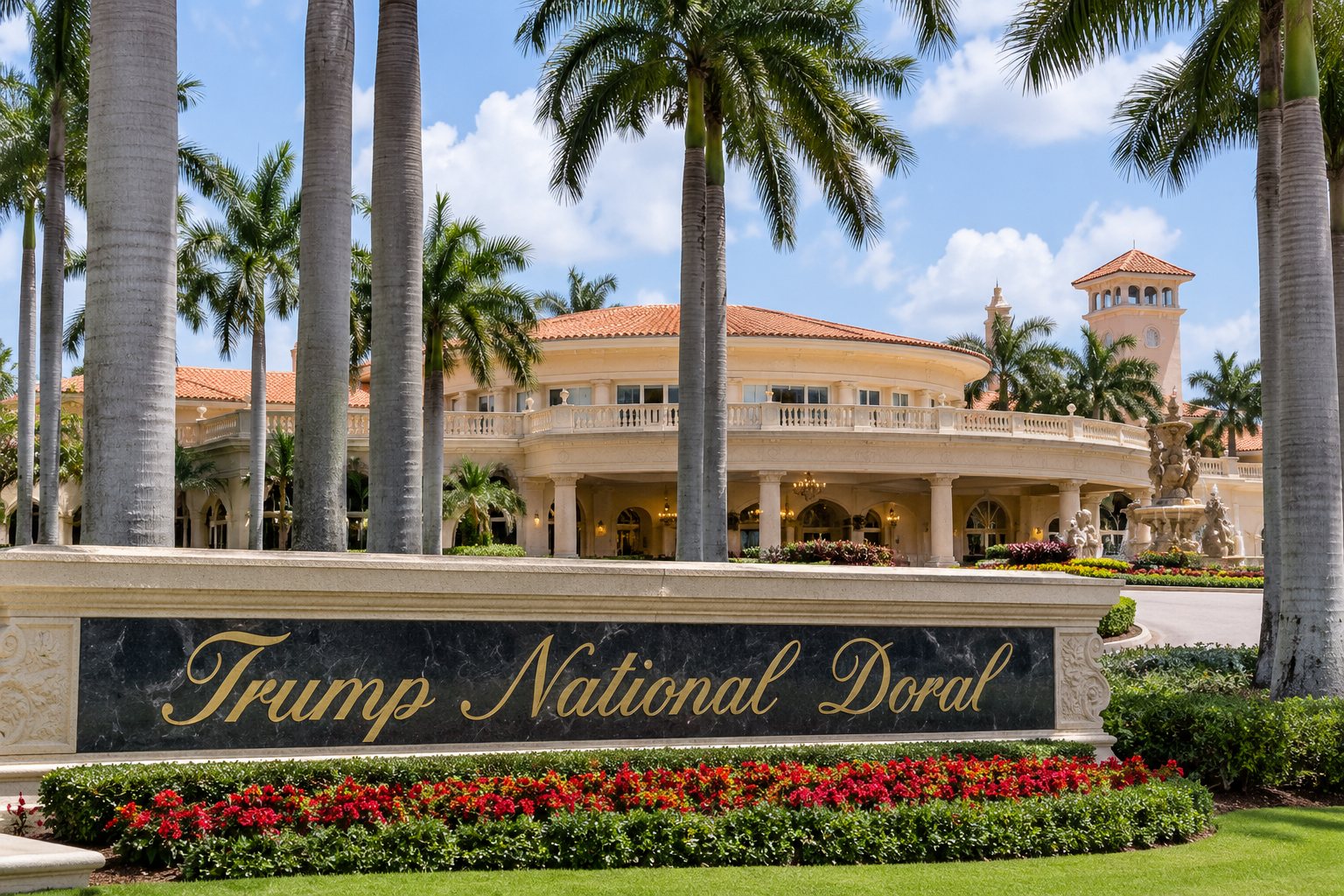
President Donald Trump's administration announced on October 17, 2019, that the United States would host the following year's G7 summit at Trump National Doral, a luxury golf resort near Miami owned by the president himself. The decision immediately triggered accusations that Trump was using the powers of the presidency to direct government and foreign spending toward his private business.
The announcement came as Trump was already facing an impeachment investigation over his dealings with Ukraine, making the decision particularly controversial. While congressional investigators examined whether the president had used his office for personal political advantage, his administration was publicly defending plans to hold a major international diplomatic gathering at a property from which he stood to benefit financially.
The White House insisted the arrangement would save taxpayers money. Ethics experts and lawmakers questioned whether any president should be permitted to select his own business for such an event.
The President Chooses His Own Property
Acting White House Chief of Staff Mick Mulvaney announced that the 2020 G7 summit, scheduled for June 10–12, would take place at Trump National Doral.
The annual gathering brings together leaders from the United States, Canada, France, Germany, Italy, Japan, the United Kingdom, and the European Union. Hosting the event requires extensive accommodations, security arrangements, conference facilities, transportation, and support services.
Ordinarily, those arrangements involve selecting a venue without a direct financial connection to the sitting president.
In this case, however, the president was effectively directing a major international event toward his own commercial property.
Mulvaney acknowledged that Trump personally suggested Doral during the selection process. He argued that an administration advance team had examined other locations and concluded that the resort was particularly well suited to the gathering.
The White House maintained that the resort would provide its services at cost rather than generate a profit.
But that explanation left significant questions unanswered.
A Struggling Trump Property Stood to Gain International Exposure
The financial condition of Trump National Doral made the announcement especially noteworthy.
According to financial records reported by The Washington Post, the resort's net operating income had declined approximately 69 percent between 2015 and 2017.
A representative of the Trump Organization had previously attributed part of the property's financial difficulties to the negative effects of Trump's political reputation on the business.
Hosting the G7 could have provided the resort with substantial international publicity, bringing world leaders, diplomatic delegations, journalists, and security personnel to the property.
Even if the resort charged only enough to cover its operating expenses, critics argued that the worldwide exposure could carry significant commercial value.
There was also the question of what constituted operating costs and how the public could verify that the president's company was not making money from the arrangement.
Mulvaney offered no detailed financial breakdown establishing the projected savings or explaining how the resort's expenses would be independently verified.
Constitutional Questions and the Emoluments Clause
The announcement renewed scrutiny of the Constitution's emoluments provisions, which restrict certain financial benefits that federal officials may receive from foreign governments and, in the president's case, additional compensation from the federal government or individual states.
Because the G7 involves foreign governments, legal experts questioned whether payments to a president-owned resort could create constitutional problems.
The administration argued that charging at cost would eliminate any improper financial benefit.
Critics disagreed, maintaining that the constitutional concerns extended beyond the question of whether the resort recorded a conventional accounting profit.
The president had retained ownership interests in his business empire while in office, although management had been transferred to his sons and other executives.
That arrangement had already generated multiple lawsuits concerning payments from foreign governments and other entities to Trump-owned businesses.
The G7 announcement placed those longstanding questions directly into the planning of one of the world's most prominent diplomatic gatherings.
No court ruled that the proposed Doral summit itself violated the Constitution before the administration abandoned the plan.
The Same Press Conference Produced Another Major Scandal
The timing of the announcement was extraordinary.
During the same October 17 briefing, Mulvaney also addressed the administration's decision to withhold nearly $400 million in military assistance to Ukraine.
He acknowledged that the withholding of assistance was connected, in part, to the administration's desire for Ukraine to investigate matters related to the 2016 American election.
When reporters questioned whether that amounted to a political quid pro quo, Mulvaney responded:
"We do that all the time."
He later attempted to clarify and retract the implications of those remarks, denying that military assistance had been conditioned on Ukraine investigating Democrats.
The two controversies unfolded during the same briefing: the administration was defending a decision to direct an international summit to the president's business while simultaneously facing questions about whether presidential authority had been used to pursue political objectives in Ukraine.
The juxtaposition intensified scrutiny of the administration's handling of presidential power and conflicts of interest.
The White House Dismisses the Criticism
Mulvaney repeatedly defended the choice of Doral, arguing that the resort offered superior facilities and would provide substantial savings.
He also rejected concerns that hosting the summit would deliver valuable publicity to Trump's business.
The administration's position was that Trump's name was already internationally recognized and that additional exposure would provide little meaningful advantage.
Ethics watchdogs challenged that reasoning, pointing out that public officials are expected to avoid conflicts between their government responsibilities and private financial interests.
The controversy was not simply about whether the resort was capable of hosting an international conference. It concerned the president's role in selecting a venue owned by his own company.
Critics argued that allowing such an arrangement would establish a troubling precedent in which presidential authority could be used to direct major government events toward a president's personal business holdings.
Trump Reverses Course Just Two Days Later
The administration's defense of the decision lasted only 48 hours.
On October 19, 2019, Trump announced that the G7 summit would no longer be held at his Doral property.
Rather than acknowledging the ethical objections as legitimate concerns, Trump blamed political opponents and the news media for the backlash.
He announced that the administration would search for another location, including the possibility of using Camp David, the government-owned presidential retreat in Maryland.
The reversal demonstrated the intensity of the controversy surrounding the proposed arrangement.
Ultimately, the planned June 2020 G7 summit was not held at Doral. The in-person gathering was later disrupted by the COVID-19 pandemic.
A Revealing Episode in Trump's First Presidency
The Doral controversy illustrated the persistent difficulty of separating Trump's private business interests from his official responsibilities.
Unlike modern presidents who placed assets in blind trusts or otherwise sought to distance themselves from financial conflicts, Trump retained ownership of a sprawling collection of hotels, golf courses, and commercial properties.
His administration argued that his businesses could continue operating while he served as president and that government decisions involving those properties were not necessarily improper.
Ethics experts countered that retaining financial interests created recurring conflicts, particularly when foreign governments or federal agencies conducted business at Trump-owned establishments.
The October 17 announcement brought those competing positions into unusually sharp focus.
A sitting American president had selected his own resort to host some of the world's most powerful leaders, with the decision announced and defended from the White House briefing room.
The administration ultimately abandoned the plan, but the episode remained a significant example of the ethical questions surrounding Trump's business interests during his presidency.
The central question was never whether Trump National Doral could accommodate a G7 summit. It was whether the president should have been involved in directing such a prestigious government event to a business he personally owned.