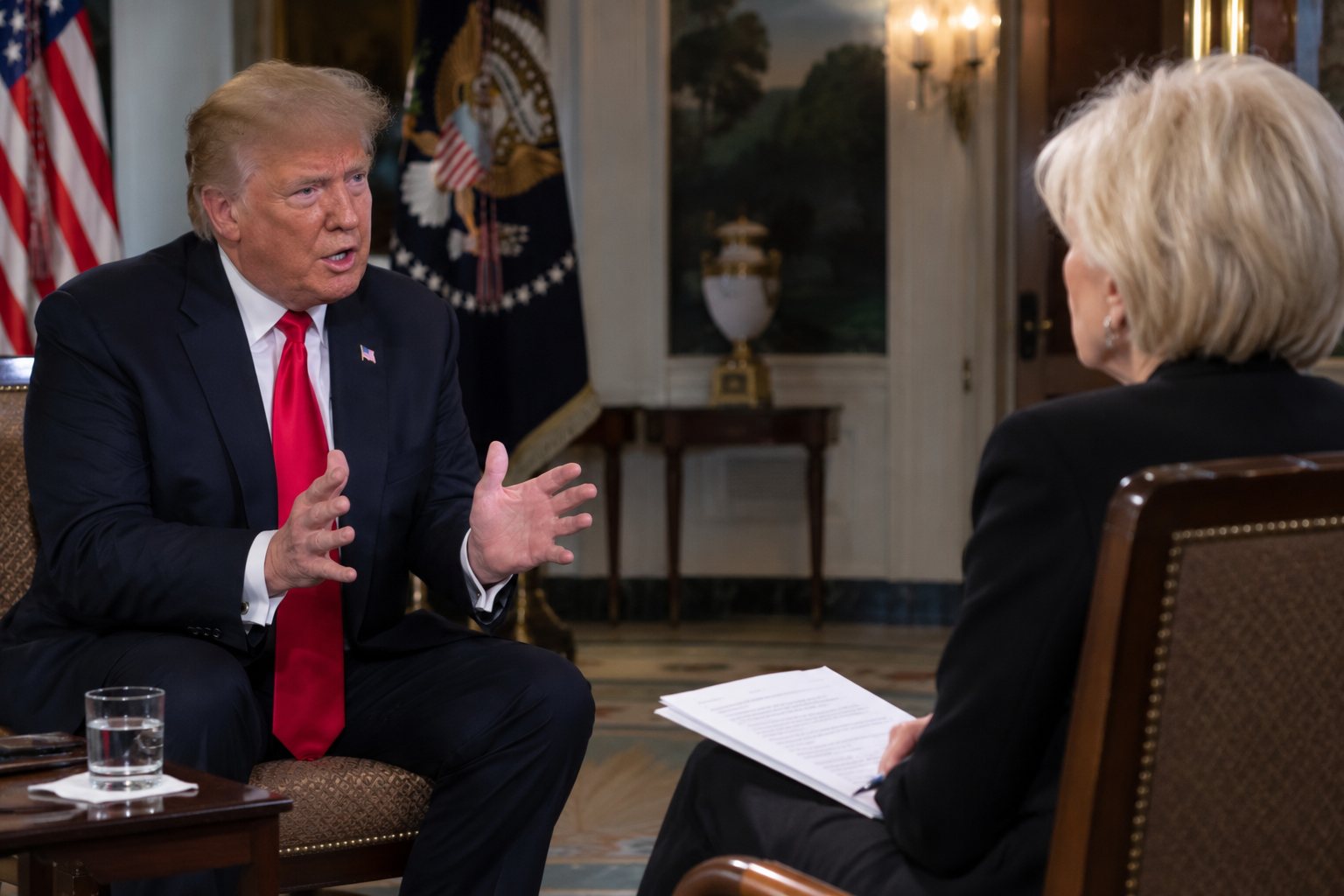
President Donald Trump faced widespread criticism on October 15, 2018, after a televised interview in which he questioned whether humans were responsible for climate change, suggested global warming could reverse itself, and accused climate scientists of having political motivations.
Speaking with veteran CBS journalist Lesley Stahl during an interview on 60 Minutes that aired the previous evening, Trump acknowledged that the Earth's climate was changing but refused to accept the scientific consensus that human activity was the primary cause.
His comments came just days after the United Nations released a major scientific report warning that the world faced increasingly serious consequences from global warming unless greenhouse gas emissions were dramatically reduced.
Rather than accepting those findings, Trump questioned the scientists themselves.
When Stahl challenged him about scientific warnings, Trump responded that researchers had a political agenda.
The exchange became one of the most widely discussed moments of the interview, highlighting the growing divide between the Trump administration's environmental policies and the conclusions of the world's leading climate researchers.
Trump Says Climate Change Could Simply Reverse Itself
The conversation began when Stahl asked Trump whether he still believed climate change was a hoax.
Trump had previously described global warming as a hoax, including a widely circulated 2012 social media post suggesting the concept had been created to undermine American manufacturing.
During the interview, however, Trump appeared to modify his position.
He acknowledged that something was happening to the climate but suggested that the changes might eventually reverse themselves.
He also questioned whether human activity was responsible.
That distinction was central to the controversy.
Natural climate variations have occurred throughout Earth's history. But the warming observed since the Industrial Revolution was occurring alongside rapidly increasing concentrations of carbon dioxide and other greenhouse gases released through human activities.
By 2018, decades of scientific research had established that human-generated greenhouse gas emissions were the dominant cause of the observed warming trend.
The evidence came from atmospheric measurements, ocean temperatures, satellite observations, ice-core records, and numerous independent scientific studies.
Trump offered no scientific evidence explaining how the current warming trend would reverse itself without substantial changes in greenhouse gas emissions.
Trump Questions the Scientists
Stahl pressed the president about the evidence presented by researchers at NASA and the National Oceanic and Atmospheric Administration.
Both federal agencies had documented rising global temperatures and other indicators of climate change.
Trump responded by asserting that some scientists disagreed.
When Stahl asked about researchers warning that climate change was worsening, Trump suggested that the scientists themselves were politically motivated.
The accusation shifted the discussion away from scientific evidence and toward the credibility of the researchers producing it.
Scientists can hold political opinions, and scientific findings should be open to scrutiny. But a researcher's personal views do not invalidate measurements, independently replicated results, or conclusions supported by multiple lines of evidence.
By 2018, the overwhelming consensus among climate scientists was that human activities were warming the planet.
The position was supported by major scientific organizations, including the National Academy of Sciences, NASA, NOAA, and the Intergovernmental Panel on Climate Change.
Trump did not identify specific scientific findings that disproved the consensus.
Instead, he suggested that political considerations were influencing researchers' conclusions.
The Interview Followed a Devastating Hurricane
The timing of Trump's comments was particularly significant.
Hurricane Michael had struck the Florida Panhandle on October 10, 2018, as a powerful Category 4 hurricane, causing catastrophic damage.
The storm destroyed homes, devastated communities, and left hundreds of thousands of people without electricity.
Michael followed several other destructive storms, including Hurricane Florence in September 2018 and Hurricanes Harvey, Irma, and Maria in 2017.
Stahl referenced the recent hurricanes while questioning Trump about climate change.
Trump responded by suggesting that more powerful hurricanes had occurred in the distant past.
It is true that severe hurricanes existed long before industrialization. Scientists do not claim that climate change created hurricanes or that every individual storm can be attributed entirely to global warming.
Instead, researchers study how warming oceans, rising sea levels, and changing atmospheric conditions influence storm intensity, rainfall, and coastal flooding.
Warmer ocean waters can provide additional energy for tropical cyclones, while higher sea levels can increase the damage caused by storm surge.
Trump's reference to historical hurricanes did not address those mechanisms.
The existence of powerful storms in the past does not contradict evidence that human-caused warming can make certain hurricane impacts more severe.
Scientists Had Just Issued a Major Warning
Only days before the interview aired, the United Nations Intergovernmental Panel on Climate Change released a major report examining the consequences of allowing global temperatures to rise 1.5 degrees Celsius above preindustrial levels.
The October 8 report warned that limiting warming to that threshold would require rapid and far-reaching changes in energy production, transportation, industry, and land use.
It also explained that the consequences of 2 degrees Celsius of warming would be significantly more severe than those associated with 1.5 degrees.
The projected differences included greater risks from extreme heat, rising sea levels, ecosystem damage, and declining coral reef populations.
The report represented the work of scientists examining thousands of published studies.
Its findings did not depend on the political preferences of a single researcher or organization.
Yet Trump responded to questions about climate science by suggesting that scientists were motivated by politics.
His comments came at a moment when researchers were warning that delaying emissions reductions would make limiting future warming increasingly difficult.
Trump Puts Economic Concerns Ahead of Climate Action
Trump also framed the issue as an economic choice.
He argued that the United States should not spend enormous sums of money or risk losing millions of jobs to address climate change.
His administration had already pursued policies intended to expand domestic fossil fuel production and reduce environmental regulations.
In June 2017, Trump announced that the United States would withdraw from the Paris climate agreement, arguing that its commitments placed American workers and businesses at a disadvantage.
The administration also moved to weaken or replace several Obama-era environmental policies, including regulations addressing greenhouse gas emissions from power plants and vehicles.
Supporters of those decisions argued that the changes would reduce regulatory costs, protect jobs in traditional energy industries, and promote American energy independence.
Environmental organizations and climate researchers warned that weakening emissions standards would make it more difficult to reduce pollution and address global warming.
The economic debate was legitimate. Climate policies involve costs, technological challenges, and consequences for workers and businesses.
But those policy disagreements were separate from the scientific question of whether human activities were warming the planet.
Rejecting particular environmental regulations did not require rejecting the evidence of human-caused climate change.
The Difference Between Climate and Weather
Trump's suggestion that the climate might simply change back also reflected a common misunderstanding about climate science.
Weather describes short-term atmospheric conditions, including daily temperatures, storms, and rainfall.
Climate refers to long-term patterns measured over decades and longer periods.
A cold winter does not disprove global warming, just as a single hot summer does not establish it.
Scientists evaluate long-term trends using measurements from around the world.
By 2018, those measurements showed a sustained increase in average global temperatures, accompanied by warming oceans, shrinking glaciers, declining Arctic sea ice, and rising sea levels.
Natural processes such as volcanic activity, solar variations, and changes in Earth's orbit can influence climate.
However, research showed that those factors could not explain the rapid warming observed during the modern industrial era.
The increase in atmospheric greenhouse gases provided the explanation consistent with the available evidence.
Trump's suggestion that warming might reverse itself did not account for the continued accumulation of those gases in the atmosphere.
The White House Versus Its Own Scientists
One of the most striking aspects of the interview was that Trump was questioning findings supported by scientists working within his own government.
NASA and NOAA had long maintained extensive climate-monitoring programs.
Their researchers collected temperature records, studied atmospheric conditions, monitored ocean changes, and analyzed long-term environmental trends.
Federal scientific assessments had repeatedly identified human activity as the principal cause of recent global warming.
In 2017, the federal government's Climate Science Special Report concluded that human influence on the climate system was clear and that recent warming could not be explained by natural causes alone.
The report was produced by scientists from multiple federal agencies during Trump's own presidency.
Yet during the CBS interview, Trump suggested that government scientists and other researchers were politically motivated.
He did not present evidence of coordinated misconduct or identify a scientific assessment that overturned the established conclusions.
The disagreement was therefore not simply between Trump and environmental activists.
It was between the president's public statements and the findings of scientific institutions within the federal government he led.
An Interview That Revealed a Fundamental Disagreement
Trump's October 2018 interview illustrated how climate change had become a major political dividing line in the United States.
The president acknowledged that the climate was changing but questioned its causes, suggested the trend could reverse itself, and challenged the motivations of scientists who warned about its consequences.
His administration emphasized economic growth, deregulation, and expanded energy production.
Climate researchers, meanwhile, continued documenting the relationship between human greenhouse gas emissions and rising global temperatures.
The debate over how governments should respond to climate change remained open to legitimate disagreement.
Countries could choose different combinations of renewable energy, nuclear power, efficiency improvements, carbon pricing, regulations, and technological investment.
But the underlying scientific evidence did not change according to political preference.
By October 15, 2018, the president's remarks had become a national news story precisely because they challenged conclusions supported by decades of research.
Trump argued that climate change might reverse itself and questioned the motivations of scientists warning about global warming. The scientific evidence, however, showed that human activities were driving a sustained increase in global temperatures—and that reversing the trend would require reducing the emissions responsible for it.