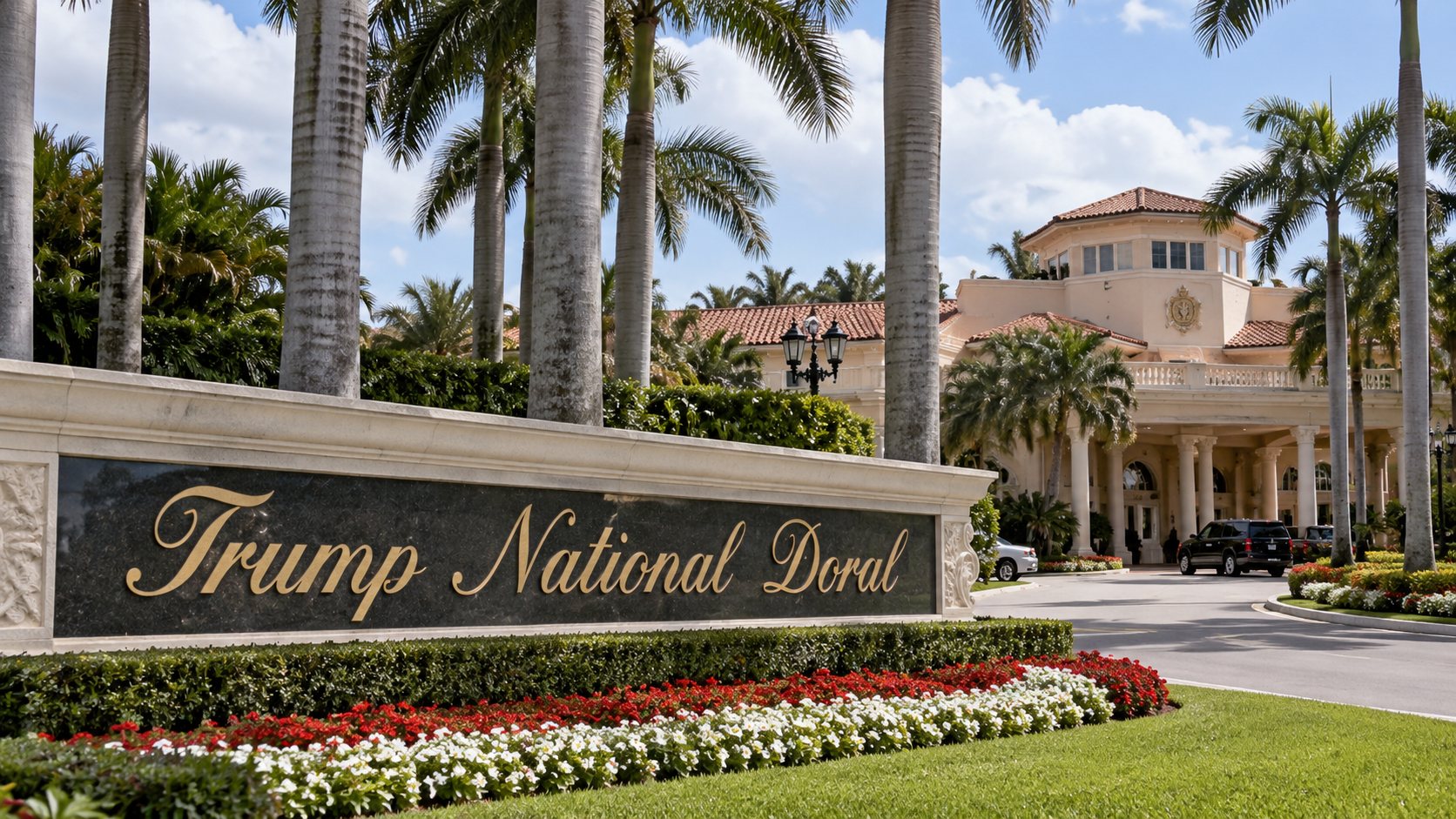
President Donald Trump abruptly abandoned plans Saturday night to host the 2020 Group of Seven summit at his own Florida golf resort, reversing a controversial decision that had prompted accusations of self-dealing, conflicts of interest, and potential violations of the United States Constitution.
The announcement came just two days after the White House revealed that Trump National Doral Miami, a luxury resort owned by the president's private business, had been selected to host leaders of seven major industrialized democracies.
The arrangement would have brought foreign heads of government, diplomatic delegations, security personnel, journalists, and international attention to a property from which Trump continues to benefit financially.
Rather than acknowledging the ethical concerns that prompted the backlash, Trump blamed Democrats and the news media for forcing the reversal.
The decision marks a significant retreat for a president who has repeatedly defended his continued ownership of a sprawling business empire while serving in the White House.
It also raises a fundamental question: Why was a privately owned Trump resort considered an appropriate destination for an official international summit in the first place?
A Presidential Summit at a Presidential Business
The controversy began Thursday when acting White House Chief of Staff Mick Mulvaney announced that Trump National Doral Miami had been selected to host the June 10–12, 2020, G7 summit.
The annual gathering brings together the leaders of the United States, Canada, France, Germany, Italy, Japan, and the United Kingdom, along with representatives of the European Union.
Hosting the summit is a major diplomatic responsibility.
The host country must provide secure meeting facilities, accommodations, communications infrastructure, transportation arrangements, and extensive security for some of the world's most influential political leaders.
Such events also attract international media coverage and considerable logistical spending.
The White House's selection was unusual because the proposed venue was not merely a private hotel.
It was a business owned by the president himself.
Trump National Doral is part of the Trump Organization, the real estate and hospitality company that remains financially connected to the president.
Although Trump transferred day-to-day management responsibilities to his sons after taking office, he did not fully divest his ownership interests.
Consequently, questions about whether presidential decisions could benefit his businesses have followed his administration since its beginning.
The G7 announcement brought those concerns into particularly sharp focus.
The White House Insisted There Was No Conflict
During Thursday's briefing, Mulvaney defended the selection and repeatedly dismissed concerns that Trump might benefit financially.
He said administration officials had examined approximately a dozen possible locations before concluding that Doral offered suitable accommodations, meeting spaces, and access to Miami International Airport.
According to Mulvaney, the resort would host the summit at cost rather than seek an ordinary commercial profit.
He argued that this arrangement would save taxpayers millions of dollars compared with other possible venues.
The acting chief of staff also acknowledged that Trump himself had suggested the property.
That admission intensified scrutiny of the decision.
The president had not merely approved a venue recommended independently by government officials. He had personally proposed a resort belonging to his own company.
Mulvaney maintained that the choice was based on practical considerations.
But he did not provide a detailed public accounting of the competing bids, the projected expenses, or the methods used to determine that Doral was the most economical option.
When reporters questioned whether the summit would promote Trump's brand, Mulvaney argued that the president's businesses were already internationally recognizable.
That explanation failed to address one of the central ethical concerns: a government decision can benefit a private business through publicity, prestige, and future commercial opportunities even when the immediate transaction generates little or no accounting profit.
Trump's Saturday-Night Reversal
By Saturday evening, the criticism had become intense enough that Trump announced the summit would be moved elsewhere.
In a series of Twitter messages, the president said his administration would no longer consider Trump National Doral as the host location.
He blamed what he characterized as irrational hostility from Democrats and the media.
Trump also defended the original decision, insisting that he had intended to provide a suitable venue at a favorable price.
The administration would immediately begin searching for another location, he said, including the possibility of using Camp David, the presidential retreat in Maryland.
The reversal came only 48 hours after Mulvaney had publicly presented Doral as the administration's preferred venue.
It was a striking change for a White House that had insisted there was no legitimate ethical problem with the arrangement.
The president's announcement did not resolve the underlying concerns about his private business interests.
It merely eliminated one particularly visible proposed transaction.
The Constitutional Question
The controversy involves more than the appearance of impropriety.
It also touches on constitutional restrictions intended to prevent public officials from using government authority for private enrichment.
The Constitution's Foreign Emoluments Clause generally prohibits federal officeholders from accepting certain benefits from foreign governments without congressional consent.
The provision was designed to reduce the danger that foreign powers might gain influence over American officials through financial favors.
Legal experts and ethics organizations have debated how the clause applies to payments made by foreign governments to businesses owned by a sitting president.
Trump has argued that ordinary commercial transactions involving his properties do not violate the Constitution.
Critics dispute that interpretation, particularly when foreign governments spend money at businesses from which the president financially benefits.
Hosting the G7 at Doral would have placed those questions at the center of a major diplomatic event.
Foreign delegations might have paid for accommodations, services, or other arrangements at a property owned by the American president.
Even if the United States negotiated favorable rates, the arrangement could still have created questions about payments from foreign governments and whether the president's private interests were receiving benefits connected to his official position.
The legal issues were not conclusively resolved by the announcement of the summit venue.
But the potential for constitutional litigation and further congressional scrutiny was evident.
Why 'At Cost' Did Not End the Debate
The administration's principal defense was that Trump National Doral would provide services without generating a conventional profit.
That argument rested on a narrow understanding of how a business can benefit from hosting a prestigious international event.
A hotel or resort may gain commercially valuable exposure even if a particular event is priced at cost.
The G7 summit would have associated Doral with the leaders of major world powers.
International television networks, newspapers, and digital media outlets would have reported from the property.
The resort's name and facilities could have appeared repeatedly in global coverage.
That attention has potential advertising and reputational value.
Moreover, a large event can generate revenue and help cover operating expenses even when a business claims it is not adding a profit margin.
Without detailed financial disclosures, the public would have had limited ability to determine whether the promised at-cost arrangement truly eliminated financial benefits.
The White House did not provide a complete public financial analysis demonstrating that the president's ownership interests would receive no benefit.
The distinction between immediate profit and broader commercial advantage was therefore central to the criticism.
A Business Empire That Remains Connected to the Presidency
Trump entered office in January 2017 with extensive business holdings, including hotels, golf courses, resorts, and commercial real estate.
Unlike many previous presidents, he did not sell his interests or place them into a blind trust managed independently of his family.
Instead, he retained ownership while his sons assumed responsibility for daily operations.
The arrangement has drawn criticism from government ethics specialists, who argue that it leaves open the possibility that official decisions could affect the president's personal finances.
Trump and his representatives have rejected allegations that he is improperly profiting from the presidency.
Nevertheless, his properties have continued to host political gatherings, government-related visits, and customers with interests before the federal government.
His Washington hotel has attracted particular scrutiny because foreign officials, lobbyists, and politically connected guests have stayed there.
The Doral decision presented a more direct question.
Rather than officials independently choosing to patronize a Trump property, the White House itself had selected the president's business as the venue for an official international summit.
That distinction made the potential conflict unusually visible.
Criticism Extended Beyond Democrats
Democratic lawmakers immediately condemned the Doral announcement.
They argued that the president was using the authority of his office to direct government-related business toward a company he owned.
Ethics watchdog organizations similarly warned that the arrangement threatened to blur the distinction between public responsibilities and private financial interests.
But criticism was not limited to Trump's political opponents.
Some Republicans also expressed concern about the appearance of self-dealing and the political consequences of selecting a Trump property.
The objections placed the White House in the position of defending an arrangement that could have been avoided simply by choosing a venue without a financial connection to the president.
The United States has previously hosted major international summits at government facilities and independently operated resorts.
The existence of those alternatives made the administration's insistence on Doral particularly difficult for critics to understand.
Camp David Was an Available Alternative
One of the alternatives Trump mentioned Saturday was Camp David.
Located in Maryland's Catoctin Mountain Park, the presidential retreat has hosted numerous high-level diplomatic meetings.
It was also the site of the 2012 G8 summit under President Barack Obama.
Camp David offers established security infrastructure and a history of accommodating foreign leaders.
During Thursday's announcement, however, Mulvaney had disparaged the retreat as an undesirable location compared with Doral.
He emphasized the Florida resort's hotel capacity, meeting facilities, and accessibility.
Those considerations are relevant when selecting a venue for a major international gathering.
But they do not explain why a property owned by the president should receive the contract.
The central issue was never whether Doral possessed adequate facilities.
It was whether the president should be involved in directing official government business to his own commercial property.
The Political Contradiction
The timing of the controversy is especially notable because Trump has been publicly attacking former Vice President Joe Biden and his son Hunter over allegations involving business relationships and political influence.
Trump has argued that the Biden family's activities raise questions about conflicts of interest.
The Bidens have denied wrongdoing, and the president's allegations have not established that Joe Biden improperly used his office to benefit his son.
Meanwhile, the White House's own G7 announcement involved a direct decision to use a business owned by the sitting president.
During Thursday's briefing, Mulvaney was asked how the administration distinguished the Doral arrangement from the concerns Trump had raised about the Biden family.
Mulvaney responded that the Trump Organization would not profit from the summit and emphasized that the Trump family had established its wealth before entering politics.
But when a family accumulated its wealth does not resolve whether its businesses may benefit from government decisions made while one of its members holds public office.
The relevant ethical question concerns the use of official authority and the financial interests that may be affected.
That standard applies regardless of political affiliation.
What the Reversal Does — and Does Not — Resolve
Trump's announcement means the 2020 G7 summit will not take place at Trump National Doral under the plan announced Thursday.
That removes the immediate prospect of the summit generating business and worldwide publicity for the resort through an official White House decision.
But it does not answer several questions raised by the episode.
The administration has not released a complete public comparison of the venues considered.
It has not provided a detailed explanation of the financial arrangements contemplated for Doral.
Nor has it established that the president's personal business interests were entirely separated from the selection process.
Those unanswered questions matter because the controversy concerns how public decisions are made, not simply where one international meeting takes place.
A government procurement decision should be based on public needs and established standards, with safeguards against private conflicts.
The public should be able to evaluate whether those safeguards were followed.
A Presidency With Unresolved Financial Conflicts
The Doral controversy illustrates a continuing problem created by Trump's decision to retain ownership of his businesses while serving as president.
Every time the federal government considers using a Trump property, questions arise about whether public money, foreign government spending, or official attention could benefit the president financially.
Those questions are not automatically proof of unlawful conduct.
But they are foreseeable consequences of maintaining substantial private business interests while exercising presidential authority.
Trump could have avoided this particular dispute by selecting an independent venue from the beginning.
Instead, the White House announced that his resort was the preferred location, defended the choice despite widespread objections, and reversed course only after the criticism intensified.
The president's explanation for the reversal blamed his opponents rather than addressing the underlying conflict-of-interest concerns.
The Larger Question: Who Benefits From Public Office?
The United States presidency carries extraordinary authority.
Decisions made by the White House affect federal spending, international diplomacy, and the commercial interests of businesses throughout the country.
That authority comes with an obligation to distinguish public responsibilities from private financial interests.
The G7 summit is intended to provide a forum for cooperation among major democratic nations.
It is not intended to serve as a commercial opportunity for the host country's head of government.
The Trump administration insisted that selecting Doral would save money and provide excellent facilities.
Critics argued that those possible advantages did not eliminate the conflict created by the president's ownership of the resort.
On Saturday night, Trump abandoned the plan.
The reversal prevents the summit from being held at his property, but it leaves unresolved why the White House was prepared to direct such a prominent international event to the president's own business.
That question extends beyond one Florida resort.
It concerns the standards governing public office, the separation of government authority from private financial interests, and the public's ability to trust that official decisions are made for the country's benefit rather than the personal benefit of those in power.