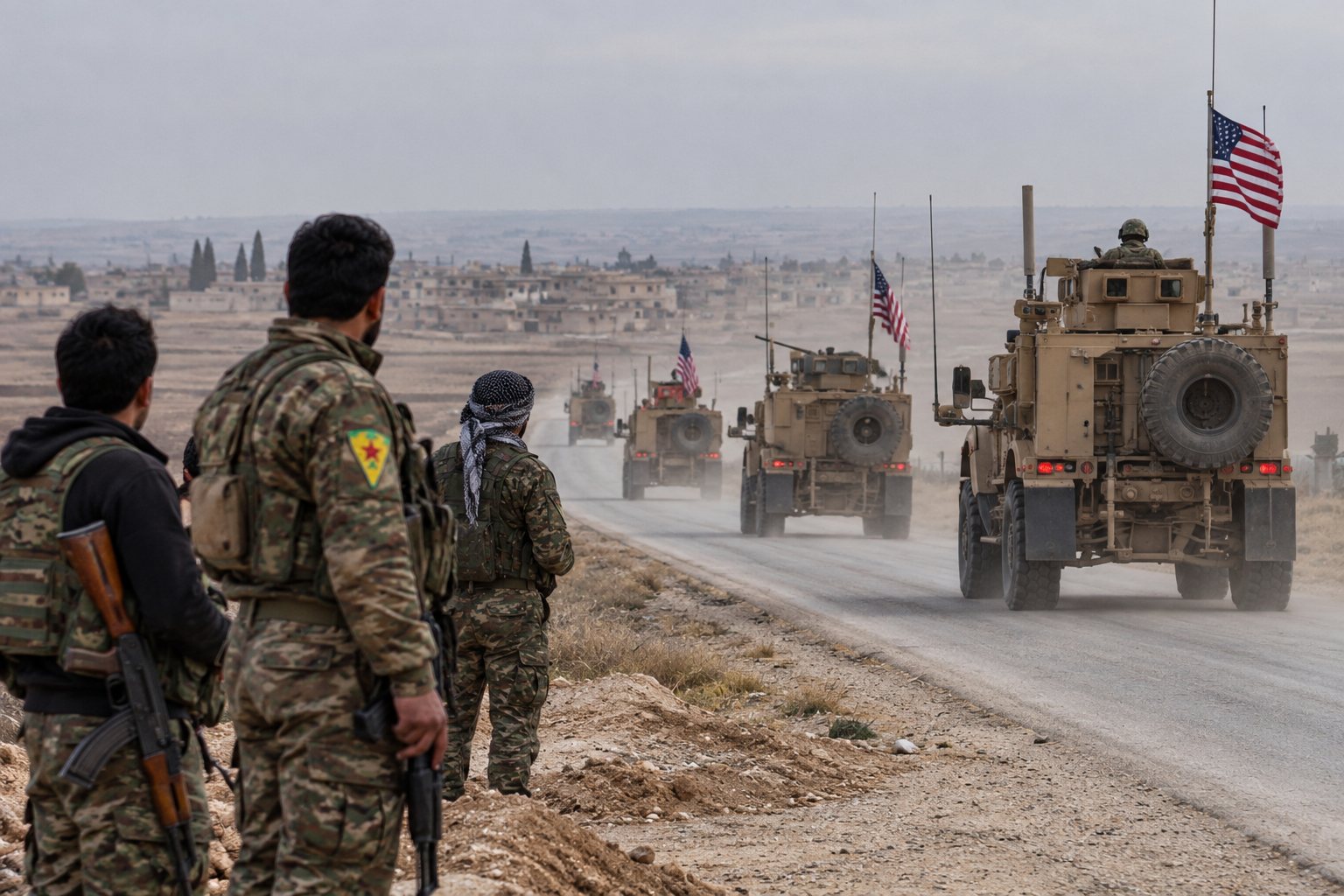
On October 15, 2019, the consequences of President Donald Trump's decision to withdraw American troops from northern Syria were unfolding in real time.
Turkish military forces continued their offensive against Kurdish fighters who had spent years helping the United States defeat ISIS. Civilians were fleeing their homes, American troops were withdrawing from positions they had occupied alongside Kurdish allies, and Russian-backed Syrian government forces were moving into territory previously protected by the American military presence.
Just one week earlier, Kurdish fighters had been among Washington's most important partners in the campaign against the Islamic State.
Now they were fighting for survival.
Trump's decision triggered an unusually fierce bipartisan backlash in Washington, with Republican and Democratic lawmakers accusing the president of abandoning American allies, jeopardizing national security, and handing a strategic advantage to Russia.
The administration announced sanctions against Turkey on October 14. But by the following day, the Turkish offensive continued, and the geopolitical consequences were becoming increasingly difficult to reverse.
The Kurds Had Helped America Defeat ISIS
For years, the United States relied heavily on Kurdish-led forces in Syria to fight the Islamic State.
The Syrian Democratic Forces, or SDF, were a coalition of Kurdish, Arab, and other fighters who worked alongside American troops and coalition airpower.
Their partnership proved essential in dismantling ISIS's territorial control across large portions of Syria.
Kurdish-led forces fought in some of the campaign's most difficult battles, including the liberation of Raqqa, which ISIS had declared the capital of its self-proclaimed caliphate.
The SDF also played a central role in the final offensive against ISIS's remaining territorial stronghold at Baghouz in March 2019.
The campaign came at an enormous human cost.
Kurdish-led forces reported losing approximately 11,000 fighters during the war against ISIS, with many thousands more wounded.
American military personnel had trained, advised, and fought alongside these forces.
The partnership allowed the United States to combat ISIS without deploying the large conventional ground forces used during earlier wars in Iraq and Afghanistan.
By October 2019, the SDF was also responsible for guarding thousands of captured ISIS fighters and maintaining detention camps holding tens of thousands of displaced people and family members associated with the terrorist organization.
The arrangement was imperfect and difficult to sustain, but it was central to American counterterrorism operations in northeastern Syria.
One Phone Call Changes Everything
On October 6, 2019, Trump spoke by telephone with Turkish President Recep Tayyip Erdoğan.
Turkey had long threatened to launch a military operation against Kurdish forces operating near its southern border.
The Turkish government regarded the Kurdish People's Protection Units, or YPG, which formed a major component of the SDF, as an extension of the Kurdistan Workers' Party, or PKK.
The PKK had conducted a decades-long insurgency against Turkey and was designated a terrorist organization by both Turkey and the United States.
Washington, however, distinguished between the PKK and its Syrian Kurdish partners in the fight against ISIS.
That disagreement had created years of tension between the United States and Turkey, despite Turkey's membership in NATO.
Following Trump's conversation with Erdoğan, the White House announced that American forces would no longer be positioned in the immediate area of Turkey's planned operation.
The announcement said the United States would neither support nor participate in the offensive.
Although the administration did not explicitly authorize Turkey to invade Syria, critics argued that moving American troops out of the way removed a significant deterrent.
On October 9, Turkish forces launched Operation Peace Spring, crossing into northern Syria with allied Syrian armed groups.
Airstrikes and ground attacks quickly followed.
Kurdish Forces Suddenly Face a NATO Military
The Turkish offensive placed Kurdish-led forces in a dangerous position.
After years of fighting ISIS with American support, they now faced a conventional military belonging to a NATO member.
Turkey's armed forces possessed aircraft, artillery, armored vehicles, and other equipment far beyond the capabilities of many Kurdish units.
Ankara said its operation was intended to protect Turkish national security by removing armed groups it considered terrorist threats from its border.
Turkey also proposed establishing a security zone inside Syria where some Syrian refugees living in Turkey could eventually be resettled.
Kurdish leaders rejected Turkey's characterization of their forces and warned that the operation threatened civilians and destabilized territory recently liberated from ISIS.
Humanitarian organizations reported rapidly increasing displacement as residents fled the fighting.
By mid-October, more than 100,000 people had already been displaced, with the numbers continuing to rise.
The violence also raised concerns about civilian casualties, attacks by Turkish-backed militias, and the treatment of ethnic and religious minorities.
October 15: Russia and Assad Move Into the Vacuum
One of the most significant developments occurred on October 15.
As American forces withdrew, Syrian government troops backed by Russia advanced into Manbij, a strategically important city in northern Syria.
Reuters journalists accompanying Syrian forces reported that government troops had entered the city's center.
Russian and Syrian flags appeared in areas where American troops had previously operated.
The developments illustrated a rapid change in regional power.
Before the withdrawal, the American military presence had helped limit direct confrontations between Kurdish-led forces, Turkish troops, and Syrian government forces.
With that presence disappearing, Kurdish leaders sought protection elsewhere.
The SDF reached an agreement with the government of Syrian President Bashar al-Assad, allowing Syrian government forces to deploy into parts of northeastern Syria.
The decision was born of military necessity.
Kurdish leaders had long sought a degree of autonomy from Damascus. But facing a Turkish offensive without reliable American protection, they turned to Assad's government and its Russian backers.
The result was an expansion of Russian and Syrian government influence in territory where the United States had previously played a major security role.
For critics of Trump's withdrawal, this was precisely the outcome they had warned about.
Republicans Join Democrats in Condemning Trump
The criticism was not limited to Trump's political opponents.
Several prominent Republicans publicly challenged the president's decision.
Senator Lindsey Graham of South Carolina, usually a strong Trump ally, warned that abandoning Kurdish partners would undermine American credibility and threaten the gains made against ISIS.
Representative Liz Cheney of Wyoming argued that the withdrawal ignored lessons learned from previous terrorist threats and strengthened America's adversaries.
Representative Adam Kinzinger of Illinois, an Air Force veteran, described the decision as a retreat from an effective counterterrorism strategy.
Former U.N. Ambassador Nikki Haley also criticized the treatment of Kurdish allies, warning that the United States had an obligation to partners who had fought alongside American troops.
Democratic lawmakers were similarly forceful.
Senate Minority Leader Chuck Schumer called for action to reverse the decision, while House Foreign Affairs Committee Chairman Eliot Engel pushed for congressional measures condemning the withdrawal and imposing consequences on Turkey.
The bipartisan response reflected concerns that went beyond the immediate humanitarian crisis.
Lawmakers questioned what message the decision sent to other countries and armed groups cooperating with American forces.
If the United States could abruptly withdraw protection from partners who had suffered thousands of casualties fighting a common enemy, future allies might question whether American security commitments could be trusted.
Trump Announces Sanctions, but Turkey Continues Its Offensive
On October 14, Trump announced economic sanctions against Turkey.
The administration targeted Turkish government ministries and senior officials, suspended negotiations over a proposed $100 billion trade agreement, and announced plans to increase tariffs on Turkish steel.
Vice President Mike Pence called for an immediate ceasefire.
The sanctions represented an attempt to pressure Erdoğan into ending the military operation.
But they also highlighted a contradiction at the center of the administration's response.
The United States was now imposing penalties on Turkey for conducting an offensive that had become easier to launch after American troops were moved from the border area.
On October 15, Reuters reported that Turkish forces were continuing their operations despite the sanctions.
Meanwhile, Russian-backed Syrian troops were advancing into areas vacated by American forces.
The administration's economic measures had not immediately stopped the fighting or restored the previous security arrangement.
What About the ISIS Prisoners?
The withdrawal created another serious concern: the fate of thousands of captured ISIS fighters.
Kurdish-led forces were responsible for securing prisons and detention facilities across northeastern Syria.
Those facilities held suspected ISIS militants, including foreign fighters from numerous countries.
Maintaining security required personnel, resources, and stable control of surrounding territory.
But the Turkish offensive forced Kurdish units to divert attention and manpower toward defending their own communities.
Reports emerged of detainees escaping or being released amid the fighting, although the numbers and circumstances varied across locations.
American military officials and counterterrorism specialists warned that prolonged instability could allow ISIS networks to reorganize.
The group's territorial caliphate had been defeated earlier in 2019, but ISIS had not ceased to exist.
Its members continued conducting insurgent attacks, organizing clandestine networks, and exploiting security weaknesses.
Critics argued that destabilizing the region risked undoing years of progress achieved through American and Kurdish cooperation.
Trump Says America Must Leave Endless Wars
Trump defended his decision by arguing that the United States should not remain indefinitely involved in conflicts across the Middle East.
He had campaigned on reducing American military commitments overseas and repeatedly criticized previous administrations for prolonged interventions.
Supporters of the withdrawal argued that Turkey was determined to launch its operation regardless of Washington's objections and that American troops should not be placed between two armed forces with competing objectives.
They also emphasized that Turkey was a NATO ally and that the United States could not permanently guarantee Kurdish security.
Those arguments raised legitimate questions about the duration and limits of American military commitments.
However, opponents of Trump's decision distinguished between a carefully negotiated withdrawal and an abrupt troop movement that left local partners exposed.
They argued that a relatively small American military presence had helped prevent a larger conflict while supporting counterterrorism operations.
The central disagreement was not simply whether American troops should remain in Syria forever.
It was whether the withdrawal had been planned and coordinated in a way that protected American interests and the forces that had fought alongside U.S. personnel.
The Strategic Consequences
By October 15, several consequences were already visible.
Turkey had launched a major military operation into northern Syria.
Kurdish-led forces were fighting to defend territory previously secured with American support.
Large numbers of civilians were fleeing the violence.
The Syrian government was reentering areas from which it had long been absent.
Russia was expanding its role as a military and diplomatic power broker.
And the security arrangements surrounding ISIS detention facilities were under increasing strain.
The situation demonstrated how quickly the regional balance could change when American military forces withdrew from a contested area.
The United States had spent years building relationships with Kurdish-led forces to defeat ISIS.
Within days, those partners were seeking protection from governments Washington had previously opposed.
A Turning Point in American Foreign Policy
The events of October 15, 2019, became a defining episode in the debate over American commitments to military partners.
Trump maintained that withdrawing troops would reduce America's exposure to another prolonged Middle Eastern conflict.
Critics from both parties argued that the decision had endangered Kurdish allies, weakened the campaign against ISIS, and allowed Russia and the Assad government to expand their influence.
The Turkish offensive continued despite American sanctions, and diplomatic efforts to secure a ceasefire remained unresolved.
Two days later, on October 17, Vice President Pence announced an agreement with Turkey for a temporary pause in military operations to allow Kurdish forces to withdraw from a designated border zone.
But on October 15, that agreement did not yet exist.
The immediate reality was a rapidly expanding conflict and a dramatic change in the position of America's Kurdish partners.
The Kurdish-led forces had helped the United States dismantle ISIS's territorial caliphate at the cost of thousands of lives. In October 2019, they found themselves confronting a Turkish invasion while American troops withdrew and Russian-backed forces moved into the territory they had defended together.
The episode raised a question that extended far beyond Syria: What happens to America's ability to build future military partnerships when those partners cannot be certain how long American support will last?