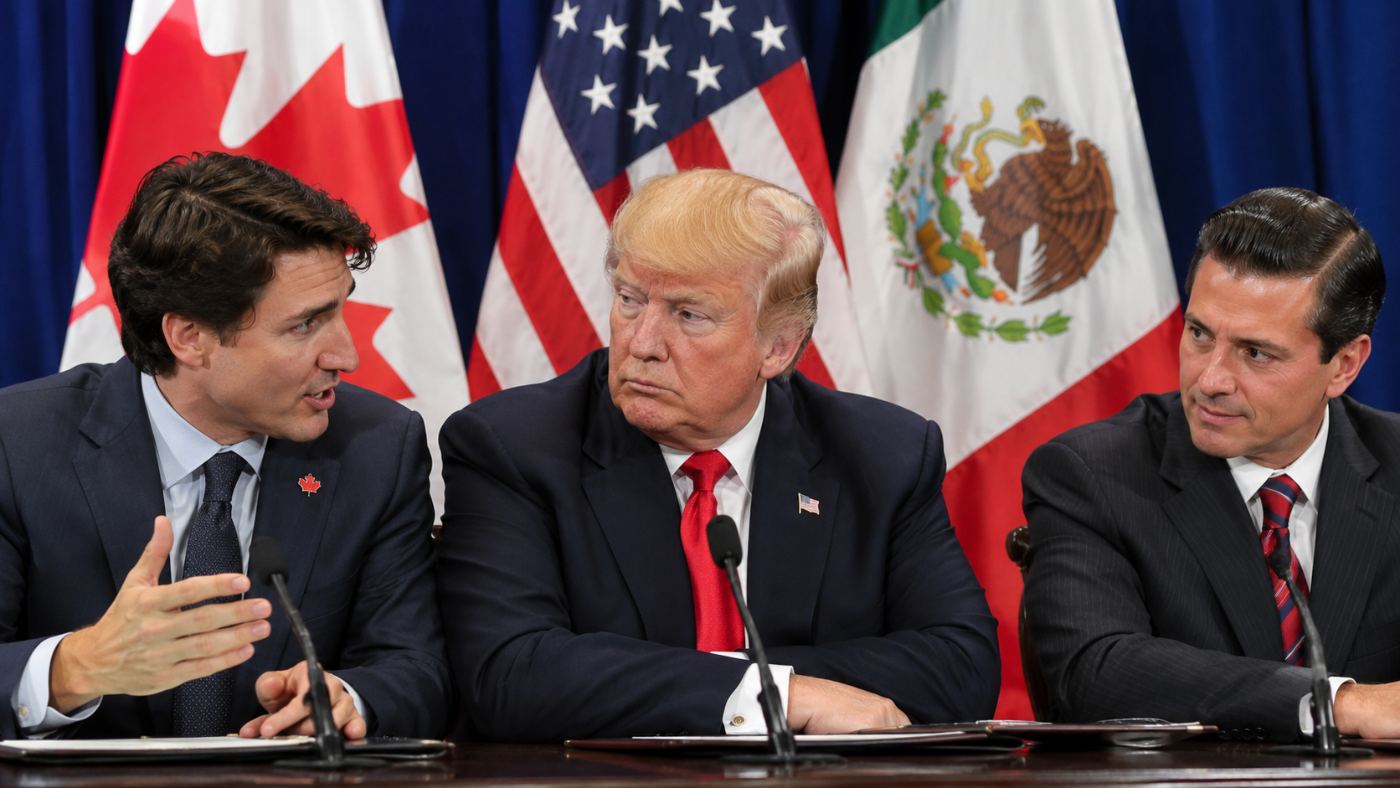
President Donald Trump's celebration of a new North American trade agreement encountered an uncomfortable reality on November 30, 2018, when Canadian Prime Minister Justin Trudeau publicly challenged the president over continuing American tariffs and the loss of thousands of manufacturing jobs.
The confrontation occurred during the signing ceremony for the United States-Mexico-Canada Agreement, or USMCA, at the G20 summit in Buenos Aires.
Trump appeared alongside Trudeau and outgoing Mexican President Enrique Peña Nieto to celebrate the agreement intended to replace the North American Free Trade Agreement, commonly known as NAFTA.
Trump described the deal as a historic achievement that would strengthen manufacturing, expand trade, and benefit workers throughout North America.
But Trudeau used the same ceremony to remind the American president that significant economic problems remained unresolved.
Only days earlier, General Motors had announced a major restructuring involving approximately 14,700 jobs and the planned elimination of production at several North American facilities.
The announcement included the planned closure of the assembly plant in Oshawa, Ontario, along with major changes affecting facilities in Michigan, Ohio, and Maryland.
The news had devastated workers and communities dependent on automobile manufacturing.
Trudeau addressed those losses directly, describing the closures as a serious blow to Canadian and American families.
He then turned his attention to Trump's tariffs on Canadian steel and aluminum.
Speaking directly to the president, Trudeau urged him to remove the trade barriers that continued to strain economic relations between the two countries.
The exchange was notable because Trump had spent much of the ceremony celebrating the agreement's anticipated benefits for manufacturing workers.
He had specifically identified automobile workers as beneficiaries of the new trade arrangement.
Yet General Motors had just announced plans that threatened thousands of jobs across the same industry.
Trump did not address the GM closures during his ceremonial remarks.
Trudeau did.
The Canadian prime minister's comments exposed a central contradiction in the administration's trade policy: even as the United States negotiated a new agreement with its closest trading partners, it continued imposing tariffs on important Canadian and Mexican products.
Earlier in 2018, the Trump administration had imposed tariffs of 25 percent on imported steel and 10 percent on imported aluminum, citing national security concerns.
Canada, one of America's closest military allies and largest trading partners, strongly objected to being treated as a potential national security threat.
Canadian officials argued that the tariffs were unjustified and damaging to industries that operated across the shared border.
Canada responded with retaliatory tariffs on American products, including steel, aluminum, and various consumer goods.
The resulting trade dispute created additional costs and uncertainty for businesses operating in both countries.
Manufacturers that relied on imported metals faced higher expenses, while American exporters confronted retaliatory measures affecting their products.
The automotive industry was particularly vulnerable because vehicles and their components frequently crossed the United States-Canada border multiple times during production.
An automobile assembled in Michigan or Ontario could contain parts manufactured in several different North American locations.
Tariffs on steel and aluminum therefore had consequences extending beyond the companies producing those metals.
They also affected manufacturers purchasing the materials.
The Trump administration defended the tariffs as necessary to protect American steel and aluminum producers, preserve domestic industrial capacity, and address national security concerns.
Supporters argued that protecting those industries would strengthen American manufacturing.
Critics countered that the tariffs increased costs for downstream manufacturers and provoked retaliation against American exports.
The disagreement remained unresolved when the three leaders gathered in Argentina.
Although the USMCA represented a substantial diplomatic achievement after more than a year of difficult negotiations, the steel and aluminum tariffs were not eliminated by the agreement.
That meant Canada and the United States were signing a new free trade arrangement while continuing to impose trade restrictions on one another.
Trudeau's remarks made that contradiction visible before an international audience.
The Canadian prime minister also avoided adopting Trump's preferred branding for the agreement, referring to it as the new North American Free Trade Agreement.
His language emphasized continuity with the existing trading relationship rather than portraying the arrangement as an entirely new economic system.
For Canada, preserving reliable access to the American market had been a central objective throughout the negotiations.
Trump had repeatedly threatened to withdraw from NAFTA, creating uncertainty for businesses and workers whose livelihoods depended on cross-border commerce.
The new agreement reduced some of that uncertainty and introduced updated provisions covering automobile manufacturing, labor standards, digital trade, and agricultural market access.
However, the signing did not immediately put the agreement into effect.
Each country still needed to complete its domestic approval process.
In the United States, Congress would have to consider the agreement, and Democrats were preparing to assume control of the House of Representatives in January 2019.
Lawmakers and labor organizations were already raising questions about enforcement provisions, wages, and environmental protections.
The agreement would ultimately undergo additional negotiations before entering into force in July 2020.
The November 30 ceremony therefore represented an important step, not the completion of every outstanding trade dispute.
The continuing tariffs also complicated Trump's argument that his trade strategy was producing immediate benefits for American workers.
The GM announcement demonstrated that major manufacturing companies were still restructuring operations and eliminating jobs despite the administration's emphasis on industrial revival.
General Motors attributed its decisions to several factors, including changing consumer demand, underused production capacity, and a shift toward electric and autonomous vehicles.
The company also reported significant additional costs associated with tariffs.
It would be inaccurate to attribute all the announced job losses directly to Trump's trade policies.
Nevertheless, the tariffs were among the economic pressures affecting the industry, and their continuation remained a legitimate concern for manufacturers and workers.
Trudeau's public remarks brought those concerns into a ceremony that Trump had intended to showcase as a trade-policy success.
The disagreement also illustrated the broader consequences of using tariffs against close economic allies.
Canada and the United States maintained deeply integrated supply chains, extensive investment relationships, and a long history of economic cooperation.
Measures intended to protect one domestic industry could impose costs on other industries operating within that same trading relationship.
The November 30 exchange demonstrated that signing a trade agreement did not automatically resolve those competing interests.
Trump celebrated the USMCA as evidence that his confrontational negotiating strategy had succeeded.
Trudeau acknowledged the agreement's importance while insisting that the work was unfinished.
The Canadian leader's intervention ensured that the ceremony addressed not only the promises of a new trade arrangement but also the immediate consequences of unresolved economic disputes.
The steel and aluminum tariffs would remain in place for several more months before the United States reached an agreement with Canada and Mexico to remove them in May 2019.
For the historical record, November 30, 2018, captured two realities of Trump's trade policy.
His administration had successfully negotiated a replacement for NAFTA, but significant disagreements with America's closest trading partners remained.
And while Trump celebrated the agreement's anticipated benefits for manufacturing, thousands of North American workers were confronting the possibility of losing their jobs.
Trudeau's public appeal underscored that the signing ceremony was not the end of the trade conflict.
It was another stage in a dispute whose economic consequences extended far beyond the three leaders seated at the negotiating table.