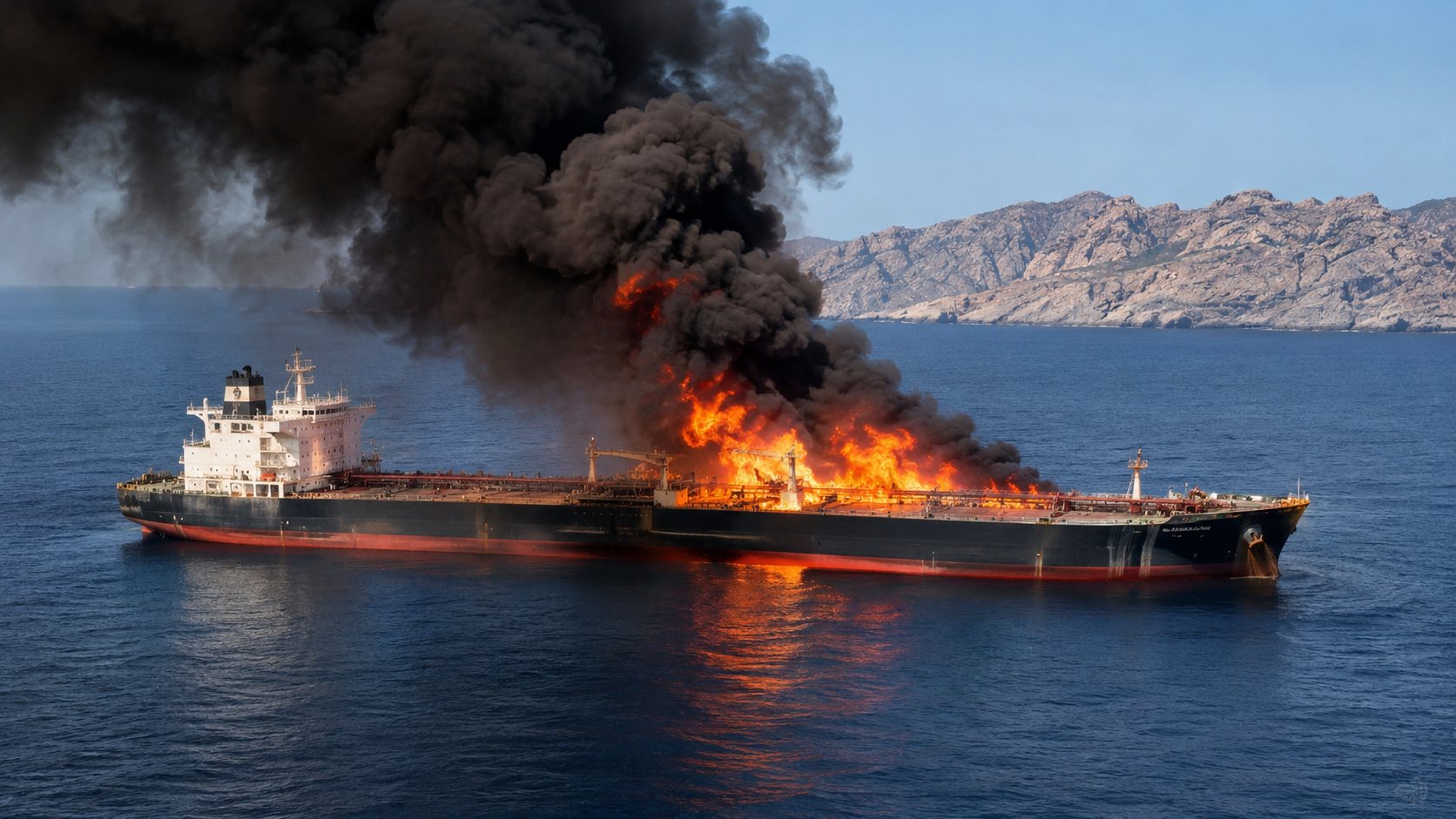
Iran's Revolutionary Guard claims three oil tankers exploded and caught fire in the Strait of Hormuz on Friday, October 30, including a massive supertanker carrying approximately two million barrels of crude oil.
The reported explosions represent another dangerous escalation in the ongoing war involving the United States, Israel, and Iran, threatening one of the world's most important energy transportation routes.
Iranian officials said the vessels struck naval mines while attempting to travel through shipping lanes Tehran considers unauthorized.
However, independent verification of all three reported explosions remains unavailable.
Three Tankers, Millions of Barrels
According to Iranian state media, the Revolutionary Guard reported that two oil tankers caught fire after allegedly striking mines in the strait.
A third vessel, described as a supertanker carrying approximately two million barrels of crude oil, reportedly struck another mine and exploded.
Iran claimed that some vessels had disabled their navigation systems and ignored repeated radio warnings.
The Revolutionary Guard did not identify the three tankers, disclose their nationalities, or provide casualty figures.
The Associated Press and Reuters reported that they could not independently confirm the Iranian military's account.
Separately, Omani authorities evacuated 25 crew members from a burning Panama-flagged tanker near the Musandam Peninsula.
It remains unclear whether that incident was connected to the three explosions claimed by Iran.
The World's Most Dangerous Oil Chokepoint
The Strait of Hormuz connects the Persian Gulf to the Gulf of Oman and the Arabian Sea.
Before the current conflict, approximately one-fifth of the world's petroleum liquids consumption passed through the narrow waterway.
Its importance makes disruptions particularly dangerous for global energy markets.
Since American and Israeli military operations against Iran began on February 28, Tehran has increasingly attempted to control maritime traffic through the strait.
Iranian authorities have demanded that commercial vessels obtain permission before passing through designated routes.
The United States has rejected Iran's restrictions and maintains that internationally recognized shipping lanes should remain accessible.
The result is an increasingly dangerous confrontation involving commercial ships, naval mines, military vessels, and competing claims of maritime authority.
Americans Could Pay the Price
The latest incidents come as oil markets remain unsettled by months of warfare.
Higher crude oil prices can eventually increase gasoline, diesel, transportation, and manufacturing costs.
Those increases affect everything from household commuting expenses to grocery prices.
The Trump administration has repeatedly promised that its military campaign against Iran would bring the conflict toward a conclusion.
Instead, the continued fighting and disruption of shipping have prolonged uncertainty for international energy markets.
The economic consequences extend well beyond the Middle East.
American consumers already dealing with elevated living expenses face additional pressure whenever oil supplies become threatened.
Diplomatic Efforts Continue
The tanker reports emerged as Qatar continued diplomatic efforts aimed at ending the conflict.
Iran also acknowledged receiving a message from Vice President JD Vance, although President Trump characterized the communication as involving humanitarian assistance rather than renewed peace negotiations.
Meanwhile, Iranian authorities separately claimed to have destroyed an American unmanned naval vessel.
U.S. Central Command rejected that assertion, stating that its unmanned surface vessels were accounted for.
A War With No Clear Resolution
The latest developments highlight the difficulty of securing commercial shipping while military operations continue.
The reported destruction of three tankers remains unverified, but confirmed attacks on shipping demonstrate that the danger is real.
The larger question is how long the conflict can continue before its economic consequences become even more severe.
For Americans already struggling with household expenses, instability in the Strait of Hormuz is not simply a distant military development.
It is another potential source of higher prices at home.