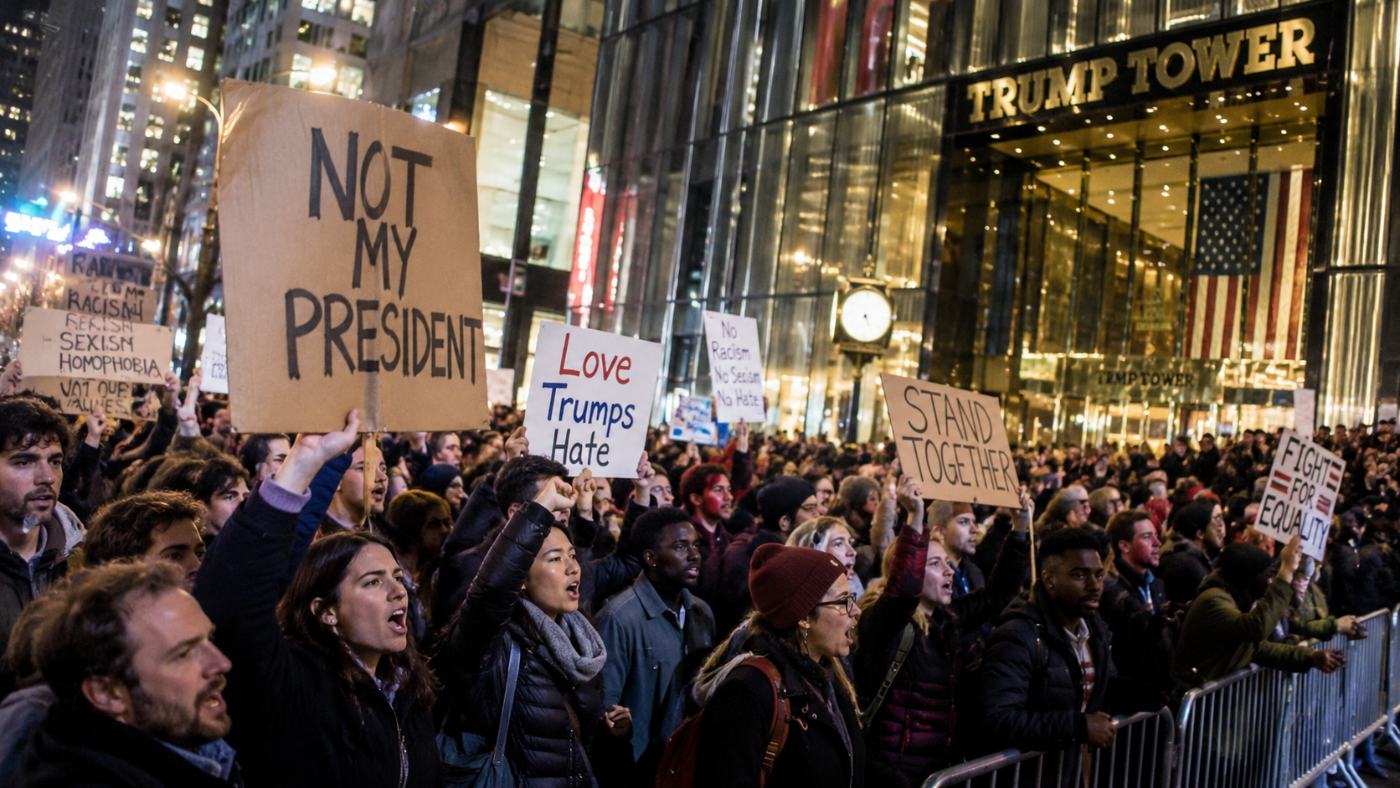
Thousands of Americans are taking to the streets for a second consecutive day, protesting Donald Trump's election as president and expressing fears about what his administration could mean for immigrants, women, Muslims, and minority communities.
Demonstrations have erupted in major cities across the country, including New York, Los Angeles, Chicago, Oakland, Boston, Philadelphia, Seattle, and Washington, D.C.
The protests began Wednesday following Trump's unexpected victory over Hillary Clinton and have continued into Thursday, with demonstrators chanting “Not my president” and demanding that their concerns be heard.
Although most gatherings have remained peaceful, some have resulted in arrests, property damage, and confrontations with police.
Protesters Gather Outside Trump Tower
In New York City, thousands of demonstrators have marched through Manhattan, converging outside Trump Tower on Fifth Avenue.
Police erected barricades around the building as protesters filled surrounding streets, carrying signs condemning Trump's campaign rhetoric and expressing concerns about the incoming administration.
Similar demonstrations have taken place outside Trump-branded properties in Chicago and Washington.
For many participants, the protests are not simply about losing an election. They reflect fears generated by Trump's promises to deport millions of undocumented immigrants, restrict Muslim immigration, and build a wall along the Mexican border.
His campaign statements about women and minority communities have also become rallying points for demonstrators.
California Sees Some of the Largest Demonstrations
In Los Angeles, thousands gathered near City Hall before crowds moved onto the 101 Freeway, temporarily blocking traffic.
Oakland has experienced particularly tense demonstrations.
Police reported that approximately 6,000 protesters participated in Wednesday's demonstrations, during which some individuals smashed windows, started fires, and threw objects at officers.
Police responded with crowd-control measures.
Demonstrations have also occurred in San Francisco, where protesters expressed concerns about civil rights and the direction of the country under Trump.
Authorities emphasize that the majority of participants nationwide have demonstrated peacefully, despite incidents involving smaller groups.
Portland Protest Turns Violent
In Portland, Oregon, thousands of protesters have gathered Thursday evening to condemn the election results.
As the night progresses, police report vandalism, damaged vehicles, and objects being thrown at officers.
Portland police have declared the demonstration a riot after what authorities describe as dangerous and criminal behavior.
The escalation contrasts with peaceful marches occurring elsewhere and has prompted concerns about public safety.
Trump Blames the Media
Rather than acknowledging the protesters' concerns, Trump has responded by accusing the media of encouraging the demonstrations.
In a message posted Thursday evening, the president-elect complained about what he characterized as professional protesters being encouraged by news organizations.
He offered no evidence establishing that the nationwide demonstrations were organized by paid protesters.
The accusation comes only hours after Trump met with President Barack Obama at the White House, where both men publicly emphasized the importance of a peaceful transition.
Trump's response to the demonstrations underscores the political divisions exposed by the election.
A Divided Nation Faces an Uncertain Transition
Trump won the Electoral College despite Clinton appearing likely to receive more votes nationwide, a result that has intensified frustration among some demonstrators.
The protests do not change the election's outcome, but they illustrate the opposition Trump faces before taking office.
For supporters, his victory represents an opportunity to change Washington. For protesters, his campaign promises raise serious questions about civil liberties, immigration enforcement, and equal treatment under the law.
As demonstrations continue across the country, the incoming president faces an immediate challenge: governing a nation in which large numbers of Americans are publicly questioning the direction of his presidency before it has even begun.