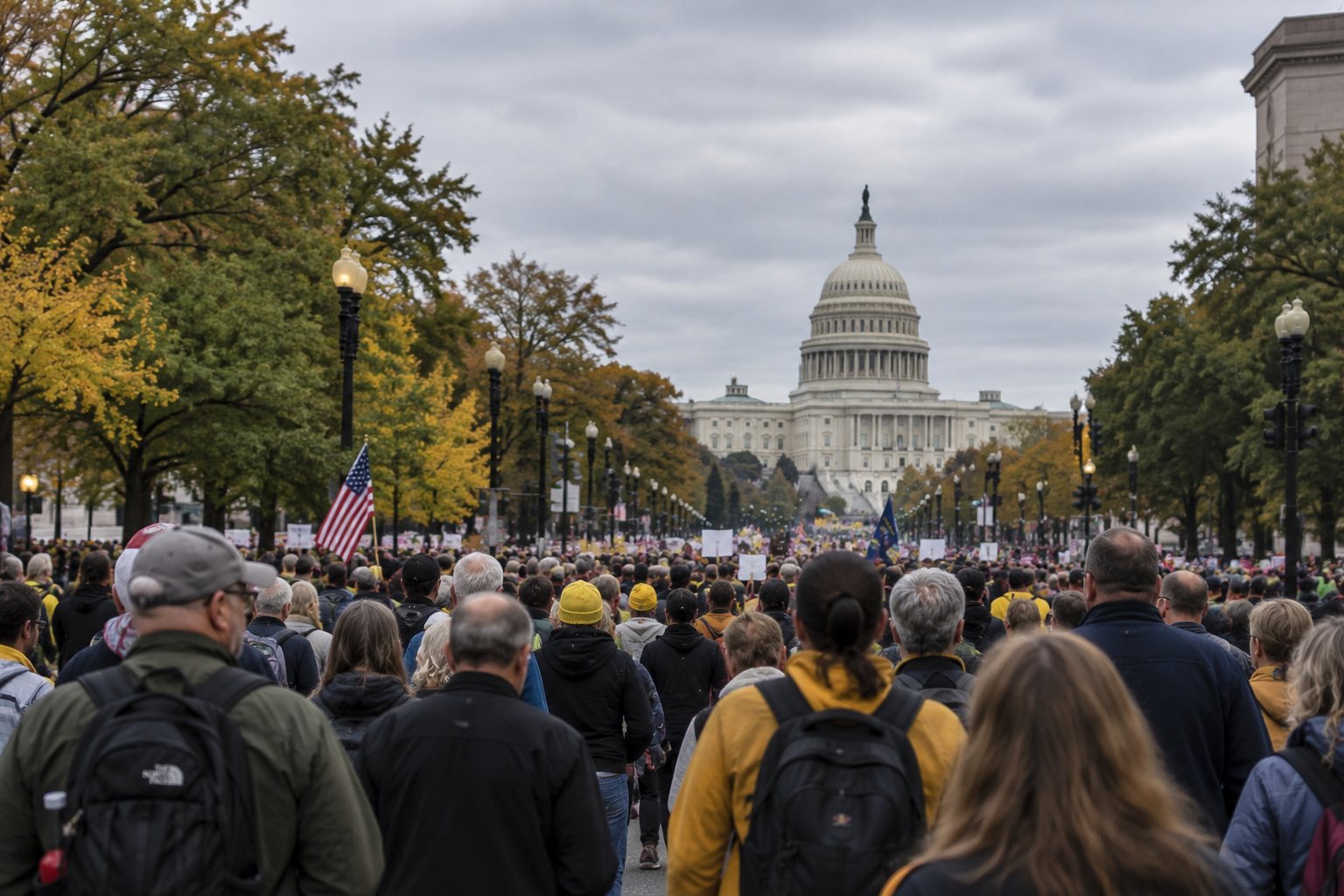
Americans across all 50 states were preparing for a massive wave of demonstrations against President Donald Trump on October 17, 2025, as organizers finalized plans for more than 2,500 protests scheduled for the following day.
The nationwide mobilization, organized under the banner of "No Kings," was intended to challenge what participants described as the Trump administration's increasingly authoritarian approach to governing.
From major metropolitan areas to small rural communities, protesters planned to gather on October 18 to oppose the administration's immigration enforcement operations, deployment of military personnel in American cities, attacks on political opponents, and efforts to expand presidential authority.
The demonstrations were also being organized against the backdrop of a federal government shutdown that had entered its third week, leaving government employees and families facing growing uncertainty.
Organizers expected millions of Americans to participate.
The central message was deliberately simple: The United States elects presidents, not kings.
More Than 2,500 Protests Across America
By October 17, organizers had announced more than 2,500 demonstrations across all 50 states and Washington, D.C., with additional events continuing to be registered.
The coordinated effort included rallies in Washington, New York City, Los Angeles, Chicago, San Francisco, San Diego, Atlanta, Boston, Houston, Honolulu, and numerous other communities.
Unlike a traditional national demonstration centered on Washington, the No Kings movement encouraged participants to organize locally.
The strategy was designed to make participation accessible to people who could not afford to travel to a major city or take time away from work and family obligations.
Small towns and suburban communities were included alongside the nation's largest cities.
The geographic reach was a defining feature of the movement.
Organizers wanted to demonstrate that opposition to the administration was not confined to Democratic strongholds or major metropolitan areas.
More than 200 organizations participated in the broader coalition, including Indivisible, the American Civil Liberties Union, MoveOn, the American Federation of Teachers, Public Citizen, and the Human Rights Campaign.
The coalition brought together labor organizations, civil rights advocates, immigration activists, LGBTQ rights groups, and other organizations with different priorities but shared concerns about the direction of the federal government.
Why the Movement Calls Itself 'No Kings'
The movement's name referred to a fundamental principle of American constitutional government: Political authority is limited by law, and no president possesses the unrestricted power of a monarch.
Organizers argued that Trump's actions during his second administration demonstrated a willingness to test or disregard traditional limits on executive authority.
Their objections included the administration's use of federal law enforcement and military personnel, its confrontations with political opponents, and its approach to immigration enforcement.
The protests also reflected concerns about the independence of federal institutions and the ability of Congress and the courts to restrain presidential power.
The movement's central accusation was political rather than a legal finding that Trump had established a monarchy.
Its supporters believed that the president was exercising executive authority in ways that threatened constitutional checks and balances.
Trump and his administration rejected that characterization, arguing that his policies were legitimate exercises of presidential authority.
In an interview released on October 17, Trump responded to the demonstrations by rejecting the comparison to a monarch.
Nevertheless, the name provided organizers with a recognizable message that connected the protests to the country's founding principles.
Military Deployments Become a Major Source of Anger
One of the most significant issues driving the demonstrations was the Trump administration's use of military personnel in American cities.
Throughout 2025, the administration had pursued controversial deployments of National Guard forces in connection with immigration enforcement operations and domestic unrest.
The actions generated legal disputes and objections from state and local officials who questioned whether the federal government was exceeding its authority.
Critics warned that deploying troops into civilian communities could blur the distinction between military operations and ordinary law enforcement.
They also raised concerns about the political implications of sending federal forces into cities governed by Democrats.
The administration defended the deployments as necessary to protect federal personnel and property, support law enforcement, and respond to threats of disorder.
Opponents argued that the government's response was disproportionate and that military deployments risked escalating tensions rather than resolving them.
For No Kings organizers, the deployments had become a powerful symbol of their broader concerns about executive authority.
The image of military personnel operating in American communities was particularly significant for a movement whose central message opposed the concentration of political power in one individual.
Immigration Enforcement Fuels the Demonstrations
Immigration policy was another major focus of the planned protests.
Since returning to the White House in January 2025, Trump had pursued an aggressive immigration enforcement agenda involving expanded detention, deportation operations, and confrontations with jurisdictions that resisted federal immigration policies.
Supporters of the administration argued that the measures were necessary to enforce immigration law and strengthen border security.
Critics raised concerns about due process, the treatment of detainees, family separations, and the methods used during enforcement operations.
Civil rights organizations challenged aspects of the administration's policies in court.
Immigrant advocacy groups also warned that highly visible enforcement operations were creating fear in communities, including among people legally entitled to remain in the United States.
The No Kings coalition incorporated those concerns into its broader opposition to the administration.
For many prospective participants, the demonstrations represented an opportunity to protest not just immigration policy itself, but also the methods used to implement it.
A Government Shutdown Adds to the Tension
The planned demonstrations came during a federal government shutdown that began on October 1, 2025.
By October 17, the shutdown had lasted more than two weeks, with no immediate resolution in sight.
The impasse centered in part on disputes over federal spending and health insurance subsidies.
Democrats demanded action to extend enhanced Affordable Care Act subsidies, warning that their expiration would increase health insurance costs for millions of Americans.
Republicans argued that the government should reopen through a temporary funding measure before negotiations over additional policy demands continued.
Each party blamed the other for the stalemate.
The consequences extended beyond Washington.
Federal employees faced uncertainty over paychecks, government services were disrupted, and public frustration grew as the shutdown continued.
Organizers of the No Kings demonstrations pointed to the shutdown as another example of political dysfunction under the administration.
The combination of interrupted government operations, military deployments, and aggressive immigration enforcement created a particularly contentious atmosphere ahead of the October 18 protests.
Republican Leaders Condemn the Planned Demonstrations
The protests drew criticism from prominent Republicans before the demonstrations had even begun.
House Speaker Mike Johnson and other Republican figures portrayed the movement as an attack on the country and accused Democrats of encouraging partisan hostility during the shutdown.
Johnson characterized the planned gatherings as a "hate America" rally.
The accusation became part of the political battle surrounding the protests.
Organizers rejected the suggestion that criticizing a president amounted to hostility toward the United States.
They argued that peaceful protest was itself an expression of American constitutional values.
The disagreement highlighted a central question surrounding the demonstrations: whether the movement should be understood as opposition to a particular administration or as opposition to the country itself.
Participants and organizers maintained that their criticism was directed at government actions and policies, not at the nation.
Republican critics, meanwhile, argued that the demonstrations were being used to intensify political divisions and pressure their party during the shutdown.
Organizers Emphasize Peaceful Protest
In preparation for October 18, organizers emphasized nonviolent participation.
The coalition encouraged demonstrators to avoid confrontations and follow local safety guidelines.
Training in de-escalation was provided to help volunteers respond to potential conflicts.
Organizers also asked participants not to bring weapons to the events.
The emphasis on peaceful assembly was important given the politically charged environment surrounding the demonstrations.
Several Republican officials had warned about the possibility of unrest.
In Texas, Governor Greg Abbott announced additional security preparations, including National Guard involvement, ahead of planned demonstrations.
The preparations drew attention to the tension between the right to protest and the government's responsibility to maintain public safety.
Organizers maintained that their events were intended to be peaceful demonstrations of political opposition.
The Second Major 'No Kings' Mobilization of 2025
The October demonstrations followed an earlier nationwide No Kings mobilization held on June 14, 2025.
That first wave coincided with Trump's 79th birthday and a military parade in Washington marking the 250th anniversary of the U.S. Army.
The June demonstrations attracted large crowds across the country.
Organizers estimated that millions participated, although crowd estimates varied and were not uniformly independently verified.
The October events were intended to build on that earlier mobilization.
Rather than treating the June protests as a one-time demonstration, participating organizations sought to establish a continuing national movement.
The second wave also reflected developments that had occurred since the summer, including additional disputes over immigration enforcement, military deployments, and federal spending.
For organizers, the October demonstrations represented an effort to sustain public attention on those issues.
The scale of the planned events suggested that opposition groups had developed a substantial nationwide organizing network.
A Broad Coalition With Different Concerns
Although the demonstrations shared the No Kings name, participants were not united around a single policy demand.
Some were primarily concerned about immigration enforcement.
Others objected to military deployments, threats to civil liberties, changes to federal agencies, or the administration's approach to government accountability.
Labor organizations focused on workers and public services.
Civil rights organizations emphasized constitutional protections and equal treatment under the law.
Other participants viewed the protests as an opportunity to express broader dissatisfaction with Trump's presidency.
The diversity of concerns helped explain the movement's geographic reach.
A protester in a major city might be responding to federal immigration operations, while someone in a smaller community might be more concerned about health care costs, federal employment, or the erosion of institutional safeguards.
The shared message allowed those different concerns to be expressed through one coordinated day of action.
A Test of the Right to Peaceful Assembly
The planned demonstrations also carried significance beyond their immediate political demands.
The First Amendment protects the rights of Americans to speak freely, assemble peacefully, and petition the government for a redress of grievances.
Those protections apply regardless of which political party controls the White House.
The right to protest does not depend on whether the president, Congress, or other government officials agree with the protesters' message.
At the same time, authorities retain responsibility for enforcing laws and protecting public safety.
The challenge for officials overseeing the October 18 events was to accommodate large public gatherings while addressing legitimate safety concerns.
For organizers, the ability to hold demonstrations across the country without intimidation or unnecessary interference was itself an important measure of constitutional freedom.
October 17: The Country Prepares to Demonstrate
As October 17 drew to a close, preparations continued for what organizers expected to be one of the largest coordinated protest days of Trump's second presidency.
Volunteers were finalizing routes, coordinating speakers, distributing information, and preparing local gathering sites.
Participants were encouraged to wear yellow as a visible symbol of solidarity.
The color was intended to create a recognizable identity across thousands of separate demonstrations.
Major cities prepared for large crowds, while smaller communities organized their own events.
The final turnout remained unknown on October 17, but the number of scheduled demonstrations demonstrated the movement's organizational reach.
The protests would also provide a measure of how many Americans were willing to express their opposition publicly, rather than through opinion surveys or social media.
A President Faces a Nationwide Wave of Dissent
The significance of October 17, 2025, lay in the scale of the opposition being organized against a sitting president.
The Trump administration defended its policies as necessary to carry out the agenda voters had elected it to pursue.
The No Kings coalition argued that an electoral victory did not eliminate constitutional limits on presidential power or the public's right to challenge government actions.
Those competing views formed the backdrop to the planned demonstrations.
The protests were not a referendum, an election, or a judicial ruling. They were an exercise of public political expression.
Their importance would depend not only on the number of people who attended but also on whether the movement could maintain its momentum and translate public concern into sustained civic participation.
On October 17, 2025, thousands of communities were preparing to deliver the same message: The presidency is an elected office with constitutional limits, and Americans retain the right to challenge the people who hold it.
The following day would reveal the scale of that mobilization.