For months, there had been an assumption hanging over Donald Trump's presidential campaign.
Eventually, this would end.
Eventually, Republican voters would become serious.
Eventually, one of the governors or senators would take control of the race.
Eventually, Trump would say something so outrageous that even his supporters would abandon him.
Eventually, the joke would be over.
Then Donald Trump won New Hampshire.
And suddenly, the joke wasn't funny anymore.
Nobody Had Ever Seen a Campaign Quite Like This
Donald Trump entered the 2016 presidential race with precisely zero experience in elected office.
He had never been a governor.
He had never served in Congress.
He had never been a mayor.
He had never served in a presidential administration.
He had never held public office at all.
Instead, Americans knew him as a real-estate developer, celebrity businessman and host of The Apprentice.
His business career had also produced decades of controversy.
Companies associated with Trump had gone through multiple corporate bankruptcies. He had been involved in extensive litigation. Trump University was facing lawsuits alleging that customers had been misled about the real-estate education they were purchasing. Trump denied wrongdoing and defended his business record.
To his supporters, none of this disqualified him.
In fact, Trump's complete separation from traditional politics became part of his appeal.
He wasn't another politician.
That was precisely the point.
The Campaign That Was Supposed to Collapse
From almost the moment Trump announced his candidacy in June 2015, predictions of his political demise became a recurring feature of the campaign.
Surely his comments about Mexican immigrants would destroy him.
They didn't.
Surely attacking John McCain's status as a war hero would destroy him.
It didn't.
Surely the confrontation with Megyn Kelly would destroy him.
It didn't.
Surely proposing a ban on Muslims entering the United States would finally make him unacceptable to Republican voters.
It didn't.
Controversies arrived with astonishing regularity.
Yet Trump remained at or near the top of Republican polling.
Political rules that had governed presidential campaigns for decades didn't seem to apply to him in the same way.
But Polls Aren't Votes
There was still one argument available to the skeptics.
Trump hadn't actually won anything.
Polls could measure enthusiasm.
Television ratings could measure curiosity.
Crowds could demonstrate excitement.
None of those things elected a president.
Iowa seemed to reinforce the doubts.
On February 1, 2016, Ted Cruz defeated Trump in the Iowa caucuses.
Perhaps this was finally the moment when Trump's unconventional campaign encountered political reality.
Maybe enormous rallies couldn't replace organization.
Maybe voters liked watching Trump but wouldn't actually vote for him.
Eight days later, New Hampshire answered that question.
Trump Wins
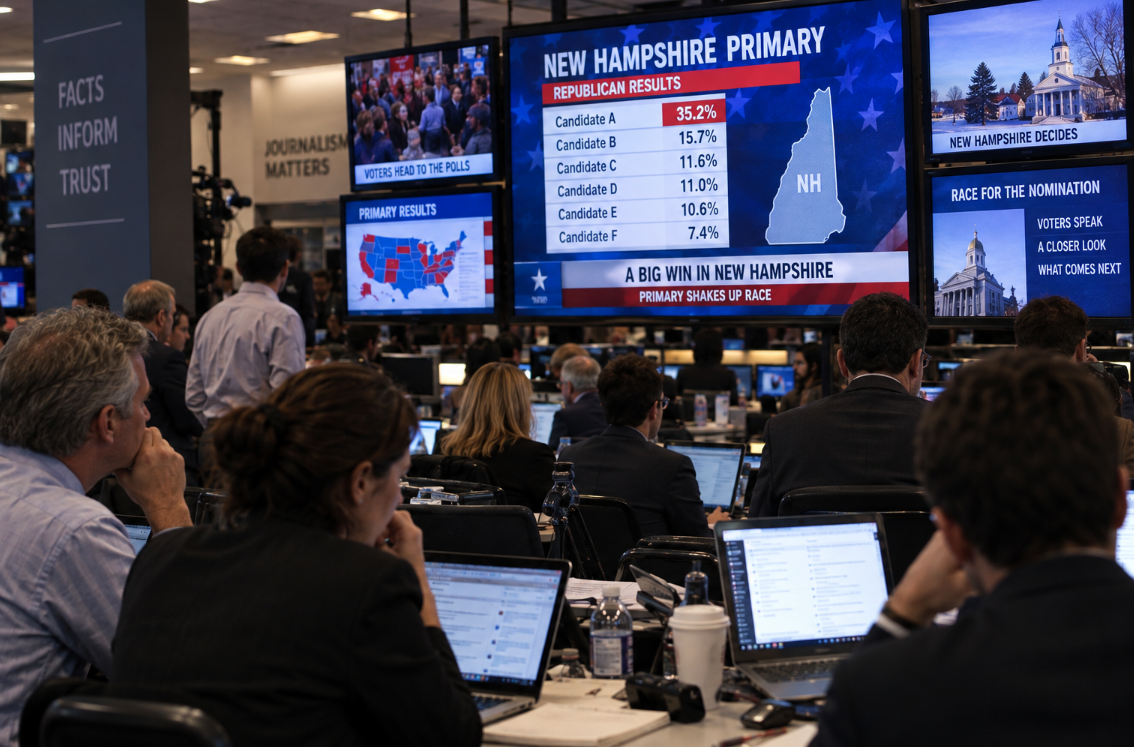
On February 9, Donald Trump won the New Hampshire Republican primary with more than 35 percent of the vote.
His closest competitor, Ohio Governor John Kasich, received less than 16 percent.
Trump didn't squeak through.
He won decisively.
The businessman.
The reality television star.
The candidate with no previous political experience.
The man whose campaign had repeatedly been predicted to implode.
He had just beaten governors and United States senators in an actual presidential primary.
The conversation changed.
The Republican Establishment Suddenly Had a Serious Problem
The Republican field had been filled with candidates who looked far more conventional on paper.
Jeb Bush was a former two-term governor of Florida and the son and brother of presidents.
John Kasich was the sitting governor of Ohio and had spent nearly two decades in Congress.
Chris Christie was governor of New Jersey and a former U.S. attorney.
Marco Rubio was a United States senator.
Ted Cruz was a United States senator.
Trump had never held a government position.
Yet Republican voters were increasingly choosing him.
The assumption had been that eventually the field would narrow and Republican voters would consolidate behind a more conventional candidate.
But what if they didn't?
What if Trump wasn't temporarily disrupting the Republican race?
What if Trump was actually taking it over?
The Media Had to Adjust Too
The news media had struggled with Trump from the beginning.
Was this a presidential campaign?
A celebrity spectacle?
A publicity stunt?
An entertainment story?
Even months into the campaign, questions remained about whether Trump truly had a path to the Republican nomination.
New Hampshire made those questions harder to sustain.
Trump hadn't simply generated attention.
He had converted that attention into votes.
The distinction mattered.
A candidate could be mocked.
A celebrity could be dismissed.
A television personality could be treated as entertainment.
But a candidate winning presidential primaries had to be treated as a potential nominee.
Something Bigger Was Happening
Trump's rise also exposed something political observers had underestimated.
Millions of Republican voters weren't necessarily looking for the candidate with the longest résumé.
Many were angry with Washington.
They distrusted political institutions.
They distrusted the Republican establishment almost as much as they distrusted Democrats.
Trump understood that anger.
When establishment Republicans pointed to his lack of political experience, Trump transformed the criticism into an argument for his candidacy.
The politicians had experience.
Trump argued that those politicians were responsible for the country's problems.
To voters who believed Washington was fundamentally broken, experience inside that system wasn't necessarily an advantage.
It could be evidence against you.
The Moment Disbelief Began Turning Into Reality
New Hampshire didn't guarantee Donald Trump the Republican nomination.
There were dozens of contests remaining.
Ted Cruz had already demonstrated in Iowa that Trump could be beaten.
Marco Rubio, John Kasich and Jeb Bush were still campaigning.
The Republican Party still had time to rally around somebody else.
But something fundamental had changed.
Donald Trump was no longer merely leading polls.
He was winning votes.
He was winning delegates.
And he was defeating politicians who had spent years preparing for exactly this moment.
For months, America had watched Donald Trump's presidential campaign while waiting for it to collapse.
After New Hampshire, a very different question began moving to the center of the 2016 election:
What if Donald Trump could actually win?