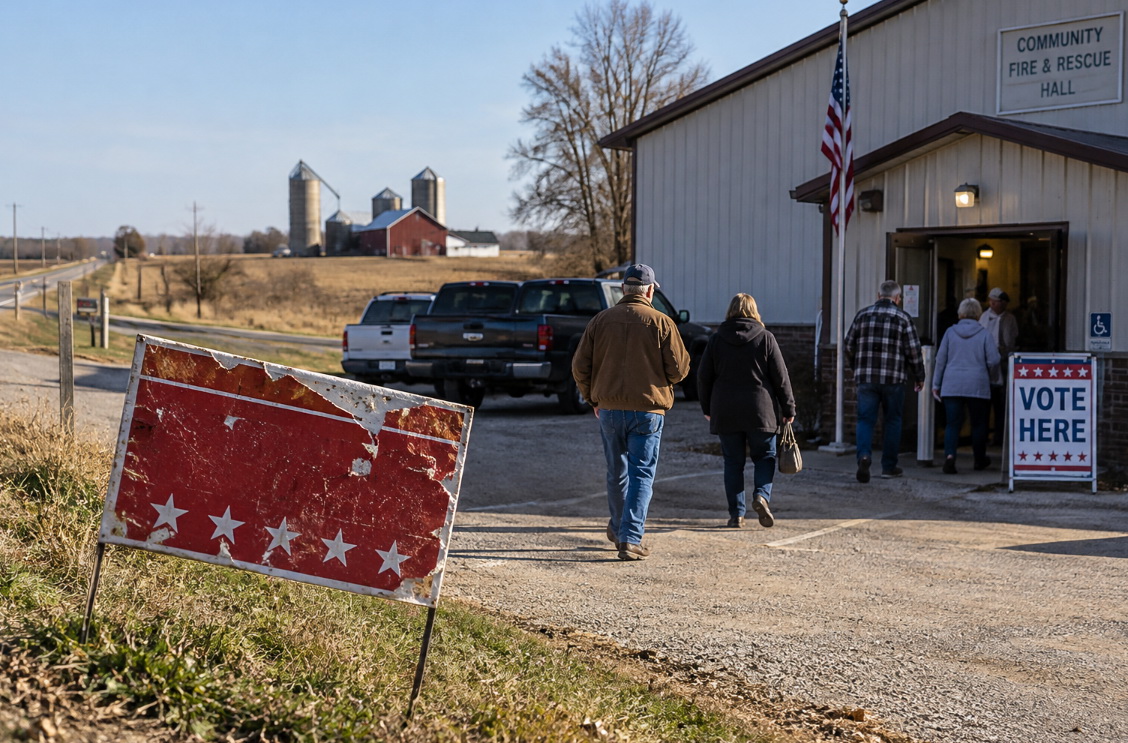
Donald Trump's political coalition is showing cracks.
Not primarily among the die-hard MAGA voters who have supported him for years.
The more significant movement is occurring among some of the voters who helped put him back in the White House in 2024 — independents, moderates, younger voters and others who gave Trump another chance.
Polling of people who voted for Trump in 2024 found that 84 percent still say they would make the same choice if they could vote again.
That means Trump's core support remains substantial.
But it also means roughly one in six of his 2024 voters would not necessarily vote for him again.
And among several politically important groups, the erosion is considerably larger.
THE SWING VOTERS ARE THE PROBLEM
Trump did not win the 2024 election solely because of voters wearing MAGA hats and attending his rallies.
He also improved his performance among voters outside the traditional Republican base.
Those marginal gains mattered.
Now some of those same voters appear to be reconsidering their decision.
According to polling reported by Fortune, approximately 31 percent of independents who voted for Trump in 2024 said they would not vote for him again if given a do-over.
Roughly three in ten political moderates who supported Trump expressed similar reservations.
About a quarter of younger and middle-aged Trump voters indicated they might make a different choice.
That doesn't mean all of these voters have become Democrats.
It doesn't even mean they will necessarily vote Democratic in November.
They could stay home.
They could vote for a third-party candidate.
They could split their tickets.
But in a midterm election, simply losing enthusiasm among voters who supported you in the previous presidential election can become a serious problem for the president's party.
THE ECONOMY WAS SUPPOSED TO BE TRUMP'S STRENGTH
Trump returned to the White House after campaigning heavily on inflation, affordability and the cost of living.
He promised voters that his policies would bring prices under control.
Instead, affordability has become one of his biggest political vulnerabilities.
A new Reuters/Ipsos poll released this week found Trump's overall approval rating at 32 percent.
Even more striking was his rating on the cost of living.
Just 17 percent approved of his handling of the issue.
That matters because Americans consistently identify the cost of living as one of the most important issues affecting their votes.
People don't experience the economy through government press releases.
They experience it at the grocery store.
At the gas pump.
When the rent is due.
When the electric bill arrives.
When they buy insurance.
And when they look at what remains in their bank account after paying everything else.
THE IRAN WAR MADE THINGS HARDER
Trump also campaigned as a president who would keep America out of prolonged foreign wars.
The war with Iran has complicated that promise.
The conflict is now approaching its seventh month.
Energy disruptions associated with the war have pushed fuel costs higher and created additional economic pressure.
That has become particularly visible in agricultural states, where farmers and truckers depend heavily on diesel fuel.
It has also begun creating political problems inside Trump's own party.
Republican candidates who previously supported Trump's Iran policy have begun calling for the conflict to end.
That includes Iowa Senate candidate Ashley Hinson, who this week called for a "successful and immediate end" to the war after repeatedly voting against congressional efforts aimed at removing American forces from the conflict.
The politics are changing because the consequences are becoming harder for voters to ignore.
TRUMP IS LOSING SUPPORT INSIDE HIS OWN PARTY
The newest Reuters/Ipsos numbers contain another warning sign.
Trump's approval among Republicans fell from 82 percent to 73 percent in approximately one week.
Seventy-three percent is still a large majority.
Trump clearly remains the dominant figure in the Republican Party.
But presidents heading into midterm elections generally need their own voters motivated enough to show up.
A Republican voter who dislikes Democrats but is disappointed with Trump does not necessarily need to switch parties to hurt Republicans.
That voter merely needs to stay home.
Midterm elections frequently come down to turnout.
THE MIDTERMS ARE BECOMING A REFERENDUM ON TRUMP
Trump appears to understand that his presidency will dominate the election.
He has reportedly told allies that although his name isn't technically on the ballot, he considers himself effectively on it.
Republican strategists face a difficult balancing act.
They need Trump's most loyal supporters to vote.
But they also need independents and less committed Trump voters who may be increasingly dissatisfied with his presidency.
Those groups are not necessarily responding to the same political message.
Trump can energize one while potentially alienating the other.
Current generic congressional polling reflects that problem.
The latest Economist/YouGov survey shows Democrats holding a double-digit advantage among likely voters.
Other recent national polling has also shown Democrats ahead on the generic congressional ballot.
Those numbers are snapshots, not election results.
Control of Congress will ultimately be decided district by district and state by state, and polling can change substantially before Election Day.
But the direction of the dissatisfaction is difficult to dismiss.
THE COALITION THAT BROUGHT TRUMP BACK
Perhaps the most important lesson from the polling isn't that Trump's MAGA base has suddenly abandoned him.
It hasn't.
More than 90 percent of several groups at the center of Trump's traditional coalition say they would still vote for him again.
The vulnerability lies around the edges.
The independent who decided to give Trump another chance.
The moderate who disliked both candidates but chose Trump.
The younger voter frustrated by prices.
The working-class voter who expected affordability to improve.
Those voters helped expand Trump's coalition enough to return him to the White House.
Now some of them are reconsidering that decision.
And Republicans don't necessarily need millions of Trump voters to become Democrats for that to matter.
They only need enough of them to decide they aren't interested in showing up again.
In a close congressional election, that could be the difference between maintaining a majority and losing it.
Trump's most loyal supporters are still with him.
The more important question heading into November may be whether the voters who gave him another chance are.