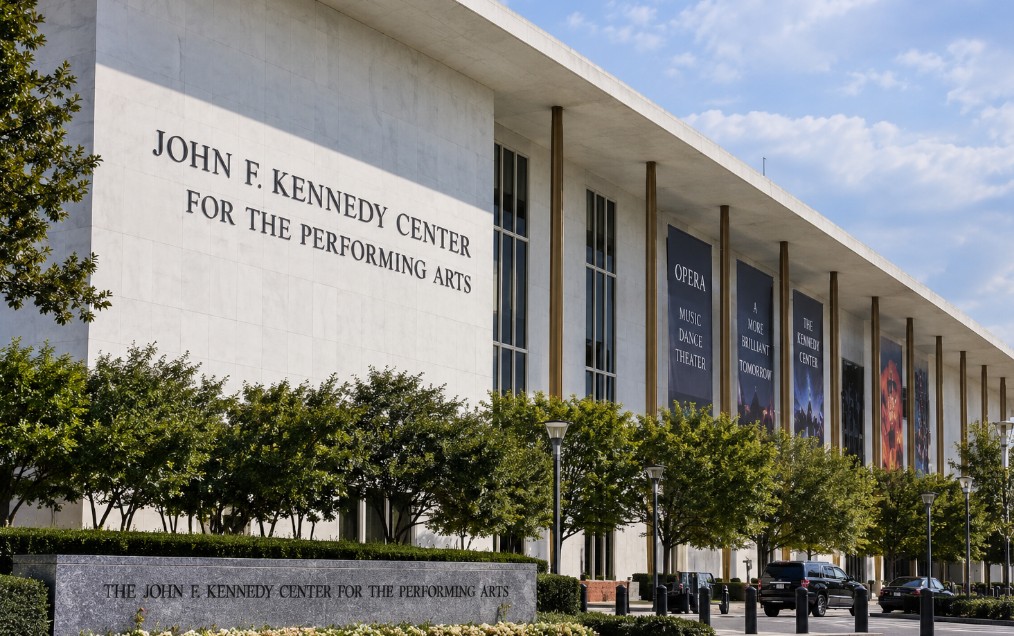
The John F. Kennedy Center for the Performing Arts was created as a living memorial to President John F. Kennedy.
That fact would seem to make one thing fairly straightforward: whose name belongs on the building.
Instead, Washington is now witnessing an increasingly unusual legal and political fight over repeated efforts to put President Donald Trump's name on one of the country's most recognizable cultural institutions.
And the dispute has moved well beyond a simple disagreement over a sign.
A federal judge has now intervened repeatedly. Trump's name was previously installed and then removed. The Kennedy Center's board tried another approach. A proposal emerged to name the surrounding grounds for Trump. And now the center is headed toward a major closure and renovation while the fight over Trump's recognition continues.
At the center of it all is a remarkably basic question:
Why does a memorial to John F. Kennedy need Donald Trump's name on it at all?
Congress Created a Memorial to Kennedy
The Kennedy Center isn't simply a theater that happens to carry Kennedy's name.
Congress established the institution as a national memorial to the 35th president following his assassination in 1963.
Its identity is therefore part of federal law.
That distinction became crucial after Trump returned to office and dramatically reshaped the institution's leadership, eventually becoming chairman of its board.
The Trump-aligned board subsequently moved to add Trump's name to the center.
But there was a problem.
Congress hadn't changed the law.
A federal court eventually ordered Trump's name removed, concluding that the board did not have authority to rename the congressionally established memorial on its own.
That might ordinarily have ended the matter.
It didn't.
Try Again — With Different Words
The board subsequently approved another proposal.
This time, instead of formally changing the Kennedy Center's name, Trump's name would appear beneath the existing signage with an inscription stating that the building had been:
“Restored and Renovated by President Donald J. Trump.”
There was also a proposal to rename the surrounding grounds the President Donald J. Trump Plaza.
The distinction was essentially this: the Kennedy Center itself technically wouldn't be renamed, but Trump's name would still be prominently placed on the building and elsewhere on the property.
Federal Judge Christopher Cooper wasn't persuaded.
On September 15, Cooper again blocked the proposal.
His reasoning was unusually direct.
The government couldn't get around the previous ruling simply by describing the new signage differently.
The court concluded that the Kennedy Center could not install a memorial honoring Trump — or anyone else — without authorization from Congress.
In other words, changing the wording didn't change the underlying legal problem.
Then Things Became Even Stranger
The dispute took another turn when the Kennedy Center board voted to close the main building for renovations shortly after the judge's ruling.
Congress has already allocated approximately $257 million for work on the Kennedy Center.
Trump has argued that the aging building needs substantial repairs and has described its physical condition in dire terms.
There are legitimate questions about the condition of the facility and the extent of renovations it requires.
But the president has also explicitly connected the renovation project with the fight over recognition of his name.
Trump said renovations could not begin until the legal dispute over the board's naming plans was resolved.
That creates an extraordinary situation.
A major American cultural institution named as a memorial to an assassinated president has hundreds of millions of dollars allocated for renovations.
Yet the future of those renovations has become entangled with whether the sitting president receives personal recognition on the building.
The Argument for Trump's Name
Trump and his supporters have offered their own explanation.
Trump argues that he is responsible for rescuing a deteriorating institution and securing the resources necessary to restore it.
He has said the Kennedy Center was in severe financial and physical trouble and that his involvement has made its renovation possible.
The board has similarly argued that Trump's participation is important to fundraising and overseeing the reconstruction project.
If Trump ultimately oversees a successful restoration of the Kennedy Center, supporters argue that acknowledging that contribution would be appropriate.
But recognition for helping renovate a federal building and attaching a president's name to a national memorial are two very different things.
And that distinction is precisely where the courts have intervened.
Imagine Applying This Standard Everywhere
Presidents routinely oversee renovations, construction projects and improvements to federal property.
Congress appropriates money.
Administrations oversee projects.
Buildings are repaired.
Future administrations eventually inherit them.
Ordinarily, those activities don't result in the sitting president's name being carved into the building.
The Kennedy Center makes the issue particularly conspicuous because the building already serves as a memorial.
Its namesake isn't ambiguous.
It's John F. Kennedy.
The institution exists, in part, specifically to preserve that memorial.
A Fight That Didn't Need to Exist
Nothing prevents an administration from renovating the Kennedy Center.
Nothing prevents Trump from advocating for repairs.
Nothing prevents the government from spending money maintaining one of America's major performing-arts institutions.
And nothing prevents historians from documenting Trump's role in whatever renovation ultimately takes place.
The controversy exists because those things became connected to something entirely different:
putting Donald Trump's name on a memorial dedicated to John F. Kennedy.
The board tried renaming the institution.
The courts intervened.
Trump's name came down.
The board then proposed an inscription.
It proposed Trump Plaza.
The court intervened again.
Now the institution faces a lengthy closure while the dispute continues.
Whatever one thinks of Donald Trump, John F. Kennedy, or the politics surrounding the Kennedy Center, the sequence illustrates how a relatively ordinary federal renovation project became something far larger.
The Kennedy Center already had a name.
It already had a purpose.
And it already had a president it was built to memorialize.
That president was John F. Kennedy.