For months, Persian Gulf oil producers have managed to accomplish something that once looked nearly impossible.
They found ways to keep millions of barrels of oil moving despite the war with Iran and the continuing danger surrounding the Strait of Hormuz.
But now the workaround itself is becoming a problem.
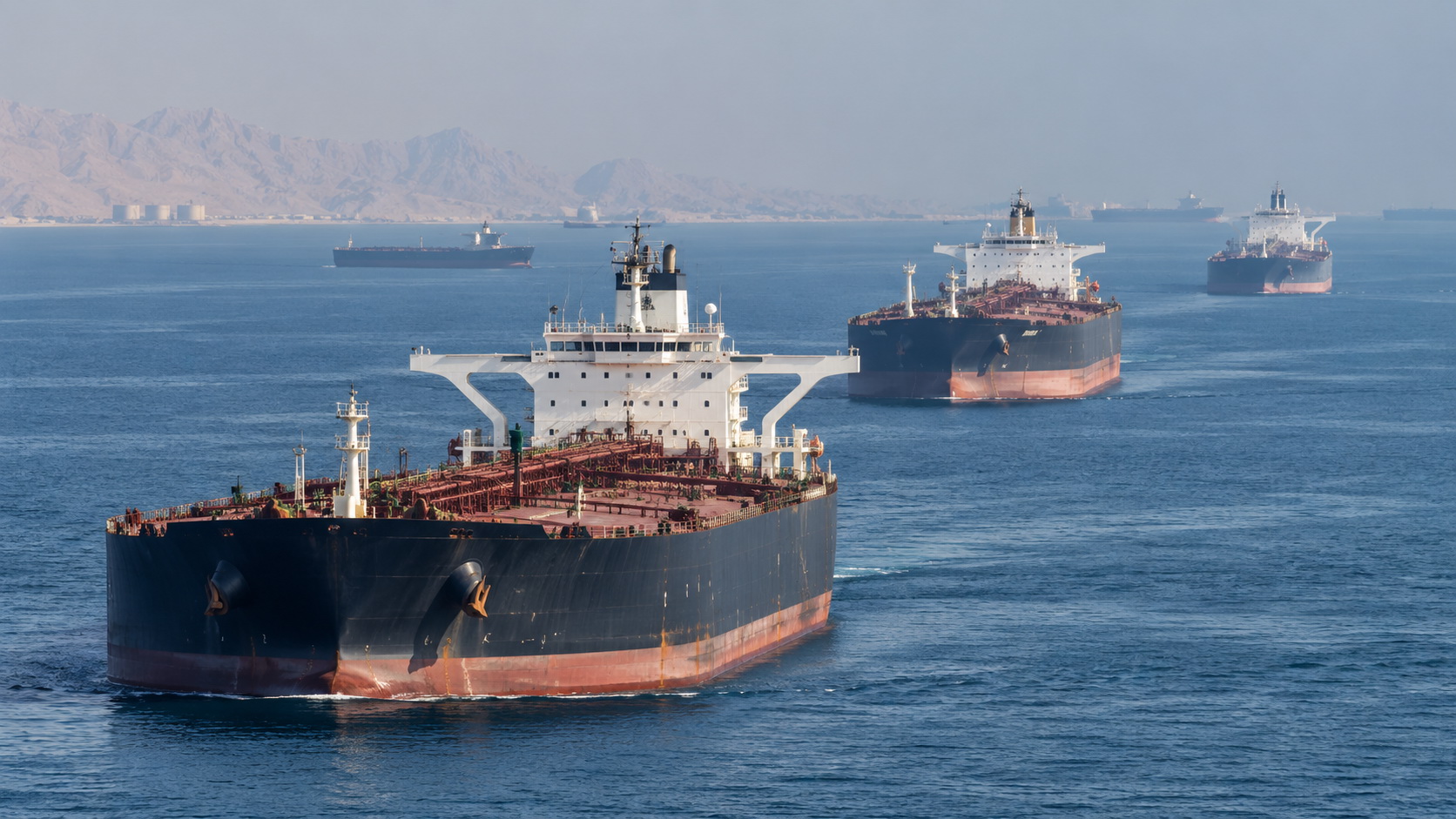
A massive tanker bottleneck outside the Strait has become so congested that oil companies are beginning to move ship-to-ship crude transfers hundreds of miles farther east — all the way to the western coast of India.
It is the latest sign that while Gulf oil exports have recovered dramatically since the beginning of the war, the system keeping those barrels moving remains expensive, complicated and remarkably fragile.
The Oil Is Moving Again
On the surface, the latest numbers actually look encouraging.
Crude shipments from the Persian Gulf have rebounded significantly from the collapse that followed the outbreak of war in February.
Kpler estimated crude flows through the Strait of Hormuz at nearly 12.5 million barrels per day during the week ending September 27, compared with roughly 13.5 million barrels per day before the war.
When alternative export routes and tankers operating without publicly broadcasting their positions are included, Goldman Sachs estimated total Gulf oil exports at approximately 23.3 million barrels per day last week.
That's an extraordinary recovery considering what happened earlier this year.
But those headline numbers conceal the increasingly complicated logistics required to make them possible.
The Tanker Shuttle
One of the most important adaptations has been a maritime relay system.
Instead of every tanker carrying oil from a Persian Gulf terminal through Hormuz and continuing thousands of miles to its final customer, some vessels now operate more like shuttle trucks.
A tanker loads crude inside the Persian Gulf.
It makes the dangerous passage through Hormuz.
Once it reaches relatively safer waters outside the Strait, it meets another tanker.
The two enormous vessels pull alongside one another at sea.
The crude is pumped from one ship to the other.
The receiving tanker then carries the oil toward customers in Asia while the shuttle tanker can return toward the Gulf for another cargo.
These are known as ship-to-ship transfers, or STS operations.
They have become one of the mechanisms helping Gulf exporters maintain oil flows despite the war.
There is just one problem.
Too many ships are now trying to use the system.
The Gulf of Oman Is Running Out of Room
Most of these transfers have taken place relatively close to the Strait, particularly in waters near Oman and the United Arab Emirates.
Those transfer areas are now becoming overwhelmed.
Vortexa analyst Emma Li recently described worsening congestion caused by long queues of tankers waiting to perform transfers.
Operations that once required roughly five to seven days have stretched toward considerably longer waits in some areas.
That matters enormously when the vessels involved are some of the largest ships on Earth.
A Very Large Crude Carrier — or VLCC — can carry roughly 2 million barrels of oil.
Every additional day one of those ships sits waiting is another day it cannot load another cargo.
And when enough tankers begin waiting simultaneously, the problem spreads through the entire supply chain.
So They're Going to India
The solution is remarkable.
Move the transfer operation somewhere else.
The Gulf of Kutch, off India's western state of Gujarat, has begun emerging as a new transfer point for Persian Gulf crude.
Tanker-tracking data reviewed by Bloomberg and Vortexa showed two supertankers recently transferring Gulf crude onto other VLCCs there.
The receiving ships then headed east toward Asian markets including Singapore and South Korea.
At least two additional VLCCs were conducting similar transfers in the area.
According to Bloomberg, these were the first eastbound Gulf crude transfers observed there since the Iran war began.
Lloyd's List Intelligence has identified an even broader shift.
It found 13 former Hormuz shuttle VLCCs delivering Saudi crude directly to India or conducting transfers off India's western coast during September.
A system originally concentrated immediately outside Hormuz is beginning to spread across the Arabian Sea.
Why Go Hundreds of Miles Farther?
At first glance, moving oil all the way toward India just to transfer it onto another ship sounds inefficient.
And under normal circumstances, it would be.
These aren't normal circumstances.
Moving the transfer point farther from Hormuz offers several advantages.
It gets tankers away from the growing queues off Oman.
It allows shuttle vessels to unload their cargoes without waiting days for an available transfer slot.
It can free tankers to return toward the Gulf more quickly.
And perhaps most importantly, it moves the transfer operation farther away from the war zone.
Ships operating around Hormuz have faced missile and drone attacks, military activity and the continuing possibility that fighting could again dramatically restrict commercial traffic.
Western India provides considerably more distance from that danger.
The downside is obvious.
Oil now has to travel farther before it can even begin the normal journey to its final customer.
Saudi Arabia Has Made the Traffic Jam Worse
Another development has added even more pressure.
Saudi Arabia possesses something most Persian Gulf producers desperately wish they had: a major alternative route that can move crude without passing through Hormuz.
The kingdom's East-West pipeline carries oil across Saudi Arabia to the Red Sea port of Yanbu.
That route became enormously valuable after the war began.
But attacks and security threats associated with Yemen's Houthi movement have complicated Saudi Arabia's western export route.
As a result, Saudi Arabia has pushed more oil back toward the Persian Gulf and Hormuz.
Saudi crude exports through Hormuz reportedly climbed to approximately 3.6 million barrels per day in September.
That additional oil entered a tanker-transfer network that was already approaching its limits.
The result is exactly what might be expected:
More ships.
More waiting.
More transfers.
And higher costs.
A Supertanker Can Now Cost More Than $1 Million a Day
Those costs are becoming staggering.
The price of hiring a supertanker has climbed above $1 million per day on some routes amid intense demand for vessels.
That is an extraordinary amount of money simply to rent transportation.
And ultimately somebody has to pay it.
Oil producers can absorb some of the cost.
Refiners can absorb some.
Shipping companies can negotiate around it.
But eventually transportation costs become part of the price of getting crude oil to a refinery.
Saudi Aramco has reportedly even considered offering discounts on some crude cargoes transferred near Oman to compensate buyers for soaring freight costs.
The oil may be flowing.
Getting it where it needs to go is becoming extremely expensive.
The Recovery Is Real — But So Is the Fragility
There is an important distinction here.
The Strait of Hormuz is no longer experiencing anything resembling the near-shutdown seen earlier in the war.
Oil producers, tanker operators, governments and militaries have adapted.
Pipelines are carrying more oil.
Tankers are making carefully managed passages.
Some ships travel without publicly broadcasting their locations.
The U.S. Navy has helped secure shipping routes.
And ship-to-ship transfers have created an improvised maritime logistics network capable of moving enormous quantities of crude.
That adaptation is one reason the feared complete collapse of Persian Gulf oil exports never became permanent.
But resilience shouldn't be confused with normality.
Before the war, a tanker could load crude and sail toward its destination.
Now some cargoes may involve one vessel entering the Gulf, another operating as a shuttle, a transfer outside Hormuz and potentially another transfer hundreds of miles away near India.
Every additional step introduces another opportunity for delay.
Another tanker is required.
Another crew is required.
Another transfer has to be coordinated.
Another insurance risk must be priced.
And another cost gets added to every barrel.
Refined Fuels Remain an Even Bigger Problem
There is another reason not to declare the Hormuz crisis solved.
Crude oil shipments have recovered much faster than shipments of refined petroleum products.
Before the war, roughly 3.6 million barrels per day of refined products moved through the Strait.
Recent flows have been dramatically lower.
That includes products such as diesel — precisely the fuels consumers and industries actually use.
Refineries and export infrastructure damaged during the conflict cannot be replaced by clever tanker scheduling.
You can move crude oil around a bottleneck.
You cannot easily replace damaged refining capacity.
That helps explain why fuel markets remain under pressure even as crude-export statistics increasingly resemble their prewar levels.
The Oil Map Is Being Redrawn in Real Time
Seven months of war have forced the global petroleum industry to redesign one of the world's most important supply chains while it is still operating.
The new map now stretches far beyond the Strait of Hormuz.
Oil can travel across Saudi Arabia by pipeline.
It can leave through terminals outside the Strait.
It can move aboard shuttle tankers through dangerous waters.
It can be transferred off Oman.
And now it can travel hundreds of miles across the Arabian Sea before being transferred again off India.
All of this is working.
For now.
But the fact that Gulf crude must increasingly be transferred from one supertanker to another off the coast of India isn't evidence that the Hormuz crisis has disappeared.
It's evidence of how extraordinary the effort to work around it has become.
The world has managed to keep the oil moving.
The growing tanker traffic jam shows just how difficult keeping it moving is becoming.