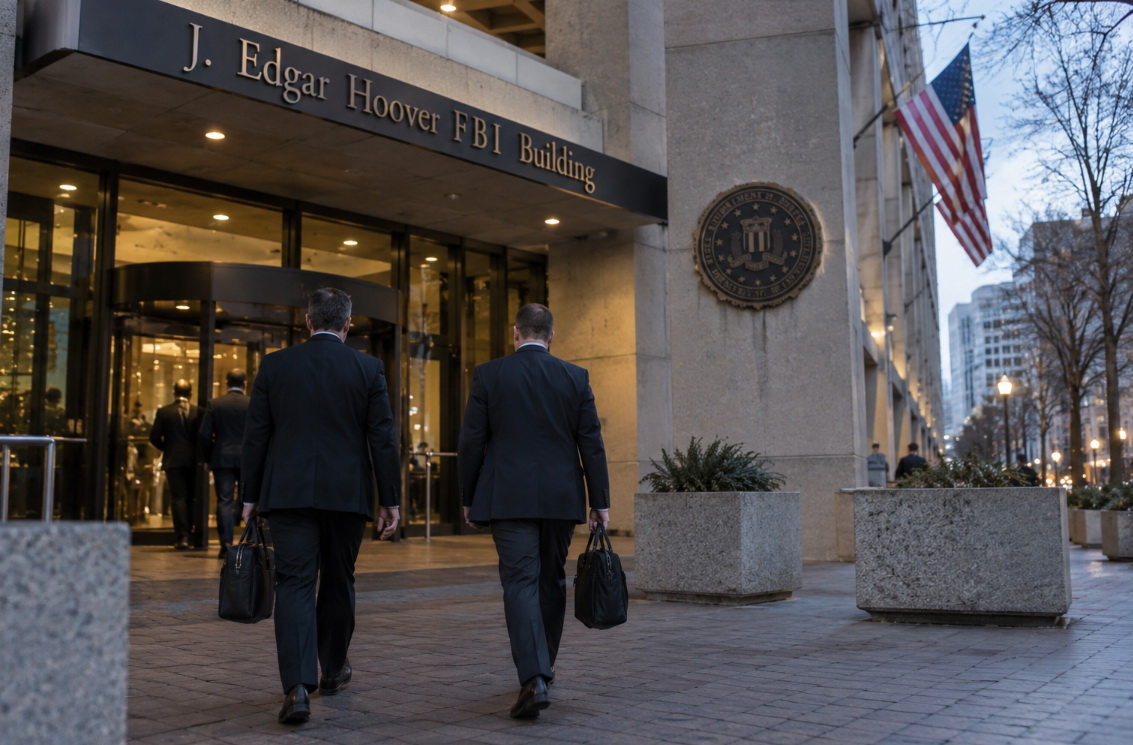
Former acting FBI Director Andrew McCabe revealed an extraordinary fact about the investigation surrounding President Donald Trump and Russia: after Trump fired FBI Director James Comey in May 2017, the FBI opened a counterintelligence investigation examining whether the president himself might have been acting on behalf of the Russian government.
It is important to be precise about what that means.
McCabe did not say that the FBI had determined Trump was working for Russia.
But he also did not say that investigators had examined the question and determined that he was not.
He said the FBI believed the circumstances were serious enough that the question had to be investigated.
In an interview with CBS's 60 Minutes, McCabe explained that investigators were examining two fundamental questions after Comey's firing.
First, had Trump fired Comey in an effort to interfere with the investigation into Russian interference in the 2016 election?
And second, if he had, was Trump acting on behalf of the Russian government?
That second question transformed the matter from a potential obstruction-of-justice investigation into something even more extraordinary: a counterintelligence investigation involving the sitting president of the United States.
McCabe described the concern as a possible national-security threat.
The FBI's concern did not arise from a single event.
Trump had asked Comey to end the investigation of National Security Adviser Michael Flynn. He had repeatedly attacked the Russia investigation as a “witch hunt.” He fired Comey while the investigation was underway. Trump then publicly connected Comey's dismissal to the Russia investigation.
For counterintelligence investigators, McCabe said, those events raised an unavoidable question.
Why?
Why would the president take actions that investigators believed could hinder an investigation into Russian interference in an American election?
McCabe said those circumstances caused investigators to consider whether there might be an inappropriate connection between Trump and the Russian government.
That was not a conclusion.
It was an investigative question.
But it was a question serious enough for the FBI to formally investigate.
McCabe said he moved quickly because he feared the Russia investigation itself could disappear if he were fired or removed.
He wanted the investigation placed on what he called “solid ground” so that anyone attempting to shut it down would leave a documented record of doing so.
The investigation soon passed into the hands of Special Counsel Robert Mueller, who was appointed days after Comey's firing.
McCabe's February 2019 interview therefore revealed something the public had not fully understood when the Russia investigation began.
The FBI wasn't merely investigating Russian election interference and people surrounding Trump's campaign.
For a period of time, investigators were examining the actions of the president himself through a counterintelligence lens.
And McCabe's interview did not provide the simple resolution that Trump's defenders might have wanted.
He did not announce that investigators had ultimately determined Trump was secretly working for Moscow.
But neither did he announce that the counterintelligence question had been investigated and definitively resolved in Trump's favor.
Those are two very different statements.
An investigation is not proof of guilt. The fact that the FBI investigated whether Trump was acting on Russia's behalf does not establish that he was.
But the fact that senior FBI officials believed the possibility warranted a counterintelligence investigation was itself historically extraordinary.
The FBI had reached a point where one of the questions being asked inside the United States government was almost unimaginable:
Was the president's conduct simply political and self-protective?
Or was there something more behind his relationship with Russia?
McCabe's revelation showed that, in 2017, the FBI considered that question serious enough to investigate.