Donald Trump still occupies the most powerful office in the United States.
But increasingly, Washington is confronting a reality that Trump has spent much of his second presidency trying to avoid:
The clock is running.
Trump cannot constitutionally be elected president again under the 22nd Amendment, and with the November midterm elections approaching, politicians, donors, foreign governments and even members of his own party have growing reason to think about what comes after him.
That doesn't mean Trump has suddenly become powerless. Far from it.
But the political phenomenon every second-term president eventually confronts — lame-duck status — is beginning to hang over a presidency that has always depended heavily on Trump's ability to make Republicans fear the consequences of crossing him.
And there are signs that grip isn't quite what it once was.
Republicans Have Started Saying No
For years, Republican lawmakers had an obvious incentive to stay in Trump's good graces.
He could endorse primary challengers. He could attack Republicans publicly. He could turn MAGA voters against them.
Trump retains considerable influence over the Republican Party, particularly with its base.
But Reuters reported earlier this year that some Republicans in Congress had begun defying the president on portions of his agenda. A presidential adviser acknowledged that Trump's leverage would naturally diminish, particularly after the midterms.
That is the fundamental problem facing every lame-duck president.
At some point, politicians stop asking what the president can do for them today and start calculating where political power will reside tomorrow.
For Trump, that transition may be particularly difficult.
The Midterms Could Change Everything
The November elections represent a major test of Trump's remaining political leverage.
A Reuters/Ipsos poll released this month found Trump's job approval at 35 percent, up slightly from 33 percent in late August.
The same poll found Democrats ahead 44 percent to 37 percent when voters were asked which party they would support for Congress.
Those numbers are snapshots, not predictions of what will happen on Election Day.
But they help explain why the White House and Republican leaders are treating the midterms so seriously.
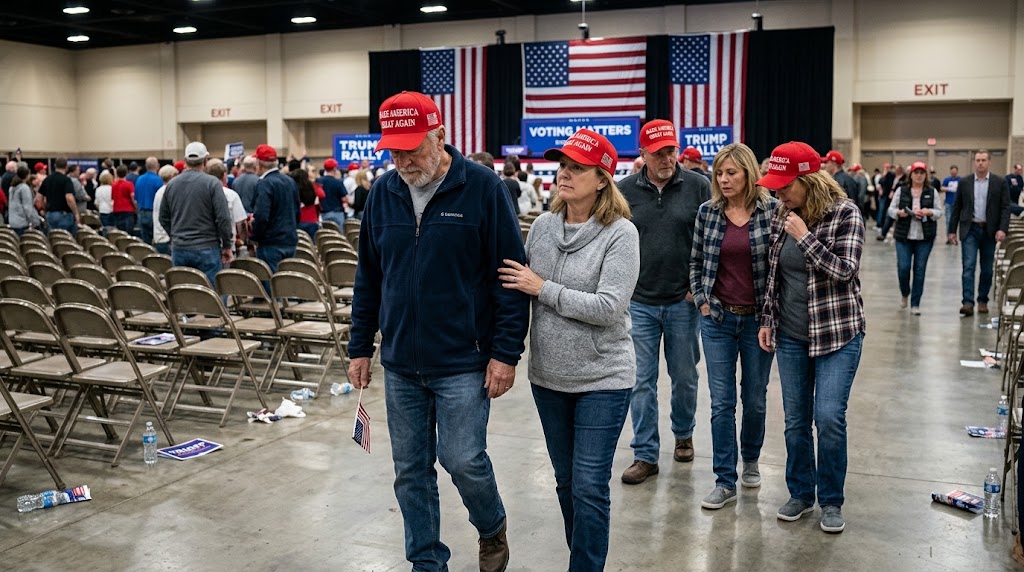
Trump himself made the stakes unusually explicit during the Republican midterm convention in Dallas, urging supporters to behave as though his own name were on the ballot.
It isn't.
But the future of his presidency effectively is.
If Republicans retain congressional control, Trump would have a considerably easier path for advancing his agenda during his remaining time in office.
If Democrats capture one or both chambers, they could gain congressional investigative powers and the ability to block substantial portions of his legislative agenda.
Either way, once the election is finished, another clock begins ticking.
The 2028 presidential campaign will gradually become more important.
Potential Republican successors will begin establishing their own identities.
Donors will start thinking about the next candidate.
And Republicans currently terrified of Trump's political retaliation may eventually discover that his ability to punish them has an expiration date.
Trump Has Tried to Keep the Third-Term Question Alive
Perhaps nothing demonstrates Trump's sensitivity to lame-duck status better than his repeated flirtation with the idea of another presidential campaign.
The Constitution is straightforward: a person cannot be elected president more than twice.
Yet Trump has repeatedly entertained discussion about 2028.
Reuters reported in June that Trump had privately told staffers that one reason he had mused about a third term was to prevent the perception that he was becoming a lame duck.
Whether Trump seriously intends to challenge the constitutional limit is a separate question.
Politically, however, keeping the possibility alive serves an obvious purpose.
As long as Republicans believe Trump might somehow remain at the center of presidential politics beyond 2028, they have another reason to remain loyal.
The moment everyone accepts that Trump is leaving, the calculations begin to change.
The Iran War Has Complicated the Picture
Trump's political problems have also become intertwined with the continuing war with Iran.
The conflict has stretched into its seventh month, despite Trump's earlier predictions of a much shorter confrontation.
Reuters reported this week that the war has contributed to higher gasoline prices, strained American military resources and created friction with traditional U.S. allies.
It has also given Trump another major political problem heading into November.
Trump once presented himself as the president who would keep America out of prolonged foreign conflicts.
Instead, he now heads toward the midterms with American forces engaged in exactly the kind of open-ended Middle Eastern conflict he repeatedly criticized before returning to office.
The Presidency Remains Powerful
None of this means Trump should be dismissed.
Even a politically weakened president retains enormous constitutional authority.
Trump can issue executive orders, conduct foreign policy, command the military, veto legislation, make appointments and exercise the countless powers available to the executive branch.
He also remains an extraordinarily influential figure within Republican politics.
That distinction matters.
Being a lame duck doesn't mean being irrelevant.
It means everyone knows there is an end date.
And for a political movement built so completely around one man, that creates an unusual problem.
Eventually, Republicans Have to Think Beyond Trump
Trump transformed the Republican Party largely because Republican politicians learned that opposing him could end their careers.
But political fear depends on political power.
Every passing month brings Trump closer to January 20, 2029.
Every approaching election encourages Republicans to think about who will inherit the party.
Every court defeat, congressional rebellion and policy setback reminds Washington that even Donald Trump's presidency has limits.
Trump can insist that he remains the center of American politics.
For now, he largely does.
But he cannot stop the calendar.
And increasingly, Washington is beginning to look at what comes next.