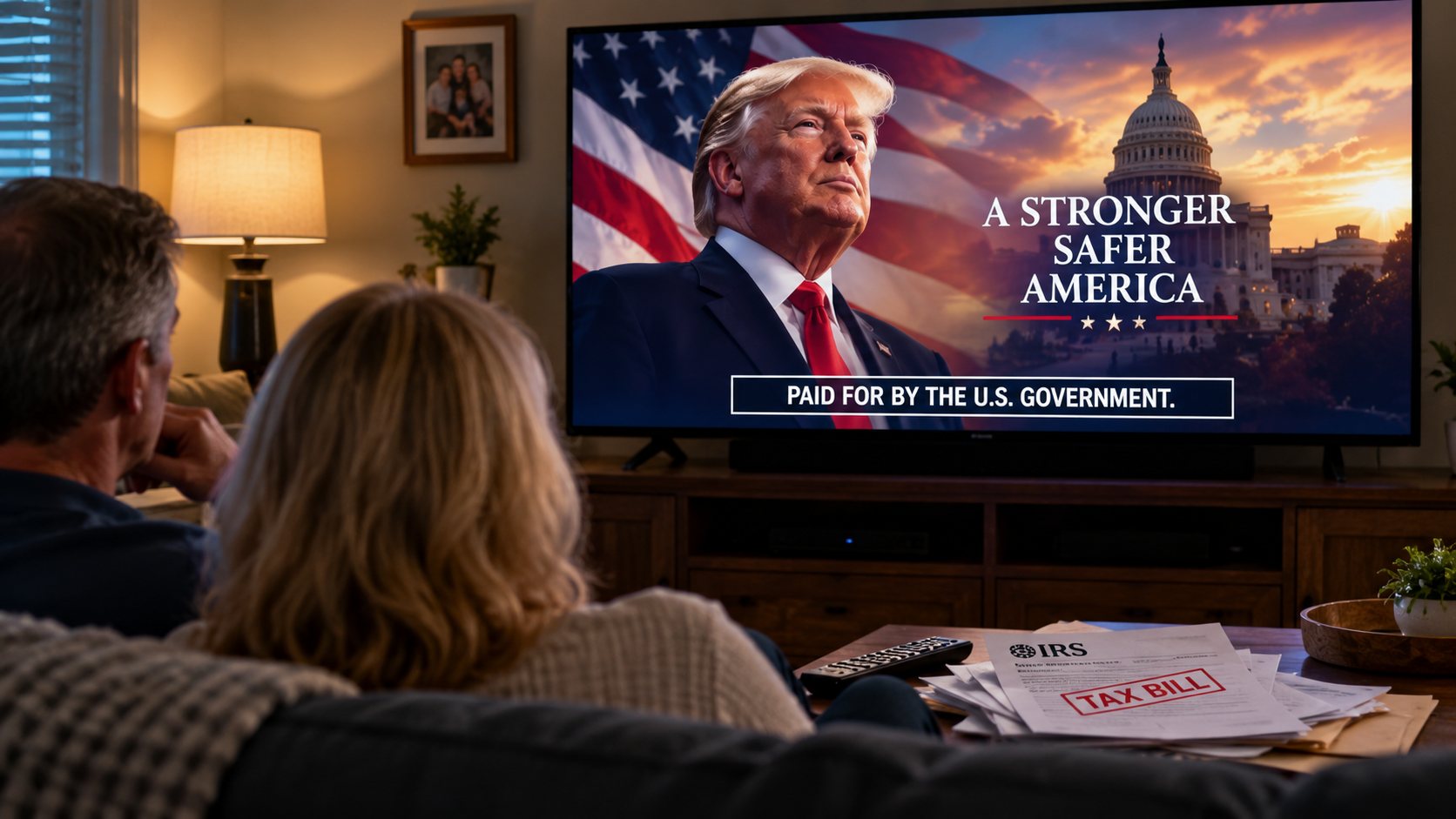
The United States government is spending millions of taxpayer dollars on television advertisements celebrating Donald Trump — including one portraying the president as a man chosen by God to save the country.
No, this isn't a Trump campaign advertisement.
At least technically.
It's being paid for by the federal government.
The Trump administration has produced at least 13 campaign-style advertisements promoting the president, his policies, his personal story and even his political battles.
Some feature military imagery.
Some celebrate Trump's presidency.
One compares him to a lion.
Another recounts his personal rise from New York real-estate developer to president.
And then there is “God Made Trump.”
That advertisement portrays Trump in almost biblical terms, presenting him as the leader America needed during a moment of national crisis.
CNN anchor Kaitlan Collins played portions of the government's advertisements during her program this week before pointing out the unusual fact behind all of them.
American taxpayers are paying the bill.
“Paid for by the U.S. Government”
The advertisements don't hide where the money is coming from.
At the end of the videos appears a disclosure:
Paid for by the U.S. Government.
Approximately $20 million in federal money has been allocated for the advertising effort.
Ad-tracking firm AdImpact estimates that at least $2.5 million has already been spent airing the advertisements.
And the money isn't coming from Trump's campaign.
It isn't coming from the Republican National Committee.
It isn't coming from MAGA Inc.
It is taxpayer money.
Reporting by CNN, The Washington Post and the Associated Press indicates that funding for the advertisements was transferred from money allocated to the Department of Homeland Security and Customs and Border Protection.
That has prompted an obvious question:
Why are taxpayers paying for advertisements celebrating the president?
“God Made Trump”
Perhaps the strangest advertisement is a three-minute video titled “God Made Trump.”
The video borrows the structure of Paul Harvey's famous “So God Made a Farmer” speech.
But instead of describing farmers, the narration describes Trump.
The president is portrayed as a uniquely strong figure capable of confronting the “deep state” while protecting ordinary Americans.
The video combines dramatic photographs of Trump with narration portraying him almost as a leader specifically created for the political moment.
The advertisement had circulated previously among Trump supporters.
Now it is part of a collection of videos assembled under a taxpayer-funded government advertising effort.
CNN's presentation of the video produced a remarkable moment on television as the network's anchors tried to process what they had just watched.
But “God Made Trump” may not even be the strangest advertisement in the collection.
Lions, UFC and Trump's Personal Story
Another advertisement is titled “King of the Jungle.”
It features footage of lions while presenting Trump as a dominant political figure.
The video also includes images of Trump's political opponents, including former Presidents Barack Obama and Joe Biden, former House Speaker Nancy Pelosi, former Secretary of State Hillary Clinton and California Gov. Gavin Newsom.
Another advertisement, titled “Resilience,” traces Trump's personal history.
It includes his early years in New York real estate, television appearances, his 2015 presidential campaign announcement, his 2023 Fulton County mugshot and footage from the 2024 assassination attempt in Butler, Pennsylvania.
There is also an advertisement promoting the UFC event Trump hosted at the White House.
Another highlights military operations involving Iran and Venezuela.
Taken together, the videos look considerably more like a political branding campaign than what Americans traditionally think of as a government public-service announcement.
What Exactly Is the Public Service?
That's where the administration's explanation becomes important.
The White House describes these advertisements as public-service announcements.
Governments routinely produce legitimate PSAs.
They tell Americans to prepare for hurricanes.
They encourage parents to vaccinate children.
They explain how to enroll in government programs.
They warn people about drunk driving.
They provide information about disaster assistance.
Those advertisements have an identifiable public purpose.
The Trump advertisements are different.
Many of them primarily celebrate Trump.
They promote his accomplishments.
They present flattering images of the president.
They repeat political themes associated with his campaigns.
Some criticize or depict his political opponents.
And some use imagery and rhetoric nearly indistinguishable from campaign advertising.
So what public service is being announced?
That's precisely what critics want to know.
The Money Came From Homeland Security
The source of the funding makes the story even more remarkable.
The $20 million allocated for the advertising effort came through the Department of Homeland Security.
Reporting indicates that money associated with Customs and Border Protection was redirected to pay for the campaign.
The Washington Post has reported that some of the money had originally been designated for purposes including border security, combating drug trafficking and commemorating law-enforcement officers killed in the line of duty.
Instead, millions of dollars are now supporting advertisements promoting the president.
That doesn't necessarily mean every dollar would otherwise have been spent directly hiring Border Patrol agents or stopping drugs at the border.
Federal appropriations are more complicated than that.
But the essential fact remains:
Government money appropriated by Congress is paying for advertisements praising Donald Trump.
Republicans Are Questioning It Too
Criticism isn't limited to Democrats.
Some Republicans have questioned why taxpayer money is being used this way.
Republican Sen. John Cornyn of Texas was asked whether the advertisements represented an appropriate use of taxpayer money.
His answer was straightforward.
“No.”
He added:
“It's not even a close question.”
Other Republicans have expressed concerns as well.
That makes this different from the usual partisan argument in Washington.
The question isn't whether Trump is allowed to promote his administration's policies.
Presidents do that constantly.
The question is whether federal agencies should spend millions of taxpayer dollars producing and purchasing airtime for advertisements that closely resemble political campaign commercials.
The Timing Makes It Even More Problematic
There is another issue.
It's October.
The midterm elections are approaching.
Republicans are trying to maintain control of Congress.
And the federal government is purchasing television airtime for advertisements presenting the Republican president in glowing terms.
Some of those advertisements are even airing on networks Trump frequently attacks.
CNN.
MS NOW.
CBS.
Fox.
Fox News.
The Trump administration is effectively using taxpayer money to buy airtime on television networks across the country for videos praising Donald Trump during an election season.
That timing has intensified questions about whether the advertisements cross the line between legitimate government communications and taxpayer-funded political promotion.
Could It Be Illegal?
Government agencies are prohibited from using appropriated funds for certain forms of propaganda or partisan political activity.
Watchdog organizations and members of Congress have questioned whether the Trump advertising campaign violates those restrictions.
Some lawmakers have called for investigations by the Government Accountability Office.
That does not mean the advertisements have already been determined illegal.
They haven't.
The White House maintains that they are legitimate public-service announcements.
FCC Chairman Brendan Carr has also said the advertisements do not raise concerns requiring action by his agency.
But government ethics experts and watchdog organizations argue that the explicitly promotional nature of the videos creates serious legal questions.
The distinction matters.
A president appearing in a government advertisement isn't inherently improper.
Presidents from both parties have appeared in public-service campaigns.
The question is the purpose of the advertisement.
Is it informing Americans about a government program?
Or is it promoting the politician appearing in it?
Trump Reportedly Drove the Project Himself
The advertisements weren't simply created by some obscure federal communications office.
Trump reportedly took a personal interest in them.
CNN reported that Trump helped select imagery and video used in the advertisements.
Other reporting indicates that Trump personally instructed his budget director to use taxpayer money for television advertisements promoting his presidency.
That makes it harder to portray the campaign as a routine communications effort developed independently by a federal agency.
The president reportedly wanted the advertisements.
The government found the money.
The advertisements were produced.
And taxpayers received the bill.
$20 Million Could Buy a Lot of Public Service
Twenty million dollars is tiny compared with the federal budget.
Washington spends trillions.
But that's not really the point.
Government officials are entrusted with taxpayer money for specific public purposes.
Americans reasonably expect federal agencies to use that money for those purposes.
Customs and Border Protection has plenty to spend money on.
Border security.
Drug interdiction.
Technology.
Equipment.
Facilities.
Personnel.
Training.
And apparently now:
Donald Trump television commercials.
Campaign Advertising Without the Campaign Paying for It
Imagine the same situation with the names reversed.
Imagine a Democratic administration spending millions of dollars from a federal agency's budget on television advertisements portraying a Democratic president as an extraordinary national savior.
Imagine one featuring lions while displaying Republican political opponents.
Imagine another chronicling that president's heroic personal journey.
Imagine another implying that God created that president specifically to save America.
Then imagine all of those advertisements airing shortly before congressional elections.
Republicans would almost certainly demand investigations.
And they would have every right to ask questions.
Government resources belong to the public.
They do not belong to a president.
And We're Paying for It
That's the part Americans shouldn't overlook amid the absurdity of “God Made Trump.”
It's easy to laugh at the advertisement.
It's weird.
It's over-the-top.
It looks like something produced by an enthusiastic fan account.
But this isn't merely another strange piece of political internet culture.
The federal government has allocated approximately $20 million for this advertising campaign.
Millions have already been spent.
And every advertisement ends with the disclosure that tells Americans exactly who paid for it:
Paid for by the U.S. Government.
Which really means:
Paid for by us.
Whether these advertisements ultimately violate federal law will be a question for government watchdogs, Congress and potentially the courts.
But taxpayers don't need a legal ruling to understand what they're looking at.
Their government is spending millions of their dollars on advertisements telling them how remarkable their president is.
And somehow, in 2026, even that manages to feel like a perfectly normal sentence to write.
Source: CNN, Associated Press, Reuters, The Washington Post and contemporary reporting on the Trump administration's taxpayer-funded advertising campaign.