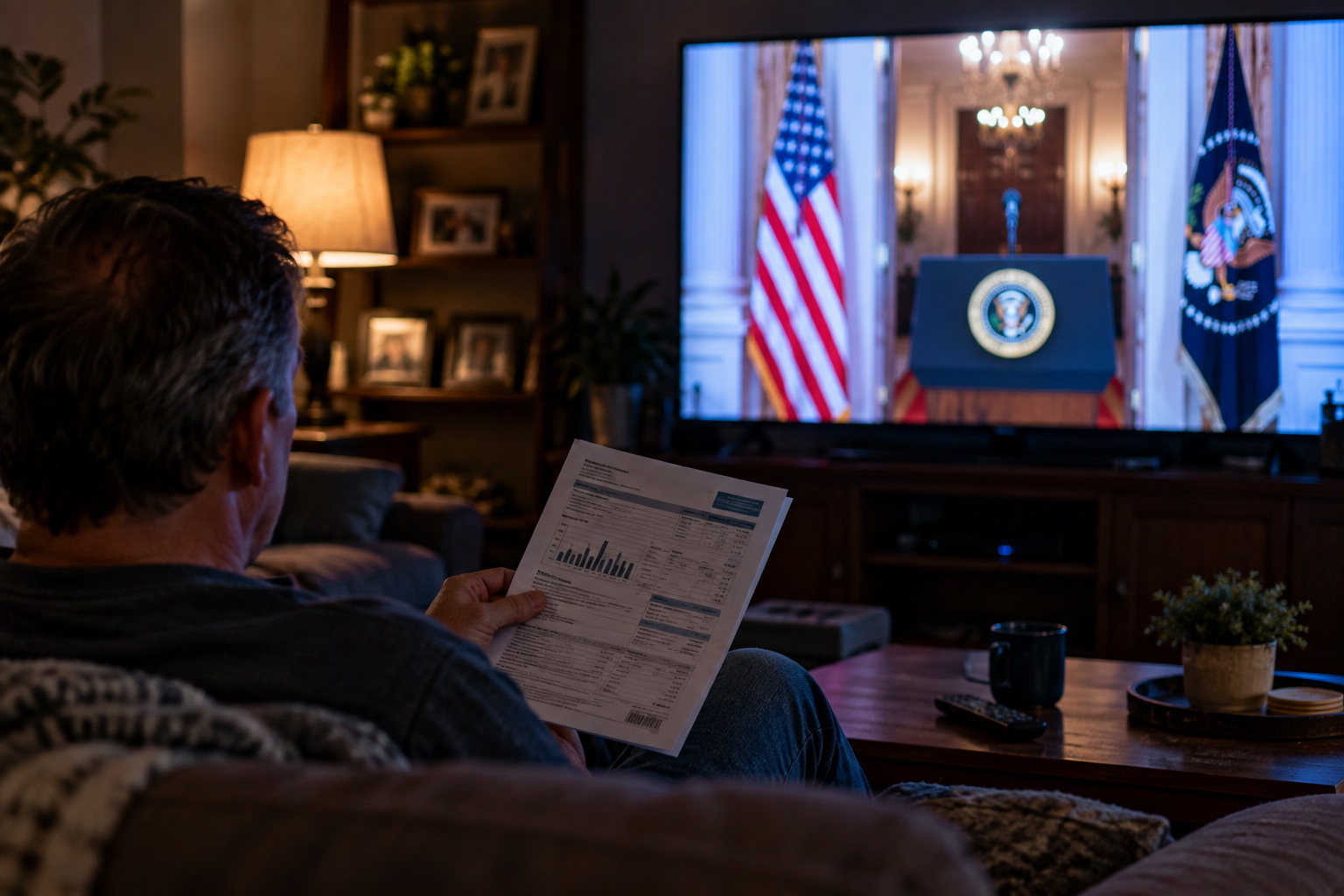
Donald Trump has found a new source of money to promote his presidency on television:
The American taxpayer.
The White House is spending federal money to broadcast advertisements celebrating Trump, his presidency and his political message on television stations across the country.
And the ads are now raising serious questions about whether the administration has crossed federal restrictions on using taxpayer money for political propaganda.
One advertisement features Trump throughout nearly the entire spot while touting what it describes as his accomplishments.
It includes Trump's declaration that "Together we will defeat communism, socialism and Marxism in America."
The commercial concludes with an unusual disclosure:
"Paid for by the U.S. Government."
This isn't a Trump campaign advertisement.
At least officially.
The White House says it is a public service announcement.
But critics — including members of Congress — say taxpayers may instead be financing political promotion of the president just weeks before Americans vote in the 2026 midterm elections.
FEDERAL LAW RESTRICTS GOVERNMENT PROPAGANDA
The federal government is allowed to advertise.
Government agencies routinely purchase advertising to tell Americans about disaster assistance, military recruitment, health programs, Medicare enrollment, vaccines and other government services.
But there are limits.
Federal appropriations laws have repeatedly prohibited executive agencies from spending appropriated money on unauthorized "publicity or propaganda."
The Government Accountability Office, which has interpreted those restrictions for decades, recognizes several categories of prohibited government communications.
Among them are purely partisan materials and government communications designed for self-aggrandizement.
That makes the content of the Trump advertisements particularly important.
This isn't an advertisement explaining how Americans can apply for a federal program.
It isn't telling people how to obtain disaster assistance.
It isn't encouraging Americans to get vaccinated.
Instead, it promotes Donald Trump.
THE AD LOOKS REMARKABLY LIKE A CAMPAIGN COMMERCIAL
The advertisement features a rapid montage of Trump during his presidency.
On-screen messages boast about tax cuts, American manufacturing and law enforcement.
It includes Trump attacking communism, socialism and Marxism.
And it concludes with praise from UFC chief Dana White, a prominent Trump supporter who spoke on Trump's behalf during the 2024 Republican National Convention.
The overall message is unmistakably favorable toward the president.
That doesn't automatically establish that a law has been broken.
But it explains why government watchdogs and members of Congress are asking whether taxpayer-funded public information has crossed over into taxpayer-funded political promotion.
THE WHITE HOUSE SAYS IT'S A PSA
The White House rejects the criticism.
Administration officials say the advertisements are public service announcements designed to promote patriotism and defend American values.
They also point out that previous presidential administrations have spent government money on public service advertising.
That's true.
George W. Bush's administration produced anti-drug advertising.
Barack Obama's administration promoted enrollment through Healthcare.gov.
Joe Biden's administration participated in advertising encouraging Americans to receive COVID-19 vaccines.
But those advertisements promoted specific government programs or public-policy objectives.
The Trump advertisement promotes Trump himself.
The White House argues there is another important distinction: Trump isn't personally on the ballot in November and the advertisement does not explicitly tell Americans to vote Republican.
Whether those distinctions are enough to keep the advertisement within federal law remains unresolved.
ANOTHER AD GOES EVEN FURTHER
The controversy intensified when the White House began airing another government-funded Trump advertisement.
This one features Trump's rhetoric about America's "final battle."
Trump talks about confronting the "deep state," globalists, communists, Marxists, fascists, political establishments and what he describes as a corrupt media.
What makes that advertisement especially noteworthy is its history.
The material was previously used as Trump political campaign content.
It appeared in connection with Trump's 2024 campaign and was shown at the Republican National Convention.
Now material that once served Trump's political campaign is being distributed with a new disclosure:
Paid for by the U.S. Government.
That transformation — from campaign messaging to taxpayer-funded government advertising — is at the heart of the controversy.
RASKIN SAYS FEDERAL LAWS MAY HAVE BEEN VIOLATED
Rep. Jamie Raskin of Maryland, the ranking Democrat on the House Judiciary Committee and a former constitutional law professor, says the administration may have violated multiple federal laws.
Raskin has raised the possibility that employees involved in producing the advertisement violated the Hatch Act, which restricts partisan political activity by federal employees.
He has also questioned whether government resources were improperly converted for political purposes.
Those are allegations, not legal findings.
No court has ruled that the Trump advertisements are illegal, and the Government Accountability Office has not yet issued a decision concluding that these particular advertisements violate federal appropriations law.
But GAO precedent makes the questions significant.
The agency has previously said the federal prohibition against publicity and propaganda can encompass purely partisan material and government self-aggrandizement.
THE GOVERNMENT DISCLOSURE MATTERS
There is one factor that could strengthen the administration's defense.
The advertisements openly identify the government as their source.
That matters because one form of prohibited government propaganda identified by the GAO is "covert propaganda" — material in which the government conceals its role in creating or distributing a message.
There is nothing covert about these advertisements.
They literally announce that the U.S. government paid for them.
But disclosure does not necessarily resolve every legal question.
GAO precedent separately recognizes purely partisan material and self-aggrandizement as potential violations of federal restrictions.
The question therefore isn't simply whether Americans know who purchased the advertisement.
It's what taxpayers are being asked to purchase.
THE BILL IS GROWING
This is also becoming more than a symbolic expenditure.
The advertisements began appearing in major television markets, including New York, Los Angeles, Miami, Washington and Chicago.
Advertising-tracking data indicates the campaign has expanded since its initial rollout.
Every dollar spent airing these advertisements comes from public funds.
Republican Sen. John Kennedy of Louisiana has also criticized the practice, saying public officials should not use government money to advertise themselves.
That makes this more than a strictly partisan objection.
THE QUESTION TAXPAYERS DESERVE ANSWERED
Presidents have enormous power to communicate.
They have the White House press corps.
They have televised speeches.
They have official social-media accounts.
They have press secretaries, cabinet officials and government communications offices.
And outside the government, political parties and political organizations remain free to spend enormous amounts of privately raised money promoting a president's agenda.
The controversy here is about something fundamentally different.
It's about using money collected from American taxpayers to purchase television advertising celebrating the sitting president shortly before a national election.
Federal law places restrictions on government propaganda for a reason.
Government resources belong to the public.
They do not belong to a president, a political party or a reelection campaign.
Whether the Trump administration has legally crossed that line will ultimately require a formal determination.
But the line exists.
And with campaign-style Trump advertisements now appearing on American televisions carrying the words "Paid for by the U.S. Government," Congress and federal watchdogs have an obvious question to answer:
Is the American government informing its citizens — or are American citizens being forced to pay for advertising promoting their president?