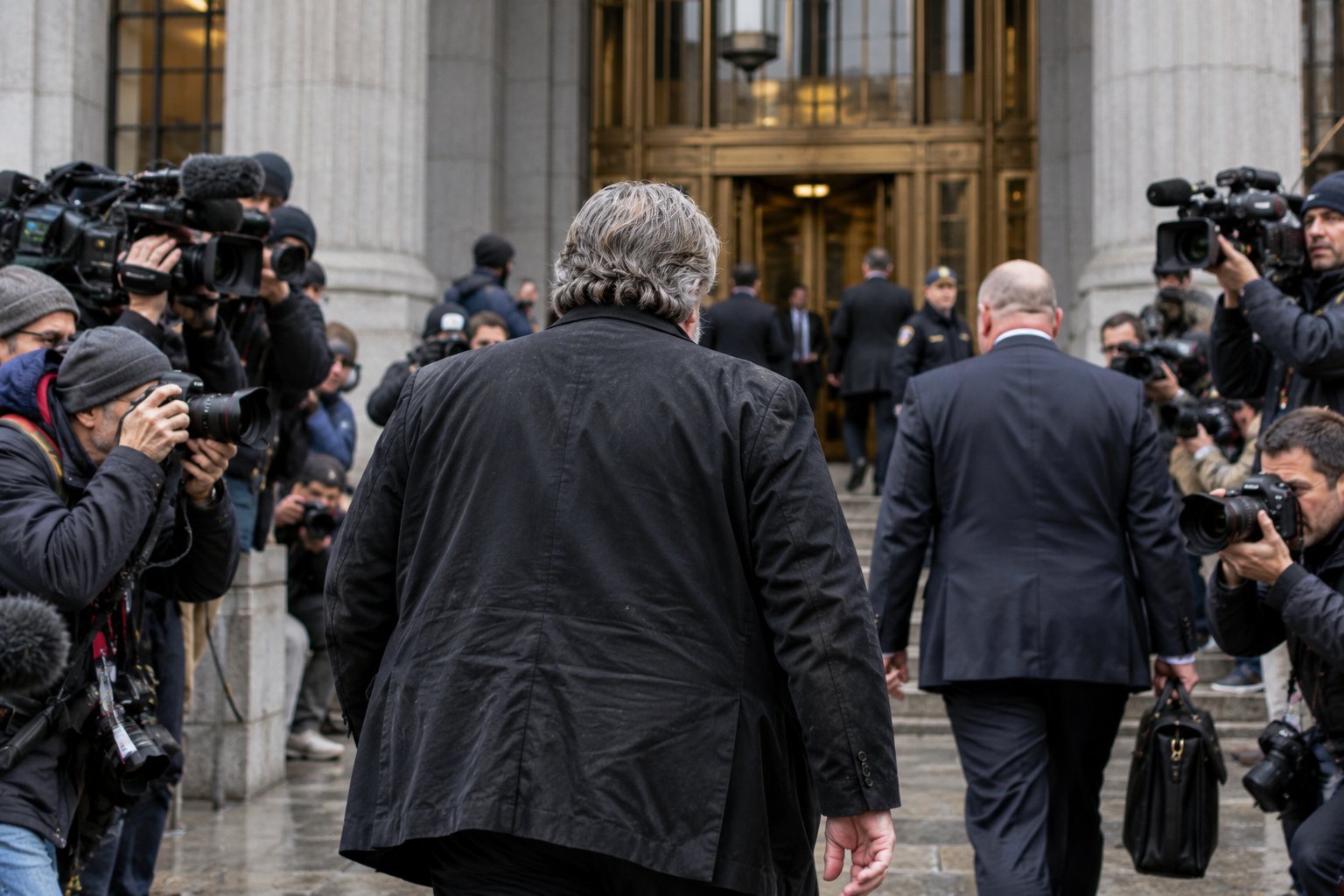
Steve Bannon was supposed to appear before the House committee investigating the January 6 attack on the U.S. Capitol. He didn't. The longtime Donald Trump adviser refused to comply with the committee's subpoena, citing Trump's assertion of executive privilege. Hours later, Chairman Bennie Thompson announced that the committee would move forward with criminal contempt proceedings. What began as a confrontation over a congressional subpoena would ultimately end with Bannon convicted on two federal charges and serving four months in prison.**
Steve Bannon had been ordered to appear.
He refused.
On September 23, 2021, the House Select Committee investigating the January 6 attack issued Bannon a subpoena seeking documents and testimony about events surrounding the attempt to overturn the 2020 presidential election.
Documents were due October 7.
His deposition was scheduled for October 14.
Bannon produced neither.
He didn't show up for the deposition.
And the committee decided it wasn't going to let the matter end there.
“Witnesses Who Try to Stonewall ... Will Not Succeed”
Committee Chairman Bennie Thompson announced that the panel would move to hold Bannon in criminal contempt of Congress.
“The Select Committee will use every tool at its disposal to get the information it seeks,” Thompson said, “and witnesses who try to stonewall the Select Committee will not succeed.”
The committee scheduled a vote on a contempt report.
It was the beginning of a legal confrontation that would continue for years.
Why Did the Committee Want Bannon?
Bannon had left his position in the Trump White House in August 2017.
He therefore wasn't a government official on January 6, 2021.
But he remained a Trump ally and was involved in discussions surrounding efforts to challenge the 2020 election results.
The committee believed Bannon possessed information relevant to what happened before January 6.
One reason attracted particular attention.
On January 5—the day before Congress was scheduled to certify Joe Biden's Electoral College victory—Bannon made a remarkable prediction on his War Room podcast.
“All hell is going to break loose tomorrow,” Bannon said.
He continued:
“It's not going to happen like you think it's going to happen.”
The following day, Trump supporters attacked the U.S. Capitol as Congress met to certify the election.
The committee wanted to know what Bannon knew, who he had spoken with and what discussions had taken place before the attack.
The Willard Hotel
Investigators were also interested in activity at Washington's Willard Hotel.
In the days surrounding January 6, Trump allies used rooms and suites at the hotel as a gathering place while efforts continued to challenge the election results.
Bannon was among the Trump allies who participated in discussions there.
The committee wanted documents and testimony concerning his communications with Trump, members of Congress, campaign officials and others involved in efforts surrounding January 6.
Bannon refused.
Bannon Cites Executive Privilege
Bannon's attorney, Robert Costello, told the committee that former President Trump was asserting executive privilege.
Trump's lawyer had instructed Bannon not to provide testimony or documents involving privileged information.
But there was an immediate problem with Bannon's argument.
He wasn't working in the White House during the period the committee was investigating.
He had been a private citizen since 2017.
That raised serious questions about whether executive privilege could protect his communications.
The committee also argued that many of the conversations it wanted to examine involved private citizens, campaign officials and members of Congress—not confidential discussions between a president and government advisers.
Bannon nevertheless refused to appear.
The Committee Makes Its Move
On October 19, the January 6 Committee voted unanimously to recommend that Bannon be held in contempt.
Two days later, the full House voted.
The result was 229–202.
Nine Republicans joined Democrats in voting to hold Bannon in contempt of Congress.
The matter then went to the Justice Department.
This was no longer merely a congressional dispute.
It had become a potential criminal case.
Bannon Is Indicted
On November 12, 2021, a federal grand jury indicted Bannon.
There were two counts.
One concerned his refusal to provide documents.
The other concerned his refusal to appear for testimony.
Each was a charge of contempt of Congress.
Bannon surrendered to federal authorities three days later.
Outside court, he remained defiant.
He pleaded not guilty.
The case moved toward trial.
The Argument Doesn't Save Him
Bannon's defense centered heavily on his claim that he believed he was following legal advice and Trump's assertion of executive privilege.
But the central issue at trial was considerably simpler.
Congress had issued a subpoena.
Bannon knew about it.
The subpoena established deadlines.
And Bannon intentionally failed to comply with them.
The Justice Department argued that Bannon had chosen outright defiance rather than appearing and invoking privilege in response to particular questions or documents.
Guilty
On July 22, 2022, the jury returned its verdict.
Guilty.
On the first count.
And the second.
Bannon was convicted of refusing to provide documents to the January 6 Committee and refusing to appear for his deposition.
The jury deliberated for only a few hours.
A subpoena that Bannon had refused to obey nine months earlier had now resulted in two federal criminal convictions.
Four Months in Prison
On October 21, 2022, U.S. District Judge Carl Nichols sentenced Bannon.
Four months in federal prison.
He was also ordered to pay a $6,500 fine.
But Bannon didn't immediately go to prison.
The judge allowed him to remain free while he appealed his conviction.
That delayed the sentence for more than a year and a half.
Bannon continued hosting his podcast and remained active in politics while his appeal proceeded.
Eventually, the courts rejected his effort to overturn the conviction.
The prison sentence would have to be served.
July 1, 2024
On July 1, 2024, Steve Bannon reported to the Federal Correctional Institution in Danbury, Connecticut.
Nearly three years had passed since he failed to appear before the January 6 Committee.
The subpoena had finally caught up with him.
Bannon began serving his four-month sentence.
October 29, 2024
Bannon walked out of federal prison on October 29.
He had served the four months imposed by the court.
He immediately returned to his political activities and his War Room program.
Bannon continued to maintain that the prosecution had been politically motivated.
But the underlying facts of the contempt case were straightforward.
Congress subpoenaed him.
He refused to provide the requested documents.
He refused to appear for his deposition.
The House held him in contempt.
The Justice Department prosecuted him.
A federal jury convicted him.
A federal judge sentenced him.
And after his appeals failed, he served the sentence.
It Started on October 14
Looking backward from Bannon's eventual imprisonment makes October 14, 2021 much more consequential.
That morning, Steve Bannon had a choice.
The House committee had ordered him to appear for a deposition.
He could have appeared.
He could have answered questions.
He could have asserted specific privileges when appropriate.
He could have challenged portions of the subpoena through the legal system.
Instead, he didn't show up.
That evening, Bennie Thompson announced what would happen next.
The committee would begin criminal contempt proceedings.
At the time, that might have sounded like another Washington threat that would disappear into months or years of political and legal fighting.
It didn't.
The committee voted.
The House voted.
The Justice Department indicted him.
A jury convicted him.
A judge sentenced him.
And on July 1, 2024, Steve Bannon entered federal prison.
The confrontation that began with a missed congressional deposition on October 14, 2021 ultimately cost him four months of his freedom.