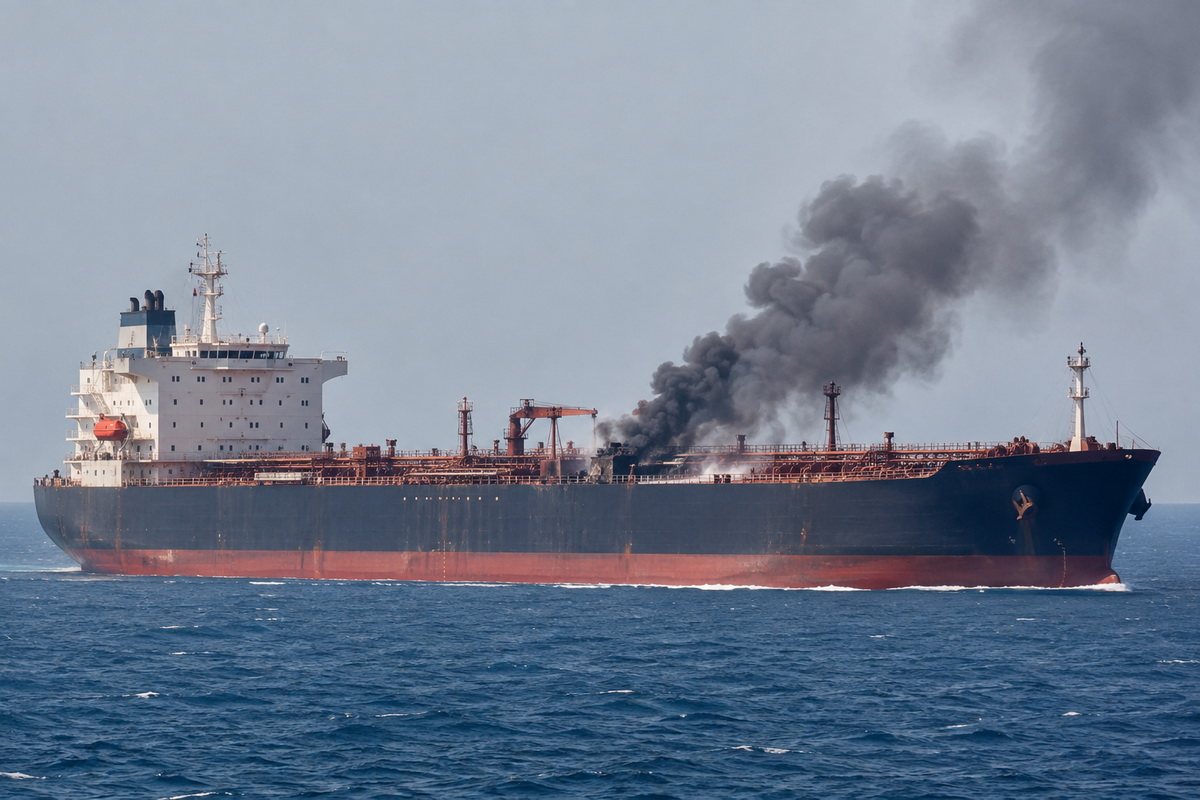
The Strait of Hormuz is open.
Ships are moving.
Oil is flowing.
And commercial vessels are still being attacked.
That last fact complicates the Trump administration's increasingly optimistic portrayal of conditions in one of the most important shipping corridors in the world.
After months of disruption, Middle Eastern oil exports have staged an impressive recovery. American military operations, alternative export routes and an increasingly sophisticated network of tanker transfers have helped keep millions of barrels of crude moving toward global markets.
But on the water itself, the crisis is far from resolved.
At least seven tankers have reportedly been attacked around the Strait since September 28.
Ships have been struck by projectiles.
Fires have broken out aboard vessels.
One tanker suffered a blackout.
Another sustained damage to its engine room.
Iran's Islamic Revolutionary Guard Corps reportedly threatened another tanker and ordered it to turn around or risk being targeted.
And now, according to reporting citing a U.S. official, Iran's ability to target commercial ships appears to be improving.
This isn't normal shipping.
It is commercial shipping operating through an active conflict zone.
Seven Ships Attacked
The recent series of attacks began September 28 and continued into October.
Maritime security reports describe vessels being struck by unknown projectiles while navigating through or near the Strait of Hormuz.
In one incident, a tanker was struck and subsequently experienced a fire and blackout.
In another, the very large crude carrier Kazimah III was reportedly struck by a projectile while traveling through the Strait on October 1, causing a fire aboard the vessel.
Then came the Lipsi.
The Liberian-flagged tanker was reportedly struck October 4 near Oman. The projectile damaged the ship's engine room.
The crew was reported safe.
Responsibility has not been conclusively established for every attack, and authorities continue investigating individual incidents.
But the overall pattern is difficult to dismiss.
Commercial ships traveling through one of the world's most economically important waterways are still being hit.
Iran May Be Getting Better at It
Perhaps the most troubling development isn't simply that the attacks continue.
It's that Iran may be becoming more effective at conducting them.
A U.S. official cited in recent reporting acknowledged that Iran's ability to target vessels has improved in recent weeks.
That presents a very different picture from a shipping crisis that is steadily disappearing.
Iran doesn't need to completely close the Strait of Hormuz to cause enormous economic disruption.
It merely needs to make sailing through it dangerous enough.
Every successful attack increases the risk calculation for shipowners.
Every damaged tanker affects insurance rates.
Every threat forces captains and shipping companies to reconsider routes.
Every strike demonstrates that despite the enormous American military presence in the region, commercial vessels remain vulnerable.
And every additional attack makes the word “normal” increasingly difficult to use.
A Tanker Was Threatened With Attack
The danger isn't limited to missiles or unidentified projectiles.
On October 5, United Kingdom Maritime Trade Operations reported an extraordinary confrontation involving a commercial vessel entering the Strait approximately 11 nautical miles north of Khasab, Oman.
The tanker was reportedly hailed by Iran's Islamic Revolutionary Guard Corps.
The message was straightforward.
Turn around.
Or risk being targeted.
The tanker turned around.
That incident alone illustrates the unresolved security problem in the Strait.
The Trump administration has emphasized American control of the waterway.
Yet an Iranian military force was apparently still capable of threatening a commercial vessel with attack and changing its course.
The ship's captain didn't test whether the threat was genuine.
Few commercial captains would.
Oil Is Flowing Again
There is an important fact that shouldn't be ignored.
Middle Eastern oil exports have recovered dramatically.
Reuters reported that crude exports from the region exceeded prewar levels on 14 days during September.
By September 30, the seven-day moving average had reached approximately 18.3 million barrels per day, according to provisional data from shipping analytics company Kpler.
That's a remarkable recovery.
But it doesn't mean that ordinary commercial traffic through Hormuz has returned to its prewar condition.
Those export figures include crude transported through the Strait as well as oil moved through alternative routes, other terminals and ship-to-ship transfers.
The oil industry has adapted to the war.
Tankers and producers have developed workarounds.
Alternative pipelines have become increasingly important.
Some cargoes are transferred between vessels outside the most dangerous areas.
Oil is finding its way to market.
That's evidence of an extraordinarily resilient global energy system.
It isn't evidence that the Strait of Hormuz is safe.
Even Saudi Aramco Says Hormuz Isn't Fully Reopened
One of the most important assessments comes from someone with an enormous financial interest in seeing the Strait return to normal.
Saudi Aramco CEO Amin Nasser has said Hormuz has not “fully re-opened” and that confidence has not yet returned.
That matters.
Saudi Aramco isn't an American opposition party.
It isn't a political advocacy organization.
It is the world's largest oil company, operating in a region whose economic stability depends heavily upon safe and predictable energy exports.
If confidence had truly returned to Hormuz, the shipping industry would behave accordingly.
Instead, companies are still confronting extraordinary risks and extraordinary costs.
The Price of Sailing Through a War Zone
Before the conflict, some tanker routes from the Middle East to Asia cost approximately $30,000 per day.
During the crisis, Reuters reported rates reaching as high as $1.2 million per day on some routes.
War-risk insurance has also risen dramatically.
Shipping companies must calculate not merely fuel costs, crew costs and delivery schedules, but the possibility that a multimillion-dollar vessel carrying hundreds of millions of dollars worth of cargo could be struck by a missile, drone or projectile.
Crews have reportedly been offered enormous financial incentives for dangerous voyages.
Naval protection has become part of commercial logistics.
Ship-to-ship transfers are helping move cargo around dangerous areas.
Alternative pipelines and terminals are being used to bypass the Strait when possible.
These are extraordinary measures.
They're working.
But nobody builds an extraordinary wartime logistics system because shipping conditions are normal.
“The Strait Is Open”
President Donald Trump has repeatedly emphasized that the Strait is open and that American forces control the waterway.
“The Strait is open,” Trump said in August.
“We have total control of that entire region having to do with the Strait of Hormuz,” Trump said.
Later that month, Trump described it as a “very functioning Strait” and emphasized the enormous quantity of oil once again moving through the region.
There is an important distinction here.
Trump is correct that Iran has not successfully sealed the Strait.
Ships are getting through.
Oil is moving.
American military power has helped prevent Iran from completely shutting down one of the world's most strategically important waterways.
That's significant.
But preventing Iran from completely closing Hormuz isn't the same thing as restoring normal commercial shipping.
The standard shouldn't be whether a tanker can make it through.
The question is what it takes for that tanker to make it through — and what risks its crew faces along the way.
“Open” Is Not the Same as “Safe”
Imagine applying the same standard anywhere else.
A highway where vehicles are routinely being fired upon could technically remain open.
Traffic could continue moving.
Police or military forces could escort vehicles.
Drivers could receive hazard pay.
Insurance premiums could skyrocket.
Alternate roads could absorb some of the traffic.
And officials could accurately announce that the highway had never been completely closed.
Nobody would describe the situation as normal.
The Strait of Hormuz is experiencing the maritime equivalent.
Ships are moving through an environment in which vessels have recently been struck, threatened and damaged.
The maritime industry itself continues issuing security warnings.
Military forces remain deeply involved.
Insurance costs remain elevated.
Shipping costs have exploded.
Companies have developed complicated workarounds.
And according to a U.S. official, Iran's ability to target vessels may actually be improving.
The Crisis Has Changed. It Hasn't Ended.
There has unquestionably been progress in the Strait of Hormuz.
The early fears that Iran might effectively shut one of the world's most important energy corridors have not materialized.
Oil exports have recovered.
American naval operations have helped keep shipping lanes functioning.
Producers and shipping companies have demonstrated extraordinary adaptability.
Those are genuine successes.
But the nature of the crisis has changed.
It hasn't disappeared.
Instead of a completely closed Strait, the world now has a functioning but dangerous Strait through which enormous quantities of energy are moving despite persistent military threats.
That may be enough to prevent a catastrophic disruption to global oil supplies.
It is not enough to declare the problem solved.
Seven recently attacked vessels tell a different story.
So does a tanker ordered by Iranian forces to turn around or risk being targeted.
So do dramatically elevated shipping and insurance costs.
And so does a U.S. official acknowledging that Iran's ability to target vessels is improving.
The Strait of Hormuz is open.
But ships are still being attacked.
The people sailing those ships still face dangers that did not exist during normal peacetime commerce.
And until commercial vessels can transit one of the world's most important waterways without the threat of being hit by projectiles, set on fire or threatened by Iranian forces, describing shipping in the Strait of Hormuz as back to normal is difficult to reconcile with conditions on the water.
The oil may be flowing again.
The crisis is far from resolved.