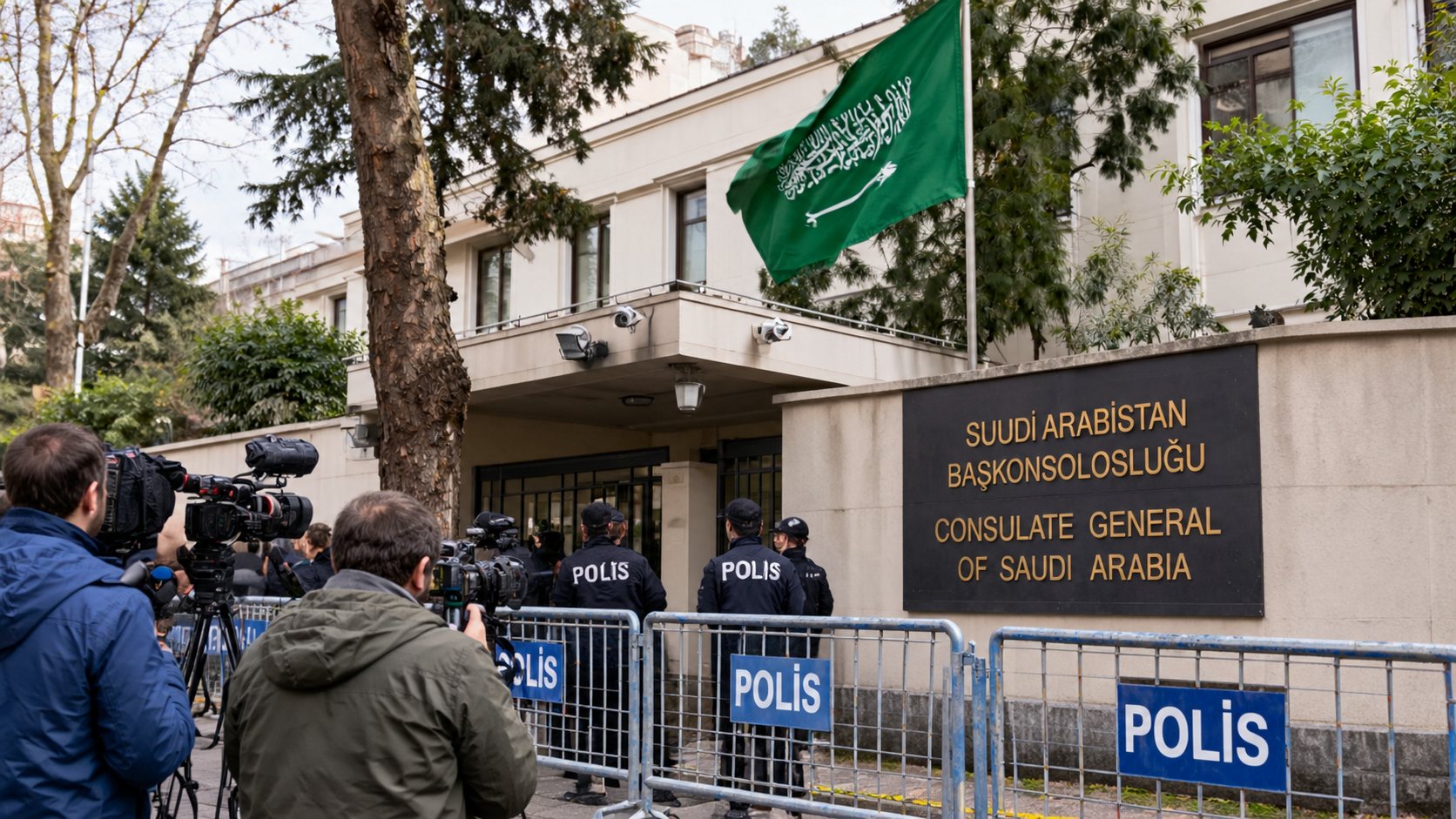
After more than two weeks of denials, shifting explanations, and mounting international pressure, Saudi Arabia acknowledged Friday night that journalist Jamal Khashoggi was killed inside the kingdom's consulate in Istanbul, confirming the death of a prominent government critic whose disappearance has become a major diplomatic crisis for President Donald Trump.
The Saudi government claimed that Khashoggi died during a physical confrontation inside the consulate on October 2, an explanation that immediately raised questions about the kingdom's earlier insistence that the journalist had left the building unharmed.
Saudi authorities announced the arrests of 18 Saudi nationals and the dismissal of several senior officials, including a close adviser to Crown Prince Mohammed bin Salman.
The announcement represented a dramatic reversal.
For more than two weeks, Saudi officials had maintained that Khashoggi departed the consulate shortly after arriving.
Turkish investigators, however, had repeatedly indicated that they believed he was killed inside the diplomatic facility by a team of Saudi operatives.
Now, Saudi Arabia has acknowledged the central fact it previously denied: Khashoggi entered its consulate and died there.
The admission places renewed scrutiny on the Trump administration, which has maintained a close relationship with the Saudi leadership and repeatedly emphasized the economic and strategic importance of the kingdom.
The immediate questions are no longer limited to whether Khashoggi is dead.
They now concern who ordered the operation, what happened inside the consulate, why Saudi officials denied knowledge of his fate, and whether the United States will hold a powerful ally accountable.
A Journalist Who Walked Into a Consulate and Never Returned
Jamal Khashoggi, 59, was a Saudi journalist, author, and commentator who had become an increasingly outspoken critic of his country's political leadership.
A longtime figure in Saudi journalism, Khashoggi had worked as an editor and adviser and had extensive experience covering the Middle East.
He was not an obscure political activist.
He was an internationally recognized journalist who understood the Saudi government from years of professional experience.
In 2017, amid growing restrictions on dissent, Khashoggi relocated to the United States.
He began writing opinion columns for The Washington Post, where he criticized the Saudi government's suppression of free expression and its treatment of political opponents.
His writings often acknowledged the kingdom's need for reform while questioning the increasingly centralized authority of Crown Prince Mohammed bin Salman.
Khashoggi believed that meaningful modernization required more than economic development and social changes.
It also required freedom of expression and the ability to criticize government policy.
On October 2, Khashoggi visited the Saudi consulate in Istanbul to obtain paperwork necessary for his planned marriage to Turkish citizen Hatice Cengiz.
Cengiz waited outside.
Khashoggi entered the building.
He never emerged.
When he failed to return, Cengiz became alarmed and contacted authorities.
What should have been an ordinary administrative visit quickly became an international mystery.
More Than Two Weeks of Saudi Denials
In the days following Khashoggi's disappearance, Saudi officials repeatedly insisted that he had left the consulate.
The government rejected suggestions that its representatives were responsible for his disappearance.
Saudi Crown Prince Mohammed bin Salman publicly suggested that Turkish authorities could search the consulate and maintained that the kingdom had nothing to conceal.
But Turkish investigators developed a sharply different account.
They reported evidence suggesting that a group of Saudi nationals had traveled to Istanbul around the time of Khashoggi's disappearance.
Turkish officials examined surveillance footage, flight records, and the movements of individuals believed to have been connected to the operation.
Reports emerged describing a 15-member Saudi team that allegedly arrived in Istanbul before Khashoggi entered the consulate.
Some of the individuals identified in reporting appeared to have connections to Saudi security or government institutions.
Turkish officials also indicated that they possessed recordings or other evidence supporting the conclusion that Khashoggi had been killed inside the building.
The claims could not all be independently verified as of Friday.
But they directly contradicted the Saudi government's public insistence that the journalist had departed safely.
For more than two weeks, the kingdom offered no satisfactory explanation for his disappearance.
Friday night's admission has made those earlier denials considerably harder to defend.
Saudi Arabia Now Claims Khashoggi Died in a Fight
According to the Saudi government's new account, Khashoggi became involved in a discussion with individuals inside the consulate.
The conversation allegedly escalated into a physical confrontation that resulted in his death.
Saudi authorities described the incident as a fight rather than an operation deliberately intended to kill the journalist.
The government announced that 18 Saudi nationals had been detained in connection with the investigation.
It also dismissed senior officials, including Saud al-Qahtani, an influential adviser to Crown Prince Mohammed bin Salman, and Ahmed al-Asiri, a senior intelligence official.
The dismissals are significant because they involve individuals connected to the Saudi leadership's security and political apparatus.
But the announcement leaves fundamental questions unanswered.
Why were the individuals involved present at the consulate?
What was their purpose in meeting Khashoggi?
Why did Saudi officials initially insist he had left the building?
Where are his remains?
And how could a confrontation resulting in the death of a prominent journalist occur inside a Saudi diplomatic facility without the government providing an accurate account for more than two weeks?
The Saudi explanation has not independently established the circumstances of Khashoggi's death.
It is an official claim made by a government that has already provided contradictory information.
Trump's Close Relationship With Saudi Arabia
The Khashoggi case has become a significant test of President Trump's relationship with the Saudi government.
Since taking office, Trump has made closer cooperation with Saudi Arabia a major component of his Middle East policy.
His first foreign trip as president, in May 2017, included a high-profile visit to Riyadh.
The administration presented the visit as the beginning of a strengthened partnership involving security cooperation, regional diplomacy, and commercial agreements.
Trump emphasized proposed arms sales and investment commitments, portraying Saudi Arabia as an important customer for American defense companies and a source of economic opportunity.
The administration also regards the kingdom as a strategic partner in countering Iranian influence across the Middle East.
Crown Prince Mohammed bin Salman has become a central figure in that relationship.
The young Saudi leader has promoted an ambitious economic modernization program while consolidating political power.
His government has introduced prominent social reforms, including ending the prohibition on women driving.
At the same time, human rights organizations have criticized the detention of activists, restrictions on political expression, and the treatment of government critics.
Khashoggi was among those who questioned whether the crown prince's reform agenda could succeed without greater political freedom.
His death now raises serious questions about the Saudi government's treatment of dissent and the willingness of Washington to challenge an important ally.
Trump Suggested 'Rogue Killers' Might Be Responsible
As reports about Khashoggi's disappearance intensified, Trump initially emphasized Saudi denials.
On October 15, following a telephone conversation with King Salman, the president told reporters that the Saudi monarch had denied knowing what happened.
Trump then raised the possibility that unauthorized individuals might have been responsible.
He suggested that "rogue killers" could have carried out the act.
The comment attracted criticism because it introduced a possible explanation absolving the Saudi leadership before investigators had established what happened.
Trump did not present evidence demonstrating that independent operatives were responsible.
His statement was framed as speculation.
Nevertheless, it drew attention because it appeared consistent with an explanation in which Saudi officials could acknowledge a killing while denying that the country's senior leadership had authorized it.
Friday night's Saudi account similarly describes a confrontation involving individuals inside the consulate rather than an officially ordered killing.
That similarity does not establish that the White House coordinated its explanation with Saudi authorities.
But it underscores why critics have questioned whether the administration has been too willing to accept Saudi assurances.
Pompeo's Visit to Riyadh
Earlier this week, Secretary of State Mike Pompeo traveled to Saudi Arabia and met with King Salman and Crown Prince Mohammed bin Salman.
The visit came as international pressure intensified and Turkish investigators continued examining evidence.
Photographs and video of Pompeo's meetings showed cordial exchanges with Saudi leaders.
The administration maintained that it was seeking a thorough investigation.
Pompeo subsequently traveled to Turkey for discussions with officials there.
The diplomatic effort highlighted the difficult position facing Washington.
Saudi Arabia is an important military, intelligence, and economic partner.
But the disappearance of a journalist who had been living in the United States and writing for a major American newspaper created a crisis that could not be treated solely as a bilateral matter between Saudi Arabia and Turkey.
The United States has longstanding commitments to freedom of expression and the protection of journalists.
Those principles are now being tested against the administration's strategic relationship with Riyadh.
Arms Sales Become Central to Trump's Response
One of Trump's most consistent arguments against immediately imposing severe penalties on Saudi Arabia has concerned American jobs and defense contracts.
The president has repeatedly emphasized the value of arms sales and other commercial agreements with the kingdom.
He has warned that canceling major defense arrangements could harm American companies and allow competitors such as Russia or China to capture Saudi business.
There are legitimate strategic considerations involved in defense cooperation with Saudi Arabia.
The kingdom plays an important role in regional security, energy markets, and American efforts to counter Iranian influence.
But critics argue that those interests cannot justify overlooking serious human rights abuses.
The administration's repeated focus on arms sales has also raised questions about the figures Trump cites.
Large announced agreements do not necessarily represent finalized purchases, immediate revenue, or jobs already created.
Some involve proposed or prospective transactions that may never be completed in full.
The distinction matters when the economic benefits of a diplomatic relationship are being weighed against allegations involving the killing of a journalist.
Trump's argument places commercial and strategic interests at the center of the discussion.
Lawmakers and human rights advocates are asking whether those interests should determine the American response to an apparent killing inside a diplomatic mission.
Members of Congress Demand Accountability
The Khashoggi case has generated criticism from both Republicans and Democrats.
Senator Lindsey Graham, a Republican from South Carolina, has sharply questioned the Saudi leadership's credibility and called for consequences if responsibility is established.
Other lawmakers have demanded a thorough investigation and raised concerns about the United States continuing business as usual with Riyadh.
The controversy has also renewed congressional attention to American support for Saudi military operations in Yemen.
The Saudi-led coalition's campaign there has been criticized over civilian casualties and the humanitarian consequences of the war.
For lawmakers already concerned about Saudi conduct, Khashoggi's disappearance has become another reason to reconsider the terms of the bilateral relationship.
The administration therefore faces pressure from within its own party as well as from Democrats.
The question is whether the White House will support meaningful accountability if investigators establish that Saudi officials deliberately targeted Khashoggi.
Friday's announcement of arrests and dismissals does not eliminate the need for an independent assessment of the evidence.
The Crown Prince Faces Increasing Scrutiny
Crown Prince Mohammed bin Salman has become the kingdom's most powerful political figure after King Salman.
He oversees major elements of Saudi economic and security policy and has consolidated authority over institutions central to the country's government.
That concentration of power has made questions about responsibility particularly important.
Turkish reporting has suggested that some individuals connected to Khashoggi's disappearance had ties to Saudi security institutions and the crown prince's circle.
Those reported connections do not, by themselves, prove that Mohammed bin Salman ordered or knew of the killing.
As of Friday night, no publicly established finding has conclusively determined his personal responsibility.
But the Saudi government's acknowledgment that Khashoggi died inside its own consulate makes a full explanation of the chain of command essential.
A government cannot resolve questions about an operation merely by announcing that lower-ranking individuals have been arrested.
Investigators must establish who planned the encounter, who authorized the individuals' actions, and whether senior officials were informed.
Without those answers, the announcement risks being viewed as an effort to contain a political crisis rather than provide a complete account.
Khashoggi's Final Column Warned About the Suppression of Free Expression
The Washington Post published Khashoggi's final column on October 17, after his disappearance.
The article concerned the absence of press freedom across much of the Arab world.
Khashoggi argued that people in the region need access to independent information and the ability to express political opinions without fear of punishment.
His final published work reflected a concern that had become central to his journalism.
He believed that authoritarian governments could promote economic modernization while continuing to suppress the independent voices necessary for meaningful political reform.
That argument now carries particular significance.
Khashoggi had left Saudi Arabia partly because he feared the consequences of speaking openly.
He continued writing from the United States.
He then disappeared during a visit to a Saudi diplomatic facility abroad.
The Saudi government's admission that he died inside that facility has intensified concerns about the safety of journalists and dissidents who criticize powerful governments.
A Test of American Principles
The United States has long presented freedom of the press as a central democratic principle.
American officials routinely criticize governments that imprison journalists, censor independent reporting, or punish political dissent.
The Khashoggi case presents a direct test of how those principles are applied when the government under scrutiny is an important American ally.
Trump has emphasized the strategic and economic costs of damaging relations with Saudi Arabia.
Those considerations are part of foreign policy.
But they do not answer whether a government responsible for the death of a journalist should face diplomatic or economic consequences.
Nor do they explain why the Saudi authorities provided false or misleading accounts of Khashoggi's disappearance for more than two weeks.
The credibility of American human rights advocacy depends in part on whether its principles are applied consistently.
If Washington demands accountability from adversaries while accepting unverified explanations from partners, critics argue that its commitments become vulnerable to charges of selective enforcement.
What Happens Next?
Saudi Arabia's admission represents an important development, but it is not the conclusion of the investigation.
Turkish authorities are continuing to examine the circumstances surrounding Khashoggi's death.
Saudi Arabia says it is investigating the individuals involved.
The United States must now assess the credibility of the kingdom's explanation and determine whether additional diplomatic measures are warranted.
Several questions remain unresolved:
- What precisely happened inside the Saudi consulate on October 2?
- Why did Saudi authorities initially claim Khashoggi had left the building?
- What roles did the detained individuals play?
- Who authorized their activities?
- Where are Khashoggi's remains?
- Did senior Saudi officials know about or approve the operation?
- Will the United States insist on an independent and credible investigation?
The answers will shape the international response.
They will also help determine whether the Saudi government's latest account can withstand scrutiny.
The Journalist Must Not Be Forgotten
Behind the diplomatic statements, intelligence reports, and political arguments is the death of a man who believed journalism could help bring greater freedom to his country.
Jamal Khashoggi was preparing to marry.
He entered a consulate to obtain paperwork for that marriage.
His fiancée waited outside for him.
He never returned.
For more than two weeks, Saudi Arabia maintained that he had left the building.
Friday night, the government acknowledged that he died inside.
The reversal raises serious questions about the reliability of the kingdom's earlier statements and the circumstances of his death.
It also places President Trump in a difficult position.
His administration has invested considerable diplomatic and political capital in its relationship with Saudi Arabia and Crown Prince Mohammed bin Salman.
Now, that relationship is under scrutiny because of the death of a journalist who criticized the Saudi government.
The central issue is not whether Saudi Arabia is economically or strategically important to the United States. It is whether that importance will influence how rigorously the United States demands the truth about Jamal Khashoggi's death.
Saudi Arabia has finally acknowledged that the journalist was killed.
The world is still waiting to learn who was responsible—and whether those responsible will be held accountable.