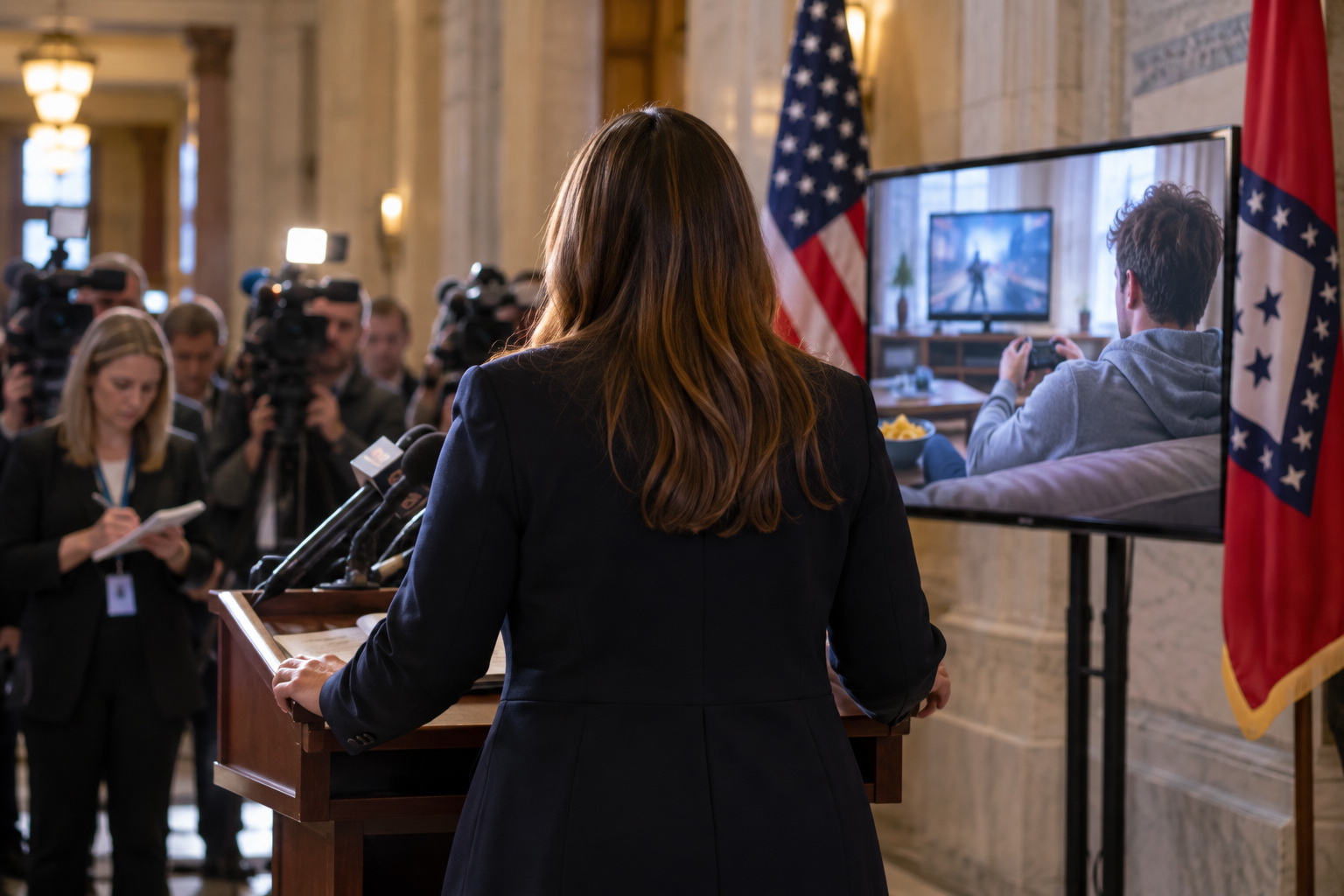
Arkansas Gov. Sarah Huckabee Sanders probably expected conservatives to applaud her latest advertisement promoting work requirements for people receiving government assistance.
Instead, she managed to start a fight within her own political movement.
And the argument wasn’t primarily about the work requirement.
It was about the race of the fictional welfare recipient in her commercial.
Sanders released an advertisement featuring “Brad,” a young white man lounging around, playing video games and eating snacks while supposedly living on taxpayer-funded benefits.
The message was straightforward: Sanders argued that able-bodied people receiving government assistance should be required to work, attend school or volunteer rather than simply choosing not to work.
That is normally the kind of message that receives enthusiastic support from conservative activists.
But then some prominent voices on the right noticed something.
Brad was white.
And apparently that was a problem.
THE BACKLASH
Conservative commentators began attacking Sanders for choosing a young white man to represent the stereotypical lazy welfare recipient.
Some argued that young white men were being unfairly portrayed as freeloaders. Others complained that the advertisement ignored the demographics of people receiving government assistance.
Trump-supporting pastor Joel Webbon went considerably further, publicly asking why Sanders had chosen a white man and suggesting that the advertisement would have been more believable if the welfare recipient had been Black.
Other conservative personalities similarly complained that Sanders had chosen the wrong demographic to represent welfare dependency.
Think about what happened here.
A Republican governor released an advertisement arguing that people capable of working shouldn't live indefinitely on government assistance.
Rather than debating whether her description of welfare recipients was accurate, whether work requirements actually improve employment outcomes, or whether people could lose healthcare despite legitimate barriers to employment, some of her critics became furious because the fictional freeloader was white.
Sanders had apparently violated an expectation about what a welfare recipient was supposed to look like.
SANDERS FIRES BACK
Sanders did not apologize.
After the criticism erupted, she mocked the controversy and reiterated the central message of the advertisement.
She said that if someone is able-bodied, that person should not receive welfare simply because they choose not to work.
But Sanders largely sidestepped the racial argument that had consumed portions of the conservative response.
The controversy nevertheless exposed something much larger than one campaign advertisement.
THE OLD “WELFARE QUEEN” STEREOTYPE
American politics has spent decades attaching racial imagery to welfare.
The stereotype of the Black “welfare queen” became particularly prominent in political rhetoric during the Reagan era and has remained part of America's political culture ever since.
Government assistance, however, is not one single program.
Medicaid, SNAP, TANF and other programs serve very different populations and have different eligibility requirements. Medicaid includes children, people with disabilities, low-income workers and families, while SNAP provides food assistance to millions of households.
That makes sweeping claims about who is “on welfare” inherently misleading.
It also makes the outrage over Brad particularly revealing.
Sanders created a fictional white welfare recipient.
Nobody claimed that white Americans are prohibited from receiving public assistance. Nobody could seriously argue that unemployed white men receiving government benefits simply do not exist.
Yet the racial identity of a fictional character became one of the biggest controversies surrounding the advertisement.
WHAT THE POLICY ACTUALLY DOES
There is another important detail buried underneath the political theater.
Sanders repeatedly uses the broad term “welfare,” but the policy she is promoting concerns work and community-engagement requirements for certain adults receiving Medicaid through Arkansas' ARHOME program.
Arkansas began gradually rolling out the program in July, with full implementation scheduled for January 2027.
Certain nonexempt adults will generally have to demonstrate that they are working, attending school, volunteering or participating in another qualifying activity for at least 80 hours per month.
There are exemptions, meaning the requirement does not simply apply to every person receiving Medicaid or every person receiving government assistance.
Arkansas has tried Medicaid work requirements before.
During the first Trump administration, the state implemented a similar program before federal litigation stopped it.
Sanders revived the effort after Trump returned to office and has made welfare reform a major part of her administration's agenda.
THE AD MAY HAVE REVEALED MORE THAN INTENDED
Sanders wanted voters talking about welfare-to-work requirements.
Instead, her advertisement produced a revealing argument about race inside the MAGA movement.
If the objection had simply been that Brad wasn't statistically representative of the population affected by the policy, that could have produced a legitimate discussion about whether political advertising should accurately represent the people affected by government programs.
But some of the criticism went considerably further.
The outrage wasn't simply that Sanders portrayed a welfare recipient inaccurately.
For some critics, the problem was that she portrayed him as white.
And when people become more offended by the race of a fictional welfare recipient than by whether the underlying claim about welfare recipients is accurate, the controversy starts telling us considerably more about the stereotype than it does about Brad.