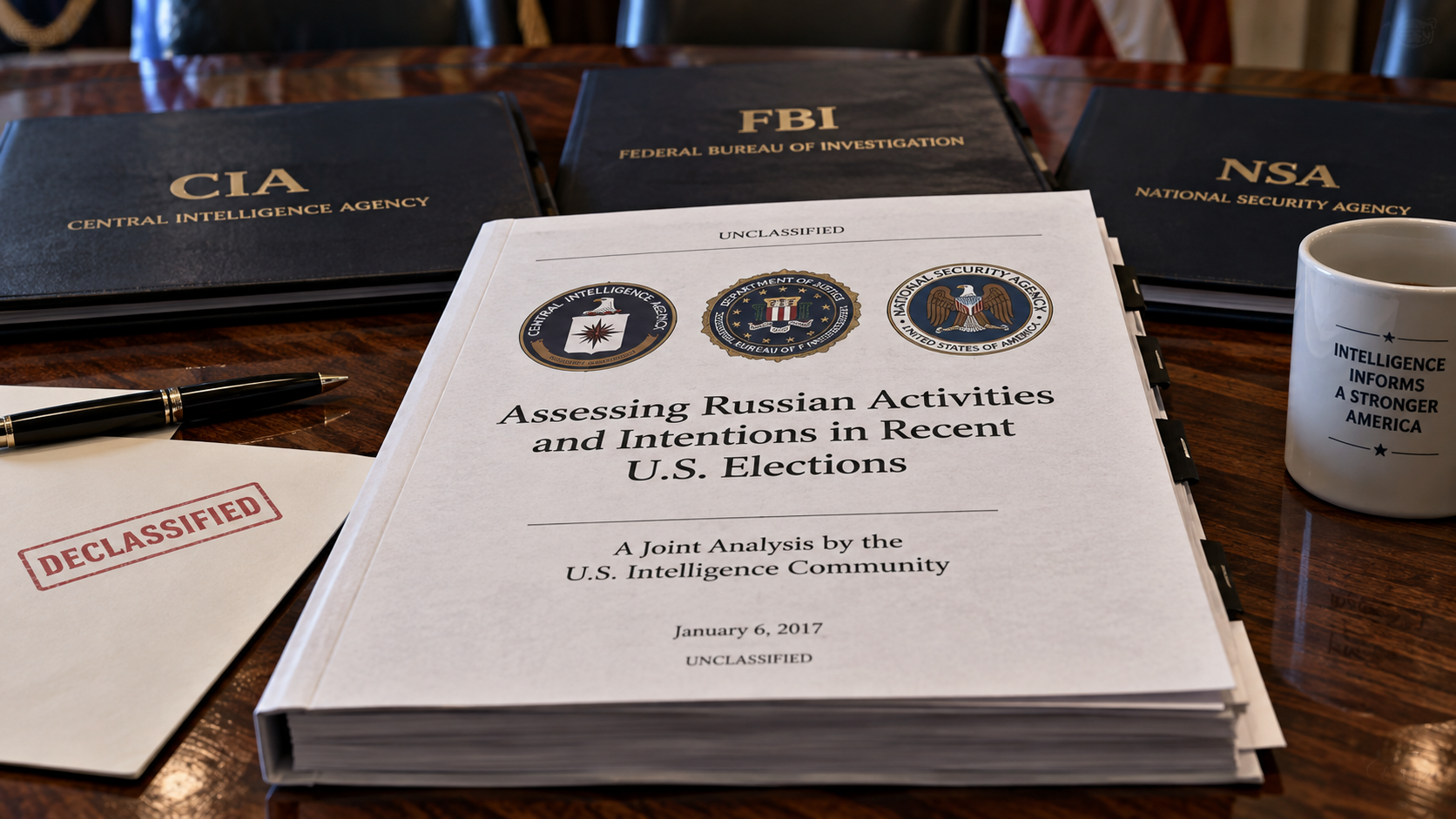
For weeks, President-elect Donald Trump had publicly questioned whether Russia was responsible for interference in the 2016 presidential election.
On January 6, America's intelligence agencies publicly delivered their answer.
A declassified intelligence assessment concluded that Russian President Vladimir Putin had ordered an influence campaign targeting the American election.
The assessment represented the most detailed public explanation yet of what U.S. intelligence officials believed Russia had done — and why.
Putin Ordered the Campaign, Intelligence Agencies Said
The assessment was produced by the CIA, FBI and National Security Agency under the Office of the Director of National Intelligence.
Its central conclusion was direct:
“We assess Russian President Vladimir Putin ordered an influence campaign in 2016 aimed at the U.S. presidential election.”
According to the assessment, Russia sought to undermine public confidence in the American democratic process, damage Hillary Clinton's candidacy and potential presidency, and eventually developed a clear preference for Donald Trump.
The agencies also assessed that Putin and the Russian government sought to help Trump's election prospects when possible by discrediting Clinton and contrasting her unfavorably with Trump.
The CIA and FBI expressed high confidence in that judgment.
The NSA expressed moderate confidence.
That distinction reflected different levels of confidence in the underlying intelligence — not disagreement over whether Russia had conducted an influence campaign.
More Than Hacked Emails
The operation described by American intelligence went beyond stealing and releasing emails.
The assessment described a broader influence campaign involving Russian intelligence services, cyber operations, state-controlled media and other methods intended to shape political discussion inside the United States.
Russian military intelligence was assessed to have used the persona Guccifer 2.0 and DCLeaks.com to release information obtained from American political targets.
WikiLeaks also published thousands of emails stolen from Democratic organizations and Clinton campaign chairman John Podesta.
The intelligence community assessed that Russia's actions represented a significant escalation compared with previous Russian attempts to influence American politics.
What the Report Did Not Say
One distinction was crucial.
The intelligence community did not conclude that Russia changed vote totals.
It did not claim Russian hackers altered voting machines to elect Trump.
And it did not attempt to determine whether Russian interference changed the final result of the election.
Those were separate questions.
The assessment examined Russia's activities and intentions.
Determining the political effect of those activities was outside its scope.
That distinction would frequently become blurred as the Russia controversy intensified.
Trump Is Briefed
Trump received a classified briefing on the intelligence findings before the public report was released.
Afterward, he acknowledged that Russia, China and other countries continually attempt to penetrate American institutions and organizations.
But he continued to emphasize that the hacking had not affected the election result.
That was technically consistent with one part of the intelligence assessment: the agencies themselves had not attempted to determine the effect on the final vote.
The larger disagreement concerned Russia's responsibility and intentions.
The intelligence agencies had now publicly placed responsibility for the influence campaign at the highest level of the Russian government.
The Conflict Wasn't Going Away
The January 6 assessment could have marked the conclusion of the controversy.
Instead, it became the beginning of a much larger one.
Trump was about to become president and assume authority over the same intelligence agencies whose conclusions he had repeatedly questioned.
The FBI would continue investigating Russian interference and contacts involving people associated with Trump's campaign.
Congress would launch investigations of its own.
Questions about Russia would follow the new administration into the White House and become one of the recurring controversies of Trump's presidency.
For the moment, however, the country's intelligence agencies had put their assessment on the public record.
Russia had interfered in the 2016 election.
And according to the CIA, FBI and NSA, the operation had been ordered by Vladimir Putin.