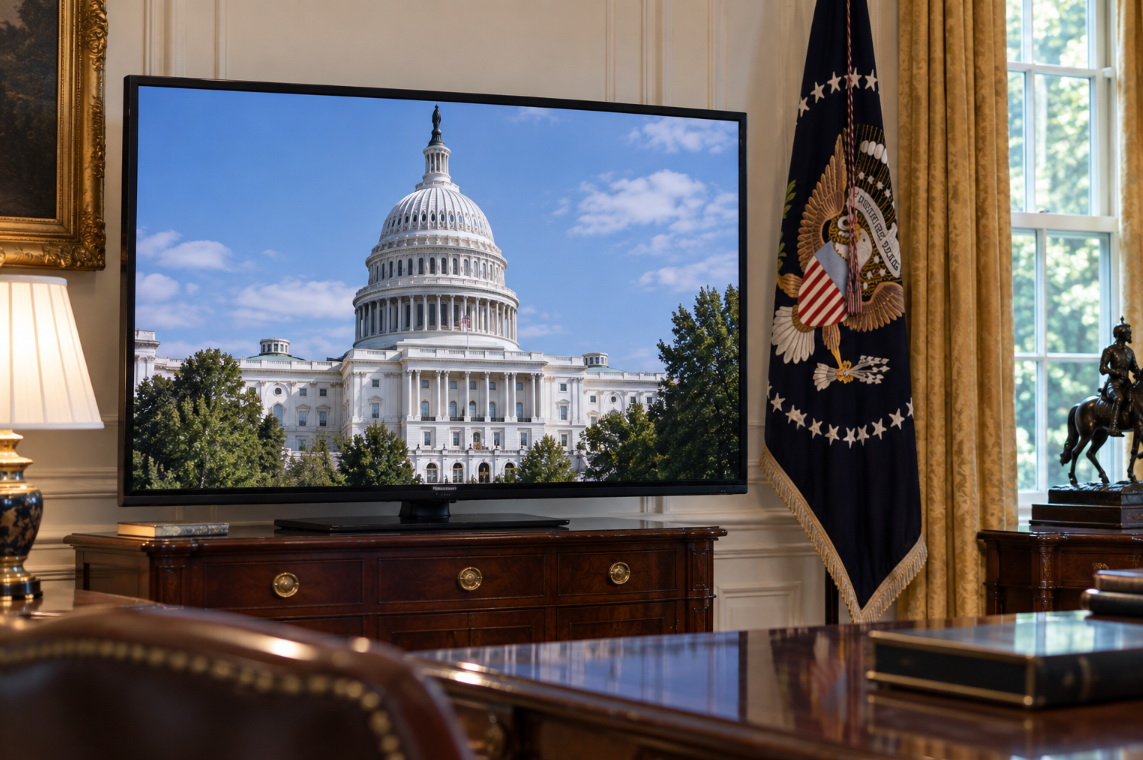
The White House has launched its own 24-hour streaming channel called “Trump TV: The Essentials Station,” arriving in the middle of an extraordinary confrontation between President Donald Trump and the independent news organizations that cover him.
The timing is difficult to ignore.
Just days before the launch, Trump barred CNN, MS NOW and Politico from the White House, revoking reporters’ access after repeatedly accusing the organizations of producing “fake news.”
The three organizations have now sued the Trump administration, arguing that the government retaliated against them because Trump dislikes their reporting and that the ban violates the First Amendment.
Then the dispute grew much larger.
The Television Pool Pushes Back
CNN had been scheduled to provide television pool coverage of Trump, footage that would ordinarily be shared with other news organizations.
After the White House prevented CNN from performing that role, the other major television networks declined to simply replace it.
ABC News, CBS News, Fox News and NBC News joined CNN in saying that no administration should restrict a news organization because it objects to its reporting.
The television pool subsequently stopped covering events designated as presidential pool coverage.
That created an unusual situation: the president of the United States was conducting official business without the customary independent television pool providing footage to the nation's news organizations.
And then came Trump TV.
Welcome to Trump TV
The White House launched “Trump TV: The Essentials Station” on September 21, describing it as a continuously updated, 24-hour stream featuring major Trump moments, presidential remarks, announcements and administration highlights.
Unlike CNN, NBC, CBS, ABC, Fox News or other independent news organizations, however, Trump TV is produced by the government it covers.
There are no independent reporters deciding which moments deserve attention.
There are no editors outside the administration determining what should be shown.
And there is no expectation that a White House-operated channel will aggressively investigate the White House itself.
The administration decides what viewers see.
That distinction matters.
From Fighting the Press to Producing the Coverage
Presidents have complained about journalists for generations. Battles between administrations and the press are hardly new.
What makes the current confrontation unusual is the combination of events.
Trump has excluded three major news organizations whose coverage he dislikes. Other television networks responded by refusing to replace CNN in the White House television pool. And almost immediately afterward, the administration unveiled its own round-the-clock video channel.
The White House says the three organizations remain free to publish whatever they want and argues that the First Amendment does not guarantee journalists access to White House property, briefing-room seats or the presidential press pool.
CNN, MS NOW and Politico argue something very different: that once the government provides press access, it cannot selectively revoke that access as punishment for unfavorable reporting.
That question is now headed to federal court.
The Government Becomes the Broadcaster
Trump TV does not prevent independent journalists from reporting on the administration, and Americans remain free to watch or read whatever news organizations they choose.
But it represents something different from traditional presidential communications.
Every White House has produced photographs, videos, speeches and promotional material. Presidents have increasingly used social media to communicate directly with Americans without journalists acting as intermediaries.
A permanent, 24-hour channel devoted to one president takes that idea considerably further.
The government is no longer merely releasing its own material.
It is packaging that material as a continuous television-style product while simultaneously fighting with independent organizations attempting to cover the president themselves.
That creates an obvious distinction viewers should understand:
Trump TV is not independent coverage of the Trump administration. It is coverage produced by the Trump administration.
An Extraordinary Moment for the White House Press
The larger story may ultimately be less about the existence of Trump TV than about the circumstances surrounding its arrival.
Within a matter of days, the White House barred three major news organizations, those organizations sued the president, major television networks stopped participating in presidential pool coverage rather than replace CNN, and the administration launched its own 24-hour stream.
Trump has spent years arguing that Americans should distrust news organizations that criticize him.
Now his administration is offering an alternative in which the White House itself controls the camera, chooses the footage and determines what makes the broadcast.
Whether Trump TV becomes an enduring feature of the presidency or merely another experiment in direct-to-audience political communication remains to be seen.
But its debut comes during one of the most consequential confrontations between the Trump White House and the American press yet.
And the question raised by its launch is bigger than whether Americans will actually watch Trump TV.
It is what happens when a president increasingly tries to decide not only who gets to cover the White House — but what version of the White House the public gets to see.