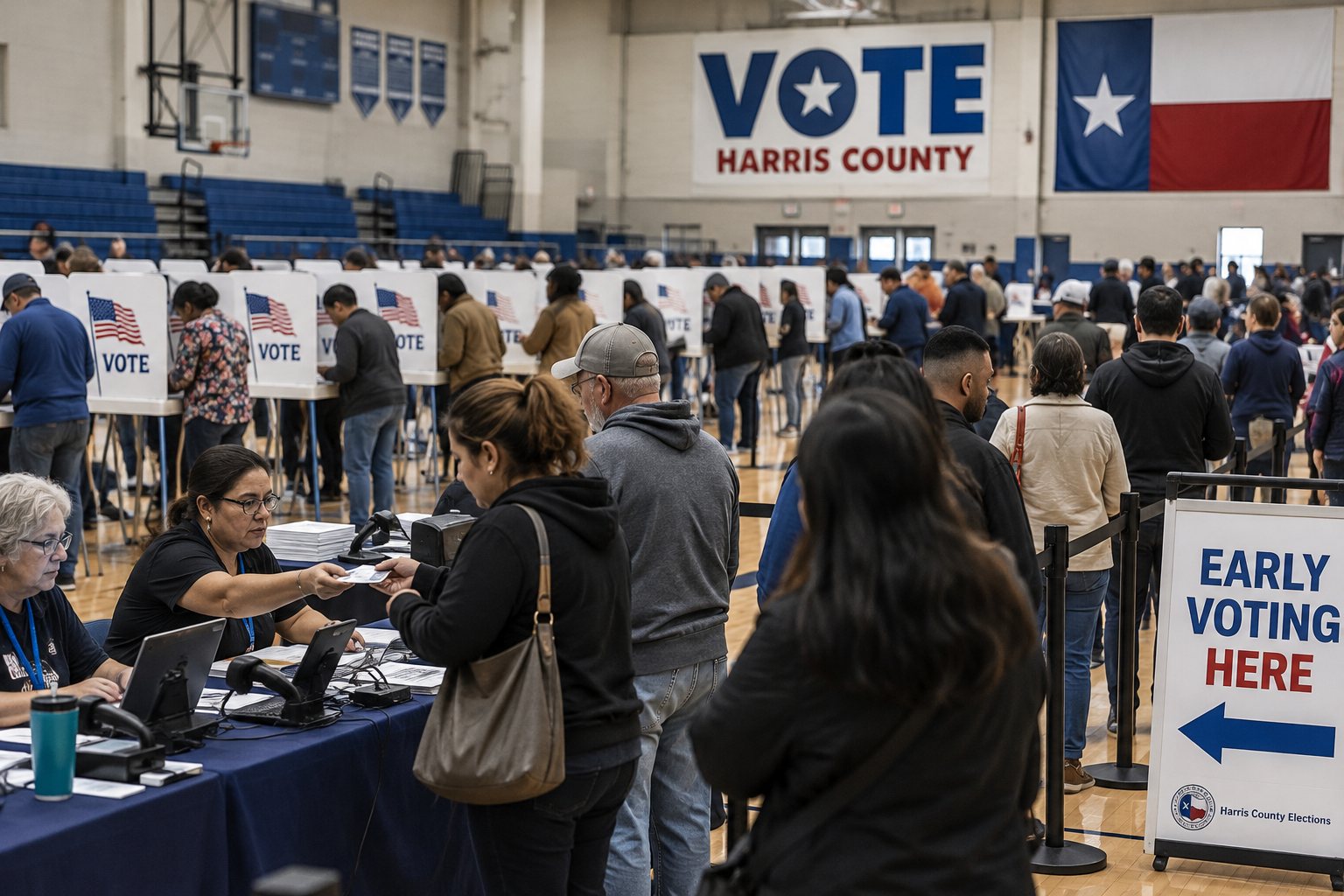
With voters turning out in record numbers ahead of the November midterm elections, the Republican-led Texas Attorney General's Office has filed a lawsuit against election officials in Harris County, raising accusations that state Republicans are interfering with efforts to encourage voter participation.
The lawsuit, filed October 29, targets a voter-information advertising campaign conducted by the Harris County Clerk's Office. The campaign encouraged residents to participate in the election, but state officials argue that its advertising methods unlawfully favored certain racial and ethnic groups.
The timing has drawn particular scrutiny.
Harris County, which includes Houston and is the most populous county in Texas, has experienced extraordinary early voting participation. More than 860,000 residents had voted by Wednesday, substantially exceeding the comparable point in the 2022 midterm election.
Rather than allowing the outreach campaign to continue unchanged, the Attorney General's Office is seeking judicial intervention just days before Election Day.
A Lawsuit Over Encouraging People to Vote
The state's complaint focuses on Facebook and Instagram advertisements that used demographic and cultural-interest targeting to reach Black, Latino, and Asian audiences.
State attorneys argue that directing voter information toward certain demographic groups while excluding others violates constitutional equal-protection guarantees.
The Attorney General's Office claims Harris County spent approximately $43,429 on the advertisements over 30 days.
Harris County Clerk Teneshia Hudspeth disputes the allegation that the campaign was unlawful.
Her office maintains that its purpose was to provide accurate, nonpartisan election information, not influence voters' candidate preferences.
Nevertheless, county officials deactivated the disputed audience-targeting settings to avoid further distractions.
Paxton's Political Conflict
The lawsuit carries additional political significance because Texas Attorney General Ken Paxton is himself running for the United States Senate against Democrat James Talarico.
Paxton has formally recused himself from the litigation because he is a candidate in the election.
However, the lawsuit remains an action brought by the state office he leads.
Democratic Congressman Christian Menefee has accused Paxton of attempting to discourage participation in Harris County, arguing that the advertisements simply helped residents understand when and how to vote.
That accusation has not been established as the lawsuit's legal purpose, but it highlights the political controversy surrounding the case.
Election Integrity or Political Interference?
The central legal question is whether government-funded voter outreach can selectively target demographic audiences without violating constitutional protections.
Texas officials maintain that all voters deserve equal access to election information and that the county's advertising practices were discriminatory.
County officials insist their outreach was lawful and intended to increase participation.
The broader concern is whether emergency litigation during an active election creates unnecessary uncertainty for administrators and voters.
The controversy is particularly consequential in Harris County, where turnout is surging and where Democrats have performed strongly in recent statewide elections.
A Troubling Election-Year Confrontation
Election officials have a responsibility to administer elections fairly, and state authorities have a legitimate role in investigating potential violations.
But those responsibilities must also be balanced against the importance of providing voters with reliable information without unnecessary disruption.
The Harris County dispute illustrates how election administration itself has become a political battleground.
With Election Day approaching, the lawsuit has intensified questions about whether Texas Republicans are protecting equal access to voting information or using legal challenges that could complicate efforts to get voters to the polls.
Ultimately, the courts must decide the legality of the advertising campaign. The political controversy surrounding its timing, however, is already unfolding.