Congressional Republicans are intensifying their defense of President Donald Trump following damaging testimony from a senior American diplomat who described an effort to pressure Ukraine into pursuing politically beneficial investigations.
Rather than directly resolving the allegations raised by Ambassador William Taylor, many Republican lawmakers are focusing their objections on the House impeachment inquiry itself, accusing Democrats of conducting an unfair and secretive process.
The response comes as the investigation examines whether Trump withheld nearly $400 million in congressionally approved military assistance to Ukraine while seeking investigations involving former Vice President Joe Biden and the 2016 presidential election.
Republicans Shift Attention to the Investigation
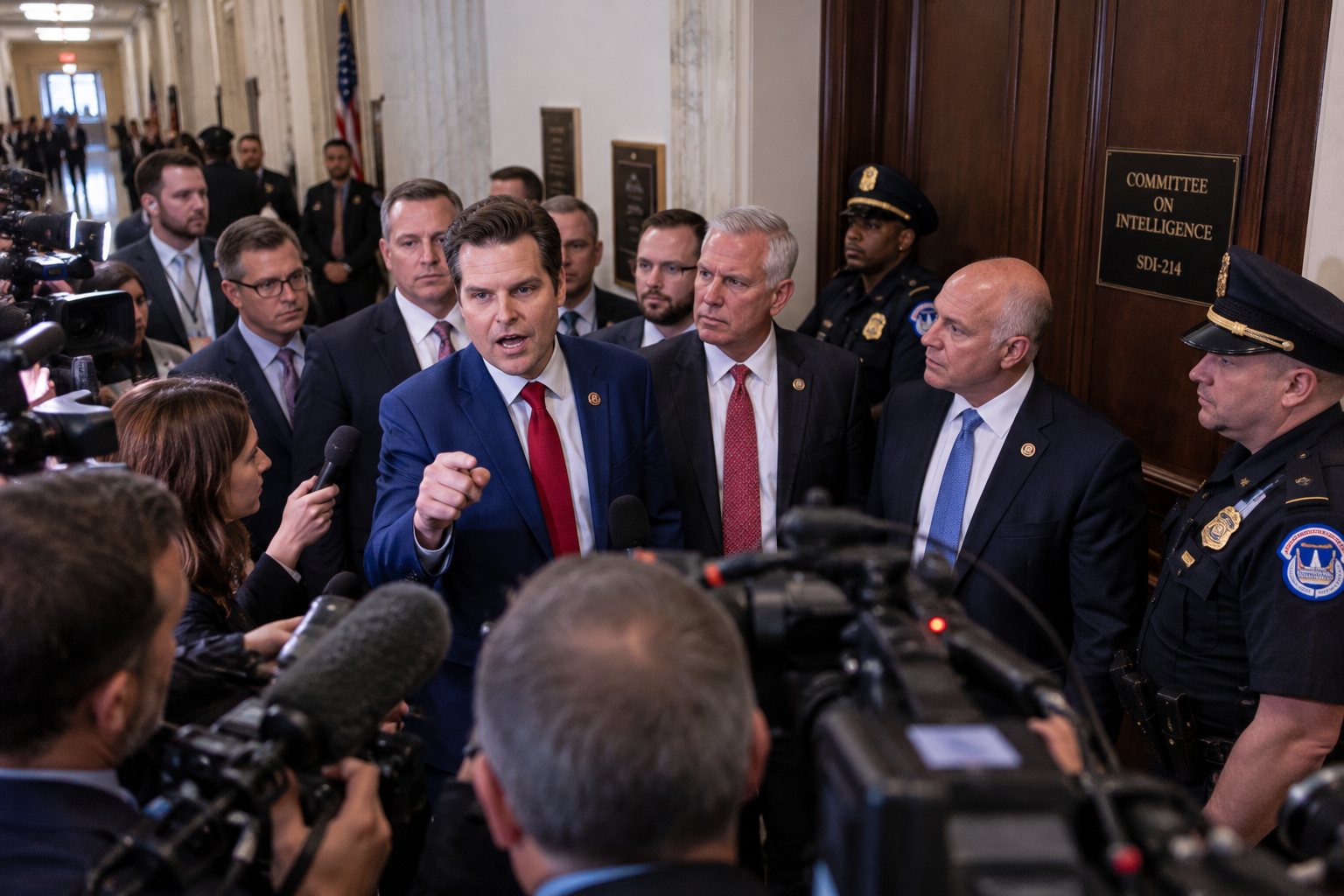
The Republican defense of Trump took an extraordinary turn Wednesday when approximately two dozen GOP lawmakers entered a secure congressional hearing area where a Pentagon official was scheduled to testify.
Led in part by Representative Matt Gaetz of Florida, the lawmakers protested the closed-door proceedings being conducted by the House committees investigating the president.
Their actions delayed the testimony of Laura Cooper, a senior Defense Department official responsible for Ukraine policy, by approximately five hours.
Several lawmakers reportedly brought electronic devices into the secure facility, where such equipment is prohibited because of security concerns.
The demonstration was intended to highlight Republican complaints that the impeachment investigation lacks transparency.
But it also shifted public attention away from the substance of the testimony that had prompted the controversy.
Republicans Were Already Participating
One of the central complaints raised by the protesting lawmakers was that Republicans were being excluded from the impeachment proceedings.
That characterization omits an important distinction.
Republican members of the House Intelligence, Foreign Affairs, and Oversight committees are permitted to attend the depositions, question witnesses, and participate in the investigation.
Approximately 47 Republican lawmakers serving on those committees have access to the proceedings.
The Republicans who entered the secure hearing room Wednesday included lawmakers who were not members of the investigating committees.
Democrats argue that the closed-door format is necessary to prevent witnesses from coordinating their testimony and to protect sensitive information.
Republicans counter that the proceedings should be more transparent and that the president deserves greater opportunities to respond to the accusations.
The disagreement concerns how the investigation is being conducted, but it does not resolve the allegations against Trump.
Taylor's Testimony Remains the Central Issue
At the center of the controversy is testimony delivered Tuesday by William Taylor, the acting American ambassador to Ukraine.
Taylor described what he understood to be an effort to condition military assistance and a White House meeting on Ukraine's willingness to publicly announce investigations sought by Trump.
The investigations included matters involving Biden, a potential Democratic opponent in the 2020 presidential election, and claims about Ukrainian involvement in the 2016 election.
Taylor's account challenged the president's repeated assertion that there had been no improper exchange involving American assistance.
The military aid was particularly important because Ukraine is engaged in an ongoing conflict with Russian-backed forces.
Congress had approved the assistance to help Ukraine defend itself.
The impeachment inquiry is examining whether the president used that assistance as leverage to obtain a personal political benefit.
Trump denies wrongdoing and maintains that his dealings with Ukraine were appropriate.
Attacking the Process Instead of the Allegations
Republican lawmakers have repeatedly characterized the impeachment inquiry as a partisan attempt to overturn the 2016 presidential election.
They have criticized House Intelligence Committee Chairman Adam Schiff, accused Democrats of conducting secret proceedings, and demanded changes to the investigation.
Some have compared the process to authoritarian methods of government.
Yet the principal allegations remain largely unanswered by those procedural objections.
Did Trump seek a public commitment from Ukraine to investigate his political rivals?
Was military assistance withheld to increase pressure on the Ukrainian government?
What role did Trump's personal attorney, Rudy Giuliani, play in communicating those demands?
And did the president place his political interests ahead of established American foreign policy?
These are the questions investigators are attempting to answer.
The fairness of the investigation is a legitimate issue for lawmakers to debate. But complaints about the process do not, by themselves, establish whether the underlying conduct occurred.
A Pentagon Witness Delayed
Wednesday's disruption prevented Laura Cooper from beginning her scheduled testimony for several hours.
Cooper serves as deputy assistant secretary of defense for Russia, Ukraine, and Eurasia.
Her responsibilities place her close to the military assistance program at the center of the impeachment investigation.
Investigators are seeking to understand why the White House delayed the release of security assistance that Congress had already approved.
Cooper eventually began testifying after the protesting Republicans left the secure area.
Her appearance is part of a growing effort by congressional investigators to establish how decisions concerning Ukraine were made and who participated in them.
The testimony also underscores the importance of hearing from officials with direct knowledge of the administration's actions.
Trump Demands Republicans Fight Harder
The confrontation on Capitol Hill follows Trump's public demands that Republican lawmakers take a more aggressive approach to defending him.
Earlier this week, the president complained that Democrats were united in their attacks while Republicans were not fighting hard enough.
He has also attacked officials cooperating with the inquiry, including Taylor.
Trump has attempted to portray Taylor as politically hostile despite the diplomat's long career in public service.
Taylor previously served as ambassador to Ukraine under President George W. Bush and returned to the country this year at the request of Secretary of State Mike Pompeo.
The president's criticism has increasingly focused on the perceived loyalties of witnesses and their attorneys rather than a detailed rebuttal of their testimony.
A Constitutional Responsibility
The Constitution gives the House of Representatives the sole power of impeachment.
It does not require the House to conduct every investigative interview in public or obtain the president's permission before questioning witnesses.
Congressional investigations routinely include private interviews, document reviews, and other evidence-gathering procedures.
Republicans argue that the current inquiry should provide additional procedural protections and that the House should formally authorize the investigation through a vote.
Democrats maintain that the committees already possess the authority to investigate possible presidential misconduct.
They have also indicated that transcripts will eventually be released and public hearings will be held.
The procedural dispute is significant, but the constitutional question extends beyond the rules governing depositions.
It concerns whether a president can use the powers of his office to pressure a foreign government into taking actions that could benefit his reelection campaign.
The Political Stakes Grow
Republican lawmakers face increasing pressure as the impeachment inquiry produces testimony from diplomats and national security officials.
Defending Trump requires them to address allegations involving foreign policy, military assistance, and presidential authority.
For some lawmakers, challenging the investigation's procedures offers a way to support the president without directly endorsing every action described by witnesses.
Democrats argue that the strategy is intended to distract from the evidence.
Republicans insist that the inquiry itself is fundamentally unfair.
The result is a growing confrontation in which arguments about congressional procedure compete with questions about presidential conduct.
The Questions Remain
The events of the past several days have placed the Trump administration's dealings with Ukraine under increasing scrutiny.
Taylor's testimony has provided investigators with a detailed account of an alleged connection between American assistance and politically advantageous investigations.
Republicans have responded with accusations of secrecy, demands for greater transparency, and a highly unusual disruption of a congressional deposition.
But the essential questions remain unresolved.
Congress approved military assistance to help Ukraine defend itself.
The Trump administration delayed that assistance.
A senior American diplomat has testified that Ukrainian officials were being pressed to announce investigations sought by the president.
Whether those actions constitute impeachable misconduct is a question Congress must ultimately confront.
For now, the Republican response has demonstrated something else: the president's allies are prepared to fight aggressively over the rules of the investigation, even as the allegations that prompted it continue to demand answers.