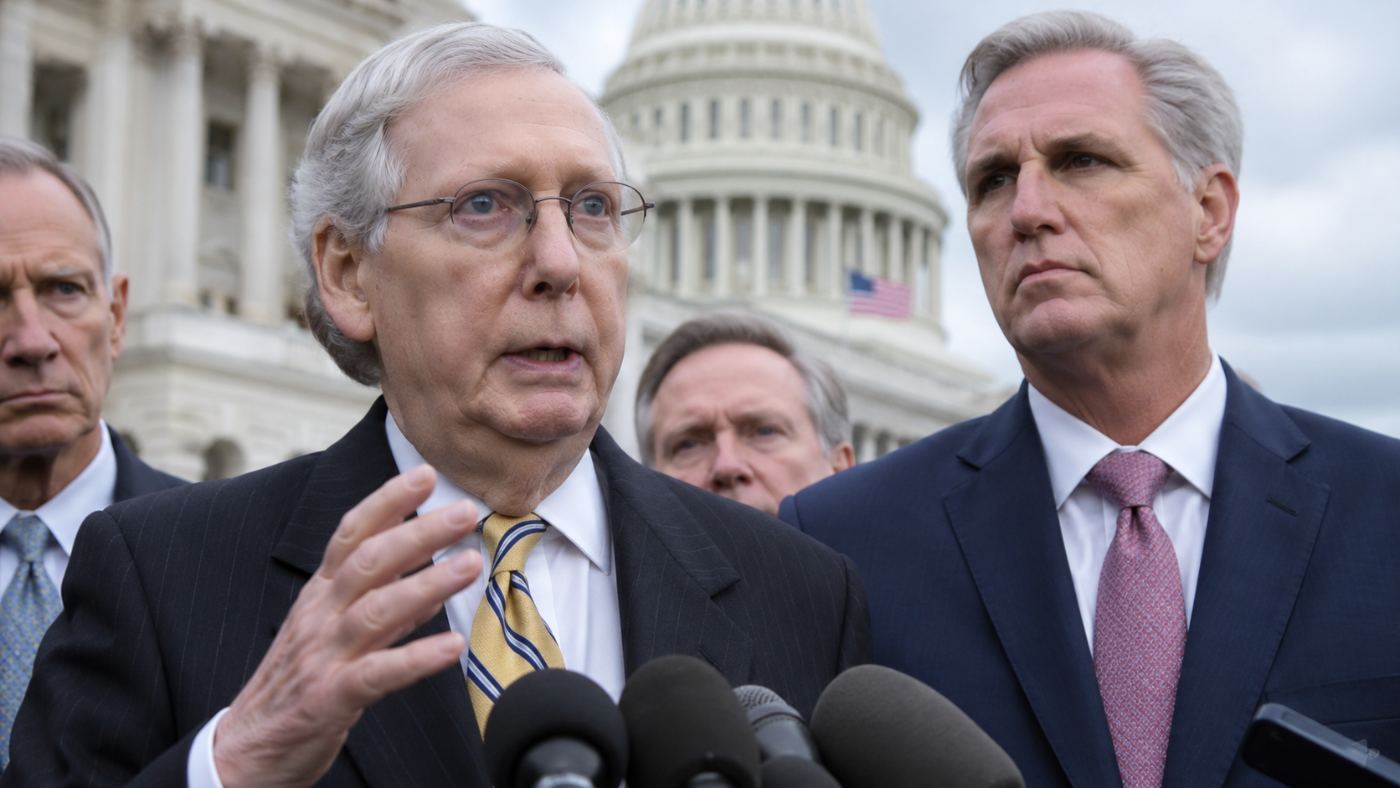
Former President Donald Trump faced public criticism from senior Republican leaders on November 29, 2022, after hosting a private dinner at Mar-a-Lago attended by white nationalist and Holocaust denier Nick Fuentes and rapper Kanye West, who had recently made a series of antisemitic statements.
The controversy placed Republican leaders in an uncomfortable position as Trump prepared another presidential campaign. While some openly criticized the meeting, others attempted to distance the party from extremism without directly confronting the former president.
Senate Minority Leader Mitch McConnell delivered one of the strongest responses.
Speaking to reporters at the Capitol, McConnell declared that antisemitism and white supremacy had no place in the Republican Party.
He also warned that political figures who associated with individuals promoting those beliefs faced serious questions about their judgment.
Although McConnell did not mention Trump by name, his remarks were widely understood as a direct response to the former president's dinner.
The controversy began with a November 22 gathering at Trump's Mar-a-Lago estate in Palm Beach, Florida.
Trump had arranged to meet with Ye, the musician formerly known as Kanye West, who was facing widespread criticism over antisemitic remarks.
Ye arrived with several guests, including Fuentes, a far-right activist known for promoting white nationalist ideas and denying the Holocaust.
Fuentes had developed a following among young far-right activists through online broadcasts and political organizing.
He had also participated in efforts supporting Trump's claims about the 2020 presidential election.
The dinner attracted widespread attention after details of the gathering became public.
Trump insisted that he had not known Fuentes would attend and claimed he was unfamiliar with the activist's background.
He described the gathering as brief and uneventful.
However, his initial public statements stopped short of explicitly condemning Fuentes or his extremist ideology.
That omission became a central issue as Republican officials were questioned about the meeting.
House Republican leader Kevin McCarthy attempted to address the controversy while avoiding a direct confrontation with Trump.
Speaking to reporters outside the White House on November 29, McCarthy stated that Fuentes had no place in the Republican Party and that nobody should be spending time with him.
But McCarthy then made a claim that was immediately challenged.
He asserted that Trump had condemned Fuentes four times.
A reporter corrected him, pointing out that Trump had said he did not know Fuentes but had not actually condemned the activist or his beliefs.
McCarthy responded by condemning Fuentes's ideology himself.
The exchange exposed a significant difference between distancing oneself from an individual and explicitly rejecting that individual's extremist views.
FactCheck.org and PolitiFact subsequently examined McCarthy's statement.
Both determined that his assertion about Trump's four condemnations was false.
Trump had issued several statements explaining that he did not know Fuentes and had not expected him to attend the dinner.
Those statements did not contain the denunciations McCarthy described.
The controversy also drew criticism from former Vice President Mike Pence.
On November 28, Pence stated that Trump had been wrong to give a white nationalist and Holocaust denier a place at his table.
Pence called on Trump to apologize and unequivocally condemn the individuals involved.
Pence nevertheless said he did not believe Trump himself was antisemitic, distinguishing his criticism of the dinner from an accusation about Trump's personal beliefs.
The dispute unfolded just two weeks after Trump announced his intention to seek the Republican presidential nomination in 2024.
Republicans were also confronting the results of the November midterm elections, in which the party had failed to achieve the sweeping congressional gains many had anticipated.
Trump's dinner added another controversy at a moment when party leaders were debating his influence over the Republican Party.
For McConnell, the issue involved both the party's public position against antisemitism and the political consequences of associating with extremists.
For McCarthy, who was seeking enough Republican support to become speaker of the House, the situation presented a different challenge.
He needed to maintain relationships with Trump's supporters while responding to questions about the former president's judgment.
His inaccurate claim that Trump had repeatedly condemned Fuentes illustrated the difficulty of balancing those competing pressures.
The controversy extended beyond congressional leadership.
Elan Carr, who had served as the Trump administration's special envoy to monitor and combat antisemitism, publicly urged Trump to condemn Fuentes and Ye.
Jewish organizations and civil rights groups also criticized the gathering, arguing that prominent political figures had a responsibility to reject antisemitism and Holocaust denial.
Later on November 29, Trump told Fox News Digital that he had not known Fuentes's views and that those views would not have been accepted had they been expressed during the dinner.
The statement went further than his earlier explanations, but it still did not amount to the four explicit condemnations McCarthy had claimed Trump had already delivered.
Trump also responded to McConnell's criticism by attacking the Senate Republican leader, calling him a loser and questioning his political standing.
Rather than resolving the controversy, the exchange highlighted the continuing tensions between Trump and Republican congressional leadership.
The November 29 developments were significant because the criticism came from within Trump's own party.
The dispute was not simply another disagreement between Democrats and Republicans.
Senior Republican officials were publicly rejecting the ideology of a man who had recently been welcomed into the former president's private residence.
Yet the responses also revealed important differences in how willing Republican leaders were to criticize Trump himself.
McConnell issued a broad warning about associating with extremists.
McCarthy condemned Fuentes while incorrectly claiming Trump had already done the same.
Pence directly criticized Trump's decision to host the gathering and called for an apology.
The episode demonstrated how Trump's associations could create political difficulties for Republican leaders attempting to maintain both party unity and a public rejection of extremist beliefs.
It also raised questions about the responsibility of prominent political figures to understand whom they invite into their circles.
Trump maintained that Fuentes was an unexpected guest whose background he did not know.
That explanation did not change the documented fact that the former president had hosted a dinner attended by a prominent white nationalist and Holocaust denier.
On November 29, 2022, the resulting controversy forced some of the Republican Party's most influential figures to address an uncomfortable question: how to condemn extremism while responding to a former president who had associated with one of its prominent advocates.
The day's public statements became part of the historical record of Trump's relationship with Republican leadership and the party's response to antisemitism and white nationalism.