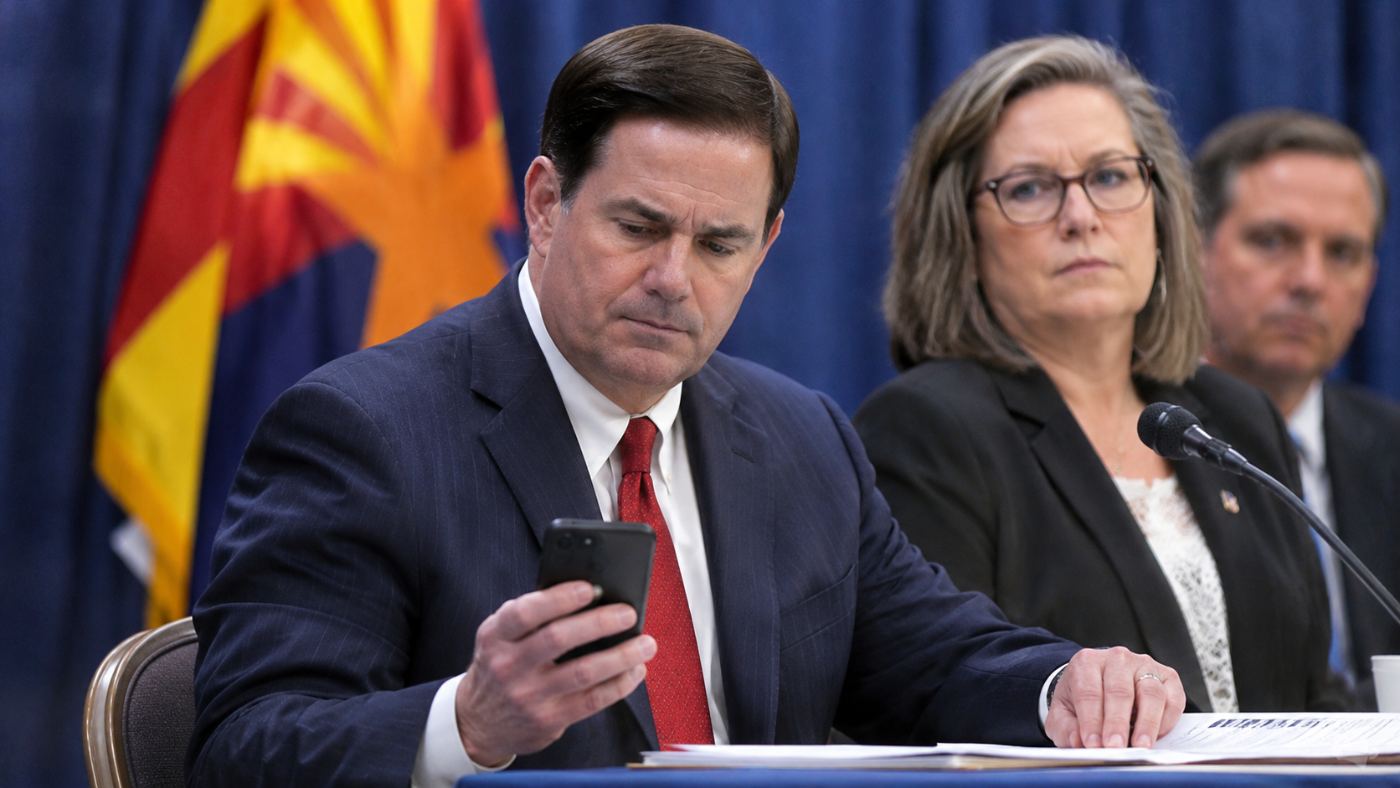
In one of the most memorable moments following the 2020 presidential election, Republican Arizona Governor Doug Ducey silenced an incoming telephone call from President Donald Trump while signing documents certifying Joe Biden's victory in the state.
The extraordinary moment unfolded during a live-streamed certification ceremony on November 30, 2020, as Arizona officials formally confirmed that Biden had defeated Trump by 10,457 votes.
As Ducey prepared to sign the official paperwork, his cellphone began playing "Hail to the Chief," the presidential anthem he had assigned as a special ringtone for calls from the White House.
Ducey reached into his jacket, removed the phone, silenced the call, and placed it aside.
He then continued certifying the election results.
The incident quickly attracted national attention because Ducey had previously explained that he assigned the distinctive ringtone to calls from Trump and Vice President Mike Pence so he would never miss an important White House communication.
Yet at the precise moment Arizona was confirming Trump's defeat, the Republican governor chose to continue the official certification ceremony rather than answer the president's call.
The symbolism was difficult to miss.
Trump had spent weeks refusing to acknowledge Biden's victory, alleging widespread election fraud and pressuring Republican officials in several battleground states to challenge the results.
Arizona was particularly significant.
The state had supported Republican presidential candidates in every election since 1996. Biden's narrow victory represented a major political setback for Trump and helped secure the Democrat's Electoral College majority.
Ducey, a Republican who had supported Trump politically, nevertheless maintained that Arizona's election procedures had produced a valid result.
State election officials had completed their canvass, and county authorities had certified their returns.
Arizona Secretary of State Katie Hobbs, a Democrat, participated in the November 30 statewide certification alongside Ducey and other officials.
The certification awarded Arizona's 11 electoral votes to Biden.
Trump's reaction was immediate.
Following the ceremony, the president publicly criticized Ducey, accusing him of rushing to install a Democratic president and warning that Republicans would remember his actions.
Trump also amplified social media posts attacking Ducey and Georgia Governor Brian Kemp, another Republican who had declined to overturn his state's election results.
The confrontation demonstrated the growing divisions within the Republican Party over Trump's refusal to accept the election outcome.
Ducey defended Arizona's election system, emphasizing that the state had established procedures for verifying results and challenging alleged irregularities.
He also explained that certification did not eliminate the opportunity for legitimate legal challenges.
Arizona law provided a limited period after certification for candidates and other eligible parties to contest election results through the courts.
Trump and his allies therefore retained legal avenues to present evidence supporting their allegations.
The certification itself was not a declaration that election procedures could never be questioned. It was the legally required recognition of the results established through the state's official canvass.
The significance of the unanswered call became even clearer years later.
In July 2023, The Washington Post reported that Trump had personally pressured Ducey to examine claims of election fraud that, if substantiated, could have reversed Biden's victory.
According to people familiar with their conversations, Trump discussed his narrow defeat and promoted allegations involving supposedly fraudulent ballots.
The reporting also revealed that Trump had repeatedly encouraged Pence to contact Ducey about the election.
Pence did speak with the Arizona governor, although he later denied pressuring him to change the results.
Ducey confirmed that he returned Trump's November 30 telephone call after the certification ceremony.
He maintained that Trump had not explicitly asked him to withhold his signature from the election certification.
The later reporting did not establish that Trump issued such a direct instruction during their conversation.
However, accounts from people familiar with the discussions indicated that Trump continued encouraging Ducey to investigate allegations that could undermine the certified result.
Those allegations never produced evidence sufficient to overturn Biden's victory in Arizona.
The incident also became part of the congressional investigation into the January 6, 2021, attack on the United States Capitol.
The House select committee documented the certification ceremony, the presidential ringtone, and Trump's subsequent public attacks on Ducey.
Its final report described the pressure placed on state officials as Trump and his allies attempted to challenge election results in states Biden had won.
Arizona was one of several battleground states where Republican officials faced demands to reconsider certified outcomes.
In Georgia, Secretary of State Brad Raffensperger resisted Trump's requests to revisit the state's vote totals.
In Michigan and Pennsylvania, Republican lawmakers and election officials faced similar pressure over the certification process.
The events raised fundamental questions about the responsibilities of elected officials when political loyalty conflicts with established election procedures.
Ducey's position was particularly noteworthy because he was not a Democratic opponent of Trump.
He was a Republican governor who had worked with the Trump administration and supported the president's reelection campaign.
Nevertheless, he signed the documents confirming that Trump had lost Arizona.
The distinction mattered because election certification is an administrative and legal responsibility, not a discretionary political endorsement.
State officials are required to follow applicable election laws and certify results established through lawful procedures, regardless of their personal preferences.
Ducey's decision to silence the incoming call did not, by itself, establish that Trump was attempting to interfere with the ceremony.
The governor later returned the call, and the precise contents of their private conversation were not publicly recorded.
But the moment occurred amid a broader, documented effort by Trump to challenge the results of an election he had lost.
The image of a Republican governor setting aside a presidential telephone call while certifying a Democratic victory became an enduring illustration of that conflict.
On November 30, 2020, Arizona completed its certification despite the president's objections.
Trump continued disputing the election, but the state's official result remained unchanged.
The episode demonstrated that even within Trump's own party, some elected officials were unwilling to substitute the president's unsupported fraud allegations for the results established by their states' election systems.
And in Arizona, that confrontation produced an unforgettable moment: the presidential ringtone sounded, the governor silenced his phone, and the certification of Biden's victory continued.