For seven years, Republicans had promised to repeal the Affordable Care Act.
They had campaigned on it.
They had voted repeatedly against it.
Donald Trump had promised voters that replacing Obamacare would be one of the defining accomplishments of his presidency.
Republicans now controlled the White House, the House of Representatives and the Senate.
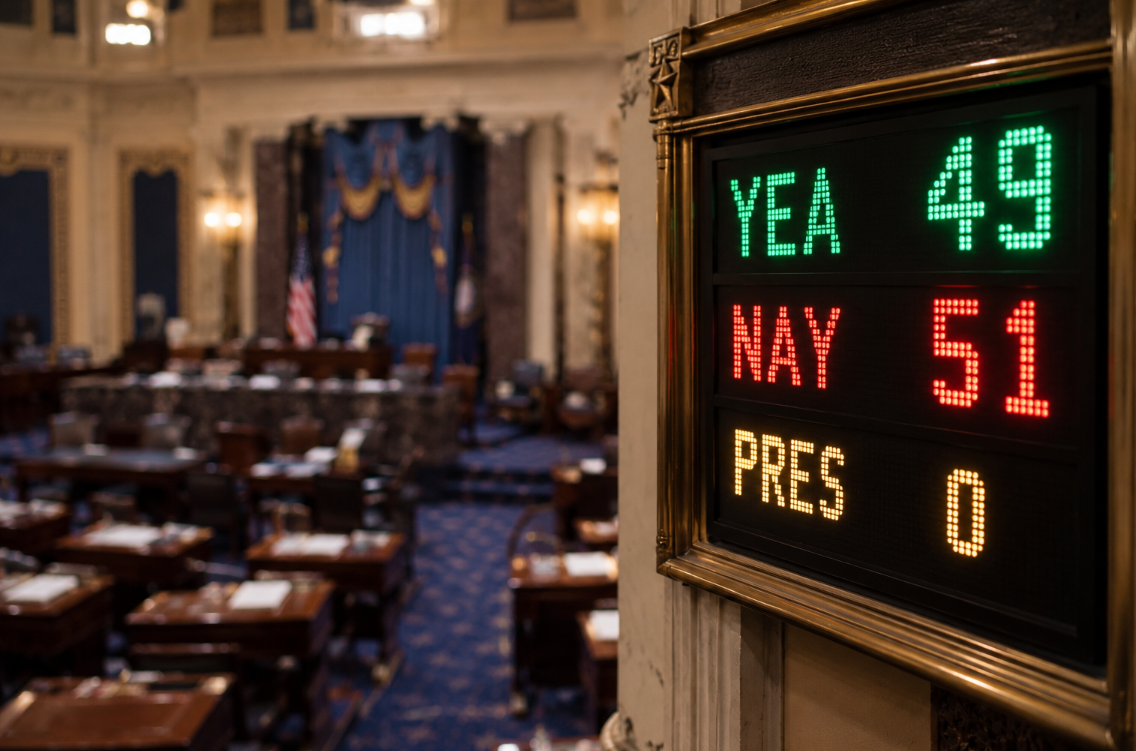
Yet shortly after 1:30 in the morning on July 28, their effort collapsed on the Senate floor.
The final vote was 49–51.
Three Republican senators—Susan Collins of Maine, Lisa Murkowski of Alaska and John McCain of Arizona—joined the Democratic caucus in voting against the proposal.
For that phase of the Republican repeal effort, it was over.
Seven Years of Promises Meet the Reality of Governing
Republican opposition to the Affordable Care Act had been a central feature of American politics since President Barack Obama signed the law in 2010.
Repealing “Obamacare” became one of the Republican Party's most consistent campaign promises.
Trump embraced that promise during the 2016 campaign.
After taking office, he repeatedly called on Congress to repeal and replace the law.
Republicans appeared to have the political alignment they needed.
They held 52 seats in the Senate.
They controlled the House.
And they had a Republican president prepared to sign repeal legislation.
But deciding what should replace the Affordable Care Act proved considerably more difficult than opposing it.
Republicans disagreed over Medicaid, insurance regulations, subsidies, taxes and how quickly the existing system should be dismantled.
Those disagreements became increasingly difficult to conceal as legislation moved through Congress.
The House Gets a Bill Through
In May, House Republicans narrowly passed the American Health Care Act.
Trump celebrated the victory with Republican lawmakers in the White House Rose Garden.
But passage in the House was only the beginning.
The Senate began developing its own legislation.
That process produced the Better Care Reconciliation Act, but Republican leaders could not assemble enough support for it.
Another proposal that would have repealed major portions of the ACA while delaying implementation also failed.
By late July, Senate Republican leaders were running out of options.
Their final strategy became known as the “skinny repeal.”
What Was the “Skinny Repeal”?
The Health Care Freedom Act was much narrower than earlier Republican proposals.
It would have repealed the Affordable Care Act's individual mandate penalties and made other changes to the law rather than replacing the entire ACA with a comprehensive new system.
But even some Republicans planning to vote for it did not necessarily want that legislation to become the final law.
The idea was to pass something through the Senate, allowing Republican senators to enter negotiations with the House and attempt to produce a broader compromise.
That created an extraordinary legislative situation.
Senators were being asked to approve legislation partly as a vehicle for negotiating something different later.
The Congressional Budget Office estimated that the proposal would result in 16 million more people being uninsured in 2026 than under existing law and that premiums in the individual market would be about 20 percent higher than under current law during much of the following decade.
Those projections intensified concerns surrounding the vote.
Collins and Murkowski Wouldn't Budge
Two Republican senators were already major obstacles.
Susan Collins of Maine opposed the Republican health-care approach.
So did Lisa Murkowski of Alaska.
Both had resisted enormous pressure from their party.
With every Democrat and the Senate's two independents expected to oppose the legislation, Republicans could afford to lose only two of their own senators if Vice President Mike Pence were available to break a 50–50 tie.
Collins and Murkowski represented those two votes.
A third Republican defection would kill the bill.
That made John McCain the center of attention.
John McCain Returns to Washington
McCain's presence in the Senate that week was already remarkable.
Days earlier, his office had announced that the Arizona senator had been diagnosed with glioblastoma, an aggressive form of brain cancer.
McCain nevertheless returned to Washington.
On July 25, he voted with Republicans to begin debate on health-care legislation.
But immediately afterward, he delivered a speech criticizing the way Congress was conducting its business.
McCain called for senators to return to committee hearings, bipartisan negotiation and what he described as the Senate's traditional legislative process.
He warned his colleagues that legislation developed behind closed doors and forced through on party-line votes was unlikely to produce durable policy.
His vote on the final legislation remained uncertain.
The Senate Waits
The drama continued deep into Thursday night and early Friday morning.
Vice President Mike Pence came to the Capitol.
If Republicans could produce 50 votes, Pence could cast the tie-breaking 51st vote.
Collins remained opposed.
Murkowski remained opposed.
Attention increasingly centered on McCain.
Senators gathered in small groups across the chamber.
McCain spoke with Democrats.
He spoke with Republicans.
He spoke with Pence.
According to contemporaneous accounts, Pence spent roughly 20 minutes talking with McCain shortly before the final vote.
Then the voting began.
Thumbs Down
Collins voted no.
Murkowski voted no.
Republicans still needed McCain.
At approximately 1:30 in the morning, McCain walked toward the Senate clerk.
The chamber watched.
McCain extended his arm.
Then he turned his thumb downward.
No.
There were audible reactions inside the chamber.
The third Republican vote against the legislation had arrived.
There would be no 50–50 tie.
Pence would not get an opportunity to break it.
The final tally was:
49 yes.
51 no.
The Senate's official record lists Collins, McCain and Murkowski among the senators voting against the amendment.
McConnell Concedes Defeat
Senate Majority Leader Mitch McConnell had spent months trying to find a version of health-care legislation capable of holding his Republican majority together.
It had failed.
After the vote, McConnell called the result “a disappointment.”
The Senate then moved on to other business.
There was no immediate Republican health-care bill waiting behind the skinny repeal.
There was no alternative proposal with enough votes.
The legislative strategy that Republicans had pursued throughout the first half of Trump's presidency had reached a dead end.
It Wasn't Just McCain
The visual image that endured from that night was McCain's dramatic thumbs-down gesture.
But the result was not produced by McCain alone.
Susan Collins voted no.
Lisa Murkowski voted no.
And the entire Democratic caucus opposed the measure.
Without Collins and Murkowski, McCain's vote would not have had the same effect.
All three Republican defections were necessary to produce the 51-vote opposition majority.
McCain supplied the dramatic final moment.
Collins and Murkowski supplied equally necessary votes.
Trump's Signature Domestic Promise Stalls
The defeat represented a major setback for one of Trump's central campaign promises.
Republicans had spent years telling voters that electing a Republican president and Republican Congress would allow them to repeal Obamacare.
Voters gave them that opportunity.
But possessing political power did not resolve the fundamental disagreements within the Republican Party over what the American health-care system should look like afterward.
Some Republicans believed the proposals went too far.
Others believed they did not go far enough.
Some worried about Medicaid reductions.
Others objected to insurance-market changes.
Still others objected to the legislative process itself.
The coalition that had spent years opposing Obamacare proved unable to agree on a replacement capable of passing the Senate.
Obamacare Survives
The Affordable Care Act had survived court challenges.
It had survived dozens of congressional repeal votes.
It had survived a presidential election in which its repeal became a central Republican promise.
Now it survived unified Republican control of Washington.
The July vote did not permanently end Republican efforts to alter the law. Congress would later eliminate the financial penalty associated with the individual mandate as part of the 2017 tax legislation, and battles over the ACA would continue in Congress, federal agencies and the courts.
But the comprehensive repeal-and-replace effort that had dominated Trump's first months in office had failed.
And it failed in one of the most dramatic Senate votes in modern political history.
At 1:30 in the morning, with senators gathered around him and the future of the legislation hanging on a single vote, John McCain walked toward the clerk.
He raised his hand.
And turned his thumb down.