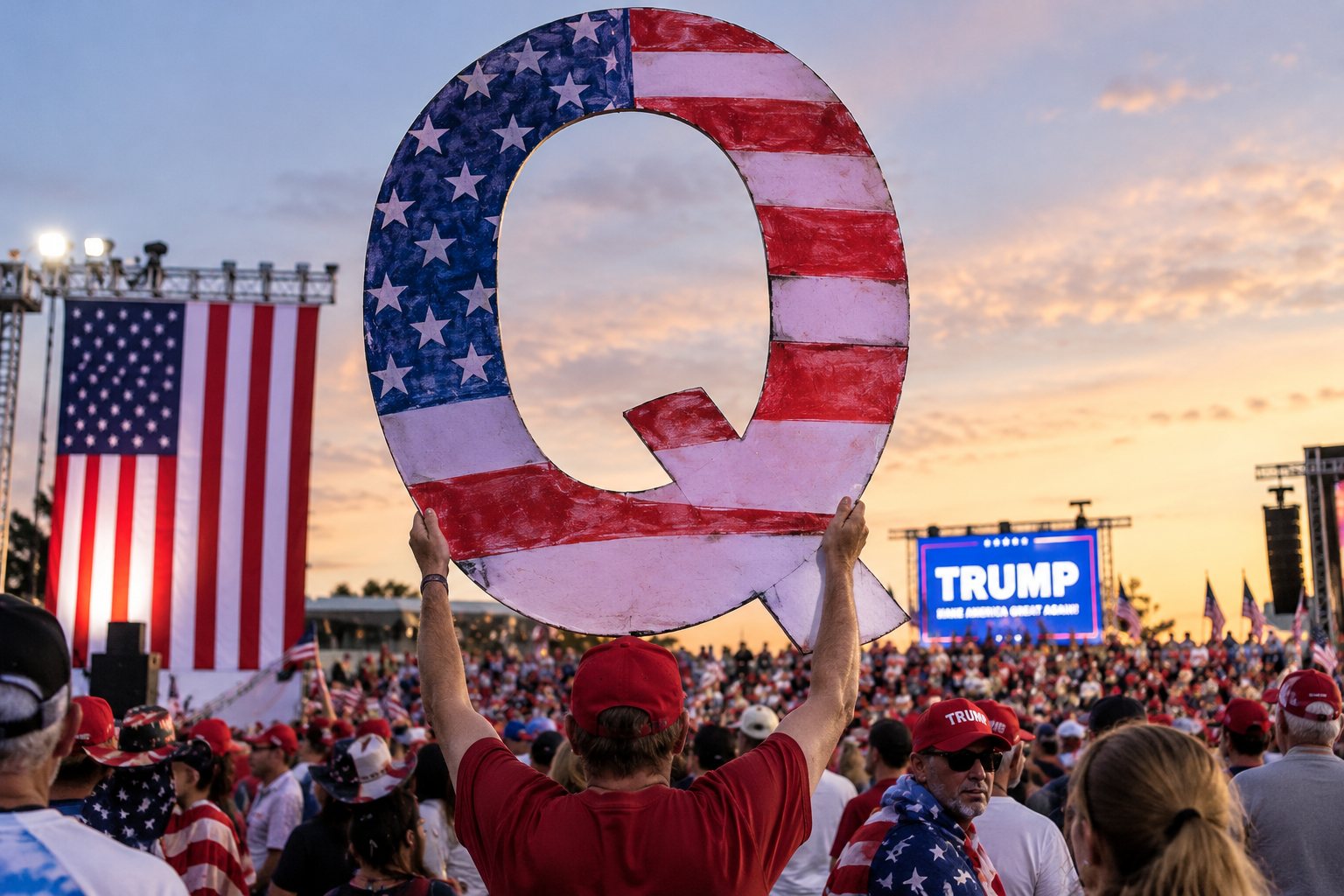
Nine years after an anonymous internet account began promising secret arrests, military tribunals and a political revolution, QAnon's most remarkable achievement may be how thoroughly its predictions failed.*
In October 2017, someone using the letter Q began posting mysterious messages on the internet forum 4chan.
The anonymous poster claimed to possess extraordinary inside knowledge about the United States government. According to the emerging conspiracy theory, Donald Trump was secretly working with military intelligence officials to destroy a vast criminal network involving Democratic politicians, Hollywood celebrities and powerful business figures.
There was no credible evidence for this extraordinary story.
Nevertheless, thousands of Americans—and eventually many more—became convinced that an anonymous account on a notoriously unreliable internet message board knew secrets unavailable to journalists, intelligence agencies and the rest of the world.
Thus began QAnon, one of the most spectacular exercises in collective gullibility in modern American political history.
Trust the Plan. Whatever That Means.
QAnon followers were repeatedly told to trust something called "the Plan."
What exactly was the Plan?
That depended on which day you asked.
Sometimes it involved the imminent arrest of Hillary Clinton. Other times it involved secret military operations, sealed indictments, emergency broadcasts or the supposed liberation of children from an international trafficking network.
The central promise was always the same: something enormous was about to happen.
Any day now.
Followers called the anticipated reckoning "the Storm." Trump's political enemies would supposedly be rounded up, prosecuted by military tribunals and sent to Guantanamo Bay.
And when none of that happened?
The explanation was simple: it was all part of the Plan.
Apparently, the Plan was so brilliant that even its complete failure was proof of its success.
The Predictions That Went Nowhere
QAnon's record of failed predictions is extraordinary.
Hillary Clinton was not secretly arrested in 2017.
There was no nationwide roundup of Democratic politicians.
Hollywood celebrities were not hauled before televised military tribunals.
The promised wave of secret indictments never materialized.
And Donald Trump did not remain president after losing the 2020 election.
That last development was particularly devastating to the movement's central mythology.
Followers had spent years insisting that Trump controlled events behind the scenes. Yet on January 20, 2021, Joe Biden was inaugurated, Trump left Washington, and the supposed master plan produced precisely none of its promised results.
A movement built around the idea that its followers possessed privileged knowledge had somehow failed to anticipate one of the most publicly documented events in American politics.
The Return of John F. Kennedy Jr.
Perhaps the most bizarre offshoot involved the belief that John F. Kennedy Jr., who died in a 1999 plane crash, was secretly alive.
Some followers convinced themselves that Kennedy would return and join forces with Trump.
In November 2021, believers gathered in Dallas near Dealey Plaza, the site of President John F. Kennedy's assassination, expecting an extraordinary appearance.
Kennedy Jr. did not appear.
Neither did his father.
The gathering became an enduring example of what happens when wishful thinking replaces evidence.
When Ridiculous Became Dangerous
It would be tempting to dismiss the entire episode as an elaborate internet prank that spiraled out of control.
Unfortunately, the consequences were not merely embarrassing.
QAnon promoted baseless accusations against innocent people, spread conspiracy theories about child trafficking and helped normalize a worldview in which political opponents were portrayed as members of a secret criminal organization.
Its narratives also overlapped with antisemitic conspiracy theories and other extremist beliefs.
On January 6, 2021, QAnon adherents were among the participants in the attack on the U.S. Capitol.
Some interpreted the violence as the beginning of the long-promised Storm.
Instead of witnessing the mass arrests they had imagined, some participants faced criminal prosecution themselves.
The irony was difficult to miss.
Then Q Disappeared
The mysterious Q stopped posting in December 2020, briefly resurfaced in 2022 and subsequently faded from view.
The person—or people—behind the account never conclusively established their identity.
No evidence emerged demonstrating that Q possessed the extraordinary government access originally claimed.
The promised revelations never arrived.
Yet the movement did not simply disappear.
Its followers migrated to alternative social media platforms, while some of its conspiracy narratives became absorbed into broader political discussions.
Researchers have documented how QAnon's ideas survived even as enthusiasm for decoding its cryptic messages diminished.
The Greatest Conspiracy Was Believing the Conspiracy
The most revealing aspect of QAnon was not any particular prediction.
It was the extraordinary willingness to excuse every failed prediction.
When something did not happen, followers were told it would happen later.
When evidence contradicted the theory, the evidence was supposedly part of the deception.
When the anonymous source disappeared, believers continued inventing explanations.
This created a system in which the conspiracy theory could never be proven wrong because every contradiction was treated as further confirmation.
Nine years after Q first appeared, the record is unmistakable.
No Great Awakening.
No secret military takeover.
No sweeping tribunals.
No mass arrests of the alleged cabal.
No triumphant revelation that the anonymous internet prophet had been telling the truth.
QAnon promised its followers that they were the only people who understood what was really happening. In reality, they were following an anonymous internet account whose most important promises never came true.
The tragedy is that what began as an absurd collection of internet fantasies did not remain harmless entertainment. It damaged relationships, fueled extremism and helped convince people that imagined conspiracies mattered more than demonstrable facts.
The Great Awakening never happened.
Perhaps the real awakening would be recognizing why so many people believed it would.