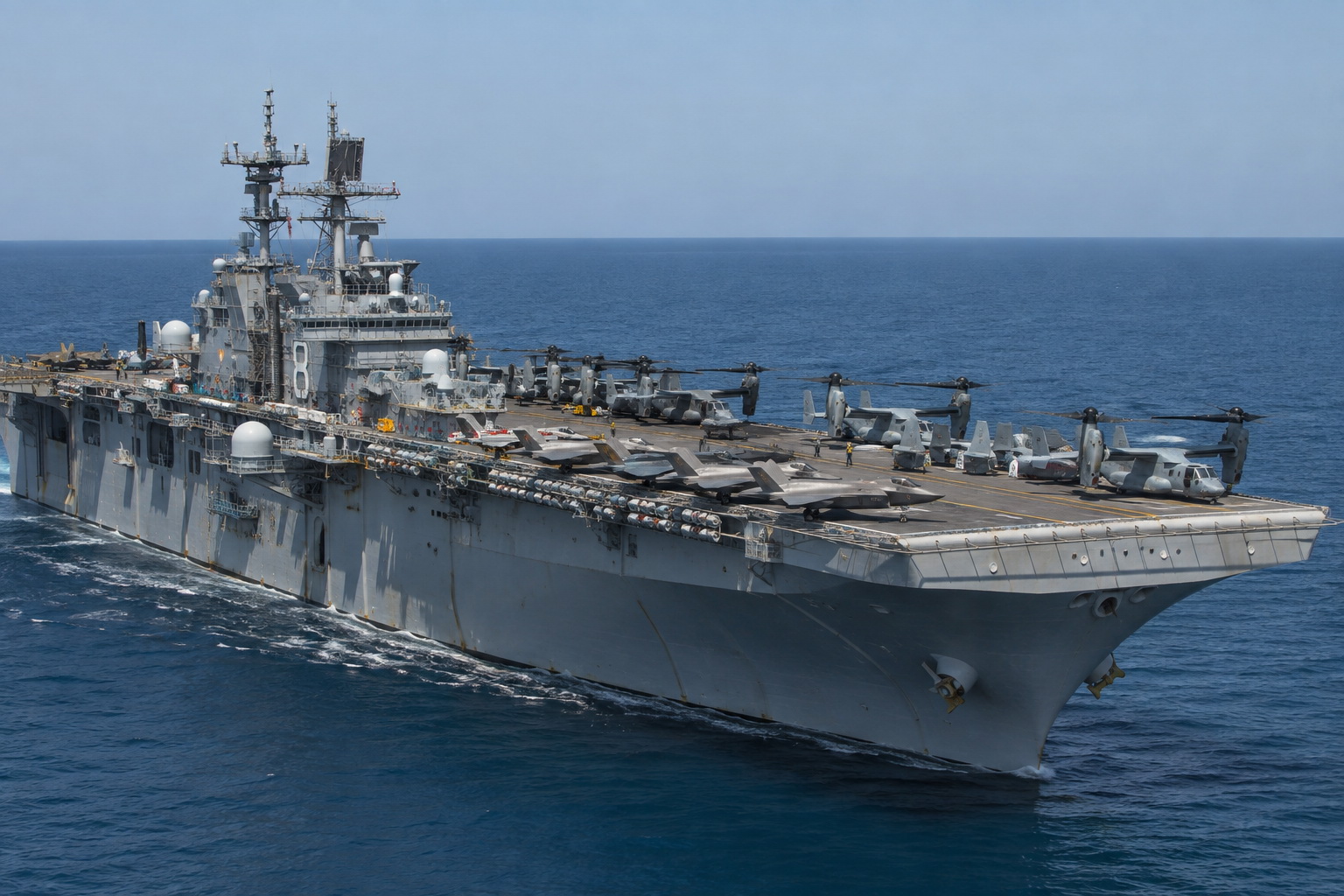
The United States is sending thousands more Marines and sailors toward the Middle East, substantially increasing American military firepower in the region as President Donald Trump openly considers another round of strikes against Iran.
The latest deployment includes the USS Makin Island Amphibious Ready Group and its embarked 13th Marine Expeditionary Unit, along with the USS Theodore Roosevelt carrier strike group.
Together, the forces heading toward the region include more than 7,000 sailors and roughly 2,000 Marines, according to U.S. officials.
The deployment comes more than seven months after the war with Iran began — and at a time when the administration is publicly leaving open the possibility of renewed large-scale military action.
Marines Head Back Toward the Fight
The Makin Island Amphibious Ready Group departed San Diego this week and consists of three amphibious warships: the USS Makin Island, USS Anchorage and USS John P. Murtha.
Aboard them is the 13th Marine Expeditionary Unit.
A Marine Expeditionary Unit is considerably more than a contingent of Marines riding aboard Navy ships. It is a self-contained Marine Air-Ground Task Force built specifically for rapid crisis response.
The 13th MEU includes Battalion Landing Team 2/4 and Combat Logistics Battalion 13, along with an aviation element equipped with aircraft including MV-22B Ospreys, AH-1Z Viper attack helicopters and F-35B Lightning II fighters.
That gives commanders a force capable of conducting operations from the sea, moving Marines ashore, providing its own aviation support and sustaining combat operations without initially requiring a large land base.
The deployment does not mean the Pentagon has decided to launch a Marine ground operation against Iran. But putting an amphibious ready group and Marine Expeditionary Unit in the region gives commanders another option should the conflict expand.
A Third Aircraft Carrier Could Join the Buildup
At the same time, the aircraft carrier USS Theodore Roosevelt and accompanying warships are also heading toward the Middle East.
Two American aircraft carriers — the USS George H.W. Bush and USS George Washington — are already operating in the region.
Depending on when ships rotate home, the arrival of the Theodore Roosevelt could temporarily put three American carrier strike groups in the Middle East.
That would represent an extraordinary concentration of U.S. naval aviation.
The last time the Navy placed three carriers in the region was earlier this year during the fighting with Iran. Before that, the United States had not concentrated three carriers there since the opening stages of the Iraq War in 2003.
The Boxer Amphibious Ready Group and its embarked 11th Marine Expeditionary Unit are also already operating in the region.
If the deployments overlap, the United States will have two major amphibious Marine forces operating alongside multiple carrier strike groups.
More Than 20,000 Sailors and Marines
The combined deployments could push the American naval presence in the Middle East above 20,000 sailors and Marines, supported by hundreds of military aircraft.
That force would provide the United States with substantially more options than airstrikes alone.
Carrier aircraft can conduct sustained strike operations. Destroyers and cruisers can launch missiles and provide air and missile defense. Amphibious ships can operate helicopters, Ospreys and F-35Bs while transporting Marines and their equipment.
The Marine Expeditionary Units add something particularly important: ground forces immediately available to commanders without first having to establish a conventional Army deployment ashore.
Their missions could range from protecting American installations and evacuating civilians to securing strategic locations or conducting raids and amphibious operations.
None of those missions has been announced.
But the capability is being moved into position.
Trump Leaves the Door Open to More Strikes
The military buildup comes as Trump continues to suggest that another major round of attacks on Iran remains possible.
The president has rejected Iran's latest ceasefire proposal and has publicly discussed the possibility of intensifying military action after the November midterm elections if an agreement with Tehran cannot be reached.
That makes the timing of the deployment difficult to ignore.
Moving carrier strike groups and amphibious forces across the globe takes time. Ships, aircraft, ammunition, logistics and thousands of personnel have to be positioned well before a president orders an operation.
Their deployment therefore does not prove that another attack has been ordered.
It does, however, ensure that the military will have substantially more forces available if one is.
A War That Was Supposed to Be Short
Perhaps the larger story is how long America's latest Middle Eastern war has already lasted.
The conflict with Iran began in late February. It is now October.
Instead of American forces drawing down, another Marine Expeditionary Unit, another amphibious ready group and another aircraft carrier are moving toward the region.
Seven months into the conflict, the United States is once again concentrating a massive amount of military power in the Middle East.
Whether those forces ultimately serve as leverage for negotiations, reinforce the existing American presence or participate in another round of fighting remains unknown.
But one thing is unmistakable:
The Pentagon is making sure the forces are there.