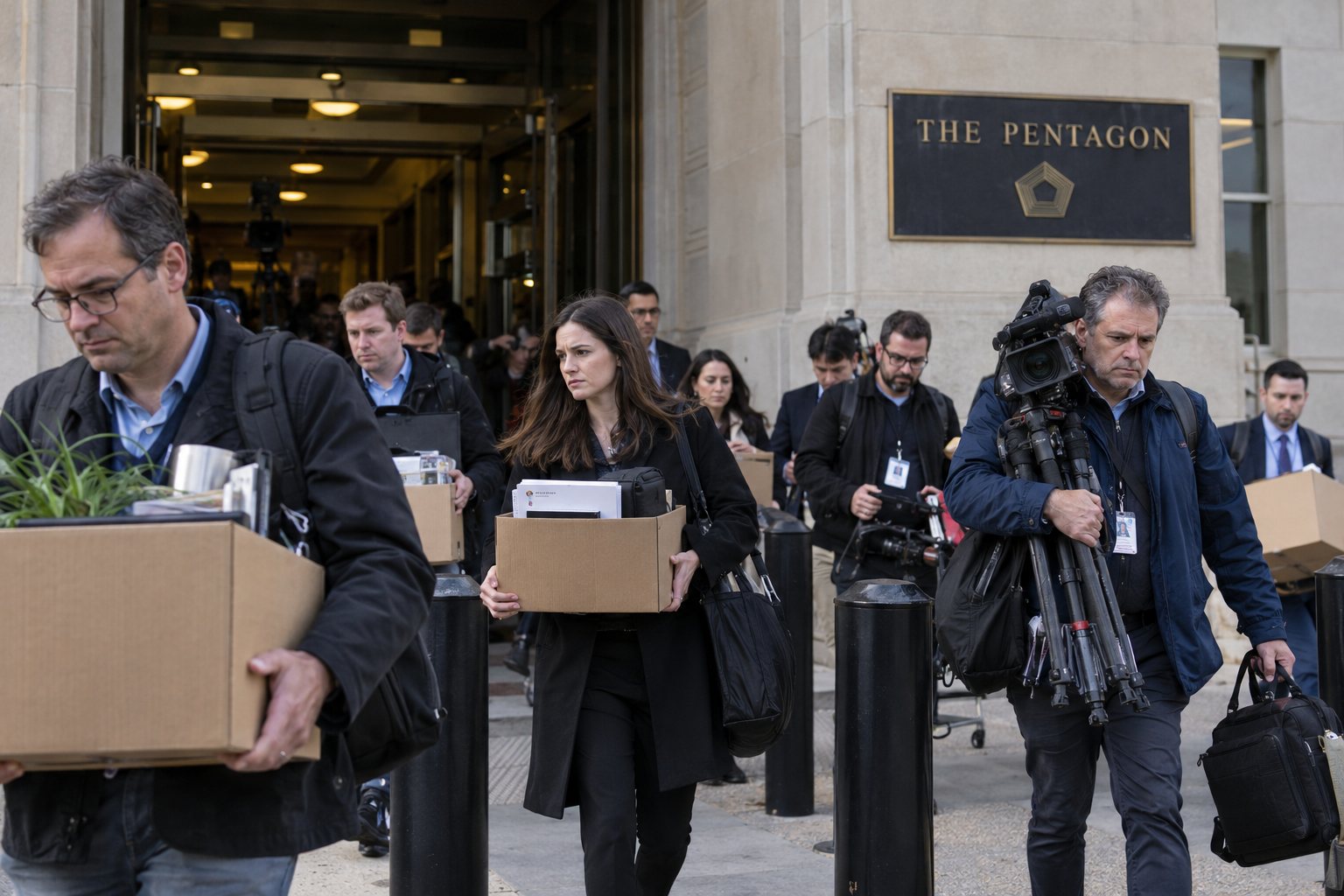
The Pentagon entered October 16, 2025, facing an extraordinary confrontation over press freedom after journalists representing nearly every major American news organization surrendered their Pentagon credentials rather than accept new reporting restrictions imposed by Defense Secretary Pete Hegseth.
The previous afternoon, dozens of reporters had packed their belongings, emptied their offices, returned their identification badges, and walked out of the headquarters of the United States military.
They were not protesting a single denied interview or a disagreement over a news story.
They were rejecting a new Pentagon policy that could result in reporters losing their access credentials for seeking information that defense officials had not authorized for release.
The restrictions covered not only classified material but also certain unclassified information.
For journalists who routinely investigate military operations, government spending, personnel decisions, and national security policy, that distinction was critical.
By October 16, the Pentagon's longstanding system of independent, on-site reporting had been dramatically disrupted.
The Trump administration defended the new rules as necessary for military security.
News organizations across the political spectrum argued that the policy threatened the basic ability of journalists to independently investigate the government.
Reporters Walk Out Together
On October 15, roughly 40 to 50 journalists left the Pentagon together after turning in their credentials.
The departure followed a deadline imposed by the Defense Department requiring reporters to acknowledge the new media policy or surrender their building access and workspaces.
For many correspondents, the Pentagon had been their regular workplace.
Reporters had maintained offices inside the building, attended briefings, developed sources, and gathered information about military activities around the world.
As the deadline approached, journalists carried boxes, books, equipment, and personal belongings out of their offices.
The Pentagon Press Association, which represents journalists covering the Defense Department, condemned the restrictions and warned that they threatened the public's ability to receive independent information about the military.
The departure was not a decision to stop reporting on the Pentagon.
Journalists said they would continue covering the military from outside the building.
But losing routine access to its headquarters meant that gathering information would become more difficult.
The immediate question was whether the Pentagon could impose conditions on access that journalists believed interfered with their constitutionally protected work.
What Hegseth's New Rules Required
The Pentagon's new media policy established conditions for journalists who wanted to receive or retain press credentials.
Under the rules, reporters could face the loss of their credentials if they sought information that the department had not authorized for release.
The policy addressed classified information but also extended to certain unclassified material.
That provision became one of the central objections raised by news organizations.
Journalists routinely ask government officials about matters that have not been publicly announced.
Those questions may concern military deployments, weapons programs, contracting decisions, disciplinary actions, operational failures, or disagreements within the chain of command.
Some information is classified because disclosure could endanger military personnel or compromise national security.
But other information may simply be embarrassing, politically inconvenient, or not yet approved for public discussion.
News organizations argued that a policy penalizing reporters for seeking unauthorized information could discourage ordinary investigative reporting.
The rules also imposed additional limits on journalists' movement inside the Pentagon, including requirements for escorts when visiting certain offices or areas.
The Pentagon said the measures were intended to protect sensitive information and establish appropriate security procedures.
Critics argued that the combined restrictions gave defense officials excessive control over what reporters could investigate.
Even Conservative News Organizations Refused to Sign
One of the most striking aspects of the confrontation was the breadth of opposition.
The organizations rejecting the policy included major television networks, newspapers, wire services, digital publications, and specialized military news outlets.
Among them were the Associated Press, Reuters, The New York Times, The Washington Post, The Wall Street Journal, CNN, NBC News, ABC News, CBS News, NPR, Bloomberg News, Politico, and The Atlantic.
But opposition was not confined to organizations frequently criticized by Trump.
Fox News, Newsmax, and The Washington Times also rejected the policy.
Newsmax publicly described the requirements as unnecessary and burdensome.
That made the dispute difficult to characterize as a conventional disagreement between the Trump administration and liberal news organizations.
The objections came from journalists and editors representing widely different political audiences.
Their common concern was that the Pentagon's rules could interfere with independent newsgathering.
By October 16, the issue had become a dispute over the conditions under which the American press could investigate its own military.
Only a Small Number Accepted the Policy
The scale of the rejection became clearer on October 16.
According to a Washington Post report based on an internal government document, only 15 journalists had signed the Pentagon's new policy by Thursday afternoon.
The signatories included representatives associated with The Federalist, One America News, and The Epoch Times, along with some independent journalists and reporters working for overseas publications.
The small number stood in sharp contrast to the broad refusal among established Pentagon correspondents.
The Federalist argued that the rules did not impose meaningful new restrictions.
Other organizations that accepted the policy defended their decisions as consistent with their ability to continue reporting.
Their participation demonstrated that not every journalist agreed with the press corps' interpretation of the rules.
Nevertheless, the overwhelming majority of major American news organizations chose to surrender their credentials rather than acknowledge the new conditions.
The result was an unprecedented disruption of the Pentagon's regular relationship with its independent press corps.
The Pentagon Says the Restrictions Protect National Security
The Trump administration rejected accusations that it was attempting to suppress independent journalism.
Pentagon officials described the rules as reasonable security requirements.
Chief Pentagon spokesman Sean Parnell defended the policy, arguing that it served American troops and national security.
Hegseth and other officials maintained that reporters should not have unrestricted access to sensitive areas or information.
The government has legitimate reasons to protect classified military intelligence, operational plans, troop movements, and other information whose disclosure could endanger personnel or missions.
Reporters do not have an unlimited constitutional right to enter military installations or demand access to classified documents.
The Pentagon also has authority to establish physical security procedures for its headquarters.
But the dispute was not simply about whether journalists should be allowed to wander through secure military offices.
News organizations objected to language that they believed could punish reporters for asking questions or soliciting information that had not been approved for public release.
The difference between protecting classified information and restricting the pursuit of unapproved information became the central issue.
The First Amendment Dispute
The First Amendment prohibits the government from making laws abridging freedom of speech or freedom of the press.
Those protections do not guarantee reporters unrestricted access to every government facility.
But they do protect a broad range of journalistic activities, including gathering information from willing sources and publishing newsworthy material, subject to applicable laws.
The Pentagon policy raised questions about how those protections applied to access credentials.
News organizations argued that journalists could be penalized for routine reporting activities that would otherwise be lawful.
They also questioned whether government officials should be able to revoke access because a reporter sought information the administration preferred not to disclose.
The Pentagon maintained that signing the document did not require journalists to surrender their constitutional rights.
Its position was that reporters were acknowledging security and access procedures, not agreeing to government censorship.
The opposing interpretations were significant.
One side viewed the rules as an administrative framework for protecting military information.
The other viewed them as a threat to independent reporting that could give officials excessive discretion to punish unwanted inquiries.
No court ruling on October 16 had resolved those competing interpretations.
Why Independent Pentagon Reporting Matters
The Pentagon oversees one of the largest and most consequential institutions in the federal government.
Its decisions affect hundreds of thousands of military personnel, civilian employees, contractors, and families.
Its budget involves enormous public expenditures.
Its operations can determine whether American forces are deployed overseas, whether weapons systems are purchased, and whether the United States becomes involved in military conflicts.
Many important defense stories have emerged because journalists obtained information beyond official press releases.
Investigative reporting has exposed problems involving military housing, sexual assault, weapons procurement, civilian casualties, failures in veterans' care, and questionable defense spending.
Not every disclosure is flattering to military leaders.
Some reporting reveals misconduct.
Other reporting identifies problems that commanders themselves may want corrected.
The public interest in independent defense journalism therefore extends beyond political disputes.
Military operations are conducted in the name of the American people and funded with public money.
Journalists play a role in examining whether those operations are lawful, effective, and consistent with the government's public explanations.
The loss of routine access to Pentagon officials and sources could make that oversight more difficult.
The Walkout Comes During Controversial Military Operations
The timing of the confrontation was particularly consequential.
The Trump administration was conducting a series of lethal military strikes against vessels it accused of involvement in drug trafficking in the Caribbean.
By October 16, five publicly announced strikes had reportedly killed 27 people.
The administration had not publicly disclosed the evidence necessary to independently verify the allegations against those killed.
Legal specialists and lawmakers were questioning the authority used to conduct the attacks.
At the same time, the United States was expanding its military presence near Venezuela.
President Trump had also acknowledged authorizing covert CIA operations involving the country.
Those developments created an immediate need for detailed reporting about military decision-making.
Journalists had questions about the legal basis for the strikes, the intelligence used to identify targets, the military chain of command, and the possibility of broader regional operations.
The Pentagon's new restrictions arrived during precisely the kind of period when independent defense reporting could be especially important.
There was no public evidence establishing that the new press policy was specifically designed to suppress reporting about the Caribbean strikes.
But its implementation during the campaign raised additional concerns among journalists about access to information concerning the use of American military force.
A Broader Pattern of Tensions With the Press
The Pentagon dispute did not occur in isolation.
Since returning to office in January 2025, Trump and his administration had engaged in several confrontations with news organizations over access and reporting.
Earlier in the year, the White House restricted the Associated Press' access to certain presidential events following a dispute over the news organization's continued use of the name Gulf of Mexico rather than the administration's preferred name, Gulf of America.
The Pentagon had also changed the allocation of office space for several news organizations, introducing a rotation system that displaced some longstanding correspondents.
Those decisions prompted objections from journalists who argued that government access should not depend on whether officials approved of a news organization's coverage.
The administration maintained that it had authority to manage press access and challenge reporting it considered unfair or inaccurate.
The October 2025 restrictions expanded that conflict to the day-to-day work of journalists covering the armed forces.
The issue was no longer limited to who could attend a briefing or occupy a particular office.
It concerned whether reporters could retain Pentagon credentials while independently seeking information that officials had not approved for release.
Press Freedom Organizations Condemn the Restrictions
On October 16, PEN America issued a statement criticizing the Pentagon's new rules and the resulting departure of journalists.
The organization described the loss of independent press access as a major retreat from government transparency.
Its criticism centered on the distinction between legitimate security protections and restrictions that could shield government actions from public scrutiny.
The Pentagon Press Association likewise maintained that its members would continue reporting despite losing their credentials.
The organization warned that the new rules could undermine accountability and weaken the public's ability to understand military operations.
These criticisms reflected the positions of press freedom advocates, not a judicial determination that the Pentagon had violated the Constitution.
But they demonstrated how seriously the restrictions were being taken by organizations dedicated to independent journalism.
The Difference Between Security and Secrecy
Every military organization must protect information that could endanger personnel or compromise operations.
The United States has legitimate national security interests in preventing unauthorized disclosure of classified intelligence.
But there is a difference between protecting operational secrets and preventing journalists from asking questions.
Reporters often uncover important information precisely because it has not been included in official government announcements.
The public may learn about a failed military program, an improper contract, an operational mistake, or misconduct only after journalists contact sources outside formal public affairs channels.
A policy that discourages those inquiries could reduce the amount of independently verified information available to the public.
The Pentagon argued that its rules did not prohibit lawful reporting.
News organizations argued that the risk of losing credentials for soliciting unapproved information created an unacceptable deterrent.
The disagreement exposed a fundamental tension between government control over sensitive information and the press's responsibility to investigate public institutions.
A Pentagon Without Its Established Press Corps
By October 16, 2025, the Pentagon's relationship with the national news media had undergone a dramatic change.
Journalists who had worked inside the building were now reporting from outside it.
Most major news organizations had refused the administration's conditions.
Only a small number of journalists had accepted the policy.
And the Defense Department was defending restrictions that many reporters believed threatened their ability to perform basic newsgathering activities.
The journalists had not abandoned their responsibility to cover the military.
They had refused to accept conditions they believed would compromise their independence.
The administration, meanwhile, insisted that the restrictions were reasonable measures to protect national security.
The result was an extraordinary standoff: the headquarters of the world's most powerful military had lost the routine presence of much of the independent press corps that had covered it for decades.
The central question was not whether military secrets should be protected.
It was whether protecting those secrets required giving Pentagon officials greater power over the questions journalists could ask and the information they could seek.
On October 16, 2025, that dispute remained unresolved.
And as American forces conducted lethal operations abroad, the reporters responsible for scrutinizing those decisions were facing new barriers to doing their jobs.