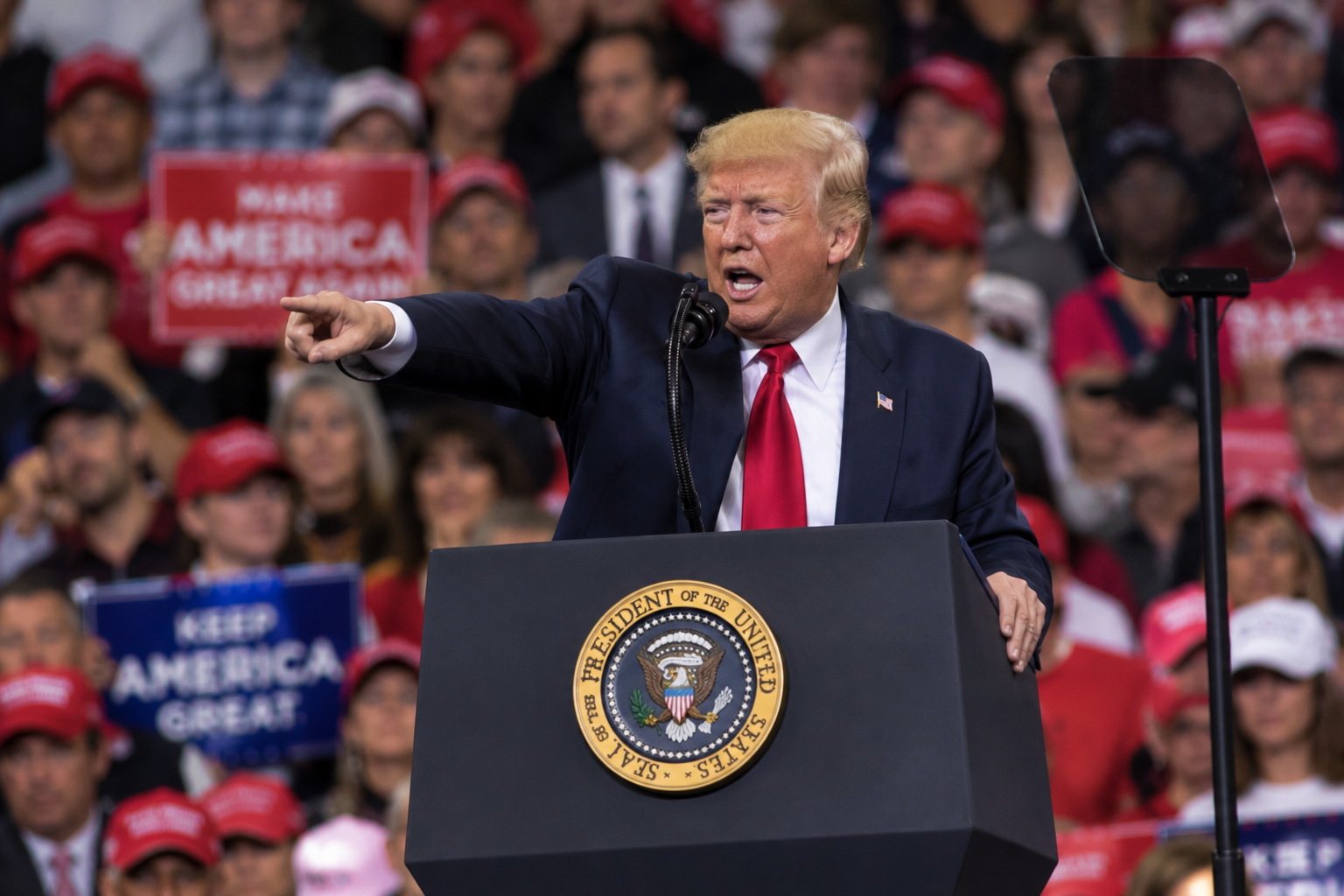
Donald Trump was attacking Joe Biden and his son Hunter from the campaign stage.
At the same time, inside the halls of Congress, the impeachment investigation into Trump's own dealings with Ukraine was getting deeper.
On October 11, 2019, former U.S. Ambassador to Ukraine Marie Yovanovitch appeared before House investigators and described how she had been abruptly removed from her diplomatic post after what she called a campaign built on “unfounded and false claims.”
Her testimony came hours after Trump used his first campaign rally since the impeachment inquiry began to intensify his attacks on the Bidens — the same political family Trump had urged Ukraine to investigate.
The two events illustrated the extraordinary political conflict unfolding in Washington.
Trump argued that the Bidens deserved investigation.
Congress was investigating whether Trump had improperly used the power of the presidency to pressure a foreign government to investigate them.
“Where's Hunter?”
The night before Yovanovitch's testimony, Trump appeared before thousands of supporters at the Target Center in Minneapolis.
It was his first campaign rally since House Speaker Nancy Pelosi announced the formal impeachment inquiry on September 24.
Trump was defiant.
Rather than retreat from his allegations against the Bidens, he amplified them.
“Where's Hunter?” Trump asked the crowd.
He mocked Hunter Biden's business experience and attacked Joe Biden personally.
Trump portrayed the impeachment investigation as an effort by Democrats to overturn the result of the 2016 election.
“They want to erase your vote like it never existed,” he told supporters.
Trump's son Eric also attacked Hunter Biden, prompting some members of the crowd to chant:
“Lock him up!”
It was a remarkable reversal.
Trump was facing an impeachment investigation largely because of his effort to have Ukraine investigate the Bidens.
His political response was to intensify the accusations against the Bidens.
Why Hunter Biden Was in the Story
Hunter Biden had joined the board of Burisma, a Ukrainian natural-gas company, in 2014 while his father was vice president and deeply involved in U.S. policy toward Ukraine.
That arrangement created legitimate questions about appearances and potential conflicts of interest.
Hunter Biden had no significant background in Ukraine or the natural-gas industry when he joined the company's board.
Trump and his allies went much further, however.
They alleged that Joe Biden had used his position as vice president to pressure Ukraine into firing Prosecutor General Viktor Shokin in order to protect Burisma and his son.
The evidence did not support that version of events.
Biden did pressure Ukraine to remove Shokin.
But he was carrying out official U.S. policy, which was supported by other Western governments and international institutions concerned that Shokin was failing to aggressively combat corruption.
There was no established evidence that Joe Biden sought Shokin's removal in order to protect Hunter Biden.
That distinction was increasingly lost in Trump's campaign rhetoric.
The Phone Call
At the center of the impeachment inquiry was Trump's July 25 telephone conversation with newly elected Ukrainian President Volodymyr Zelensky.
According to the White House's own memorandum of the call, Trump asked Zelensky to investigate matters involving the 2016 election and later raised Joe and Hunter Biden.
Trump told Zelensky:
“There's a lot of talk about Biden's son.”
He then discussed Joe Biden and asked Zelensky to have Ukrainian officials look into the matter.
Trump also repeatedly directed Zelensky toward Rudy Giuliani, Trump's personal attorney.
The call occurred while congressionally approved U.S. military assistance to Ukraine had been temporarily withheld.
Investigators were trying to determine why that assistance had been frozen and whether Trump had attempted to use presidential power to obtain investigations that could benefit him politically.
Trump denied wrongdoing and repeatedly described the call as “perfect.”
Then Came Marie Yovanovitch
On October 11, another piece of the Ukraine story moved directly into the impeachment inquiry.
Marie Yovanovitch had served as U.S. ambassador to Ukraine since 2016.
A career Foreign Service officer, she had served under both Republican and Democratic administrations.
Her assignment in Ukraine was supposed to continue into 2020.
Instead, she was abruptly recalled in May 2019.
Yovanovitch told congressional investigators she had been instructed to return to Washington “on the next plane.”
She said Deputy Secretary of State John Sullivan later informed her that Trump had lost confidence in her and no longer wanted her serving as ambassador.
But according to Yovanovitch, Sullivan also told her something else:
She had done nothing wrong.
“Unfounded and False Claims”
Yovanovitch told investigators that she was “incredulous” that her diplomatic assignment had been cut short.
She said her removal appeared to have resulted from a campaign against her based on “unfounded and false claims by people with clearly questionable motives.”
Those claims included accusations that Yovanovitch was hostile toward Trump and had attempted to prevent Ukrainian authorities from investigating corruption.
She categorically denied those allegations.
She specifically rejected claims that she had created or circulated a Ukrainian “do not prosecute” list.
The former Ukrainian prosecutor who had helped spread that allegation had himself subsequently retracted it.
Yovanovitch also denied ever telling Ukrainian officials not to investigate legitimate corruption.
And she said she had never met Hunter Biden.
Rudy Giuliani's Role
One name repeatedly appeared in the story:
Rudy Giuliani.
Trump's personal attorney had been conducting his own effort to communicate with Ukrainian officials outside normal State Department diplomatic channels.
Giuliani was seeking information about the Bidens and about allegations involving Ukraine and the 2016 election.
He had also publicly criticized Yovanovitch.
Yovanovitch told investigators that she did not know precisely why Giuliani had targeted her.
But she suggested that individuals associated with him may have viewed the embassy's anti-corruption policies as obstacles to their personal financial ambitions.
Her testimony raised a fundamental question:
Why was the president's personal attorney involved in shaping American diplomacy toward Ukraine at all?
Giuliani held no government position.
He had not been confirmed by the Senate.
He was not an ambassador.
He was Donald Trump's private lawyer.
Yet he had become deeply involved in a shadow diplomatic effort involving a foreign government and investigations potentially beneficial to Trump's reelection campaign.
Two Giuliani Associates Had Just Been Arrested
The timing made Yovanovitch's testimony even more significant.
Only one day earlier, federal prosecutors announced campaign-finance charges against two Giuliani associates involved in his Ukraine efforts: Lev Parnas and Igor Fruman.
The men had been arrested at Dulles International Airport as they prepared to board an international flight.
Federal prosecutors alleged that Parnas and Fruman participated in schemes designed to conceal the source of political contributions and funnel foreign money into American politics.
The indictment also described efforts involving the removal of the U.S. ambassador to Ukraine.
Yovanovitch was that ambassador.
Suddenly, several seemingly separate stories were converging.
Giuliani's effort to investigate the Bidens.
Yovanovitch's removal.
Parnas and Fruman.
Trump's July telephone call.
Military assistance to Ukraine.
And the House impeachment inquiry.
They were becoming pieces of the same investigation.
Trump Distances Himself
On October 11, Trump was asked whether Giuliani was still his personal attorney.
His answer was unusually uncertain.
Trump said he didn't know, then noted that he had spoken with Giuliani briefly the previous day and described him as a very good attorney who had represented him.
Giuliani subsequently confirmed that he was still Trump's lawyer.
Trump was also asked about Yovanovitch.
He said he did not know her personally and suggested she might be a nice woman.
But the memorandum of Trump's July call with Zelensky showed that Trump had already discussed her directly.
Trump had called the former ambassador “bad news.”
The Investigation Was Getting Bigger
By October 11, the Ukraine controversy was no longer simply about one telephone call.
Investigators were examining an entire chain of events.
Why had Yovanovitch been removed?
Why was Giuliani conducting unofficial diplomacy?
Why were Giuliani's associates involved?
Why had military assistance to Ukraine been withheld?
Why had Trump asked Zelensky to investigate the Bidens?
And were those actions connected?
Trump's response was increasingly political.
Rather than focus primarily on rebutting each allegation, he portrayed impeachment as an attack on his supporters and intensified his accusations against the Bidens.
At his Minneapolis rally, he turned the investigation itself into a campaign issue.
October 11, 2019
The contrast was striking.
Hours earlier, Donald Trump stood before thousands of supporters attacking Joe and Hunter Biden.
Then Marie Yovanovitch walked into Congress.
She testified for hours about her sudden removal from Ukraine, the campaign of allegations against her and Rudy Giuliani's unusual role in American foreign policy.
The president said the Bidens needed investigating.
Congress was increasingly asking a different question:
Had Donald Trump used the powers of the presidency to make that investigation happen?
On October 11, 2019, that question became considerably harder for Washington to ignore.