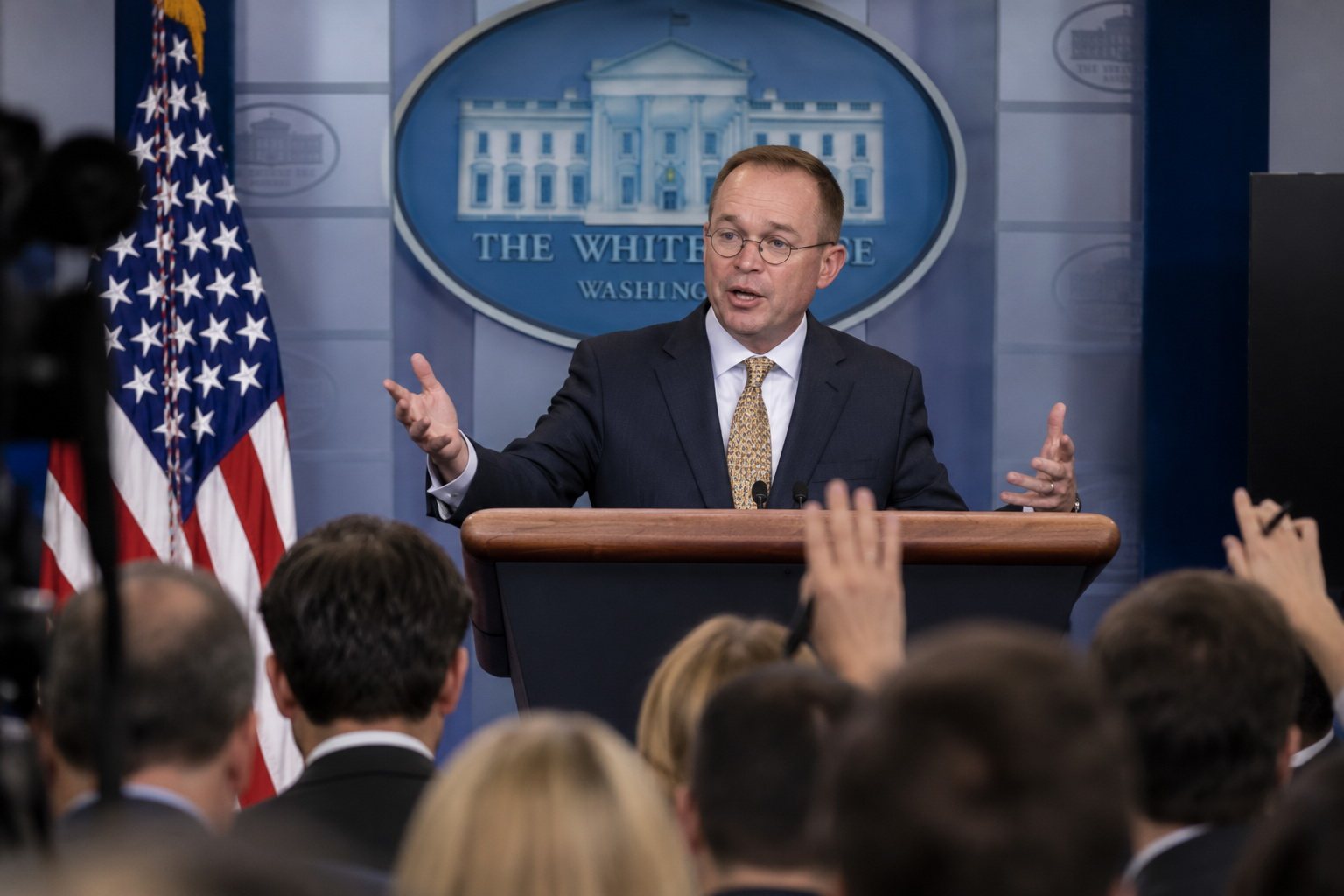
President Donald Trump's White House spent October 18, 2019, attempting to contain the fallout from an extraordinary admission by one of its most senior officials: The administration had withheld hundreds of millions of dollars in military assistance to Ukraine partly because Trump wanted the Ukrainian government to investigate a conspiracy theory involving Democrats and the 2016 presidential election.
The admission came directly from Mick Mulvaney, Trump's acting White House chief of staff, during a televised press briefing the previous day.
For weeks, Trump and his allies had insisted that there was no quid pro quo involving American military assistance and investigations sought by the president.
Mulvaney's remarks directly contradicted that defense.
By October 18, the administration was scrambling to explain how its own chief of staff had publicly acknowledged the very arrangement the president had repeatedly denied.
The Admission That Sparked the Crisis
The controversy began during an October 17 White House news conference.
Mulvaney was initially expected to discuss the administration's decision to host the following year's G7 summit at Trump's privately owned Doral resort in Florida.
But questions quickly turned to Ukraine and the nearly $400 million in American security assistance that had been temporarily withheld.
At the time, House Democrats were investigating whether Trump had used military assistance and the prospect of a White House meeting to pressure Ukrainian President Volodymyr Zelensky into announcing politically useful investigations.
Mulvaney acknowledged that Trump's interest in investigating the origins of the 2016 Russia investigation was among the reasons for withholding the assistance.
Specifically, Trump wanted Ukraine to examine a discredited conspiracy theory involving a Democratic National Committee computer server.
When ABC News correspondent Jonathan Karl asked whether that investigation was a factor in withholding the money, Mulvaney answered affirmatively.
Karl then pointed out that the arrangement appeared to constitute a quid pro quo: American funding was being withheld while the administration sought an investigation.
Mulvaney did not reject the characterization.
Instead, he defended the practice.
"Get Over It"
Mulvaney's response became one of the most widely discussed moments of the impeachment investigation.
"We do that all the time with foreign policy," he said.
He then delivered the remark that would define the controversy:
"Get over it."
Mulvaney argued that political considerations frequently influence foreign policy decisions and that the administration's actions were appropriate.
But the distinction at the center of the impeachment investigation was not whether governments could attach legitimate policy conditions to foreign assistance.
Governments routinely use diplomatic and economic leverage to advance national security interests.
The question was whether Trump had used congressionally approved military assistance to obtain investigations that could provide him with a personal political advantage.
That distinction was critical.
Ukraine was fighting Russian-backed forces and depended heavily on American military support.
The aid had been approved by Congress to help strengthen Ukraine's defenses.
The president's critics argued that withholding the assistance to secure politically advantageous investigations would represent an abuse of presidential authority.
The White House Attempts to Reverse Course
Within hours of his news conference, Mulvaney issued a statement attempting to walk back his remarks.
He accused the media of misconstruing his comments and insisted that there had been no quid pro quo.
The new explanation claimed that the military assistance had been withheld because of concerns about corruption in Ukraine and insufficient financial contributions from other countries.
Mulvaney also denied that Trump had ordered the assistance withheld until Ukraine investigated the Democratic server conspiracy theory.
The difficulty was that his original remarks had been recorded and broadcast.
Reporters could compare the written denial directly with what he had said at the podium.
The contradiction created an immediate credibility problem for the White House.
The administration was effectively asking the public to accept a later written statement over the chief of staff's own televised explanation.
October 18: Trump Dismisses the Controversy
The following day, October 18, Trump faced questions about Mulvaney's statements.
During an event at the White House recognizing the first all-female spacewalk, a reporter asked whether the president wanted to clarify what his acting chief of staff had said.
Trump declined to provide a detailed explanation.
"I think he clarified it," the president responded.
The brief answer did little to resolve the contradiction.
Mulvaney had acknowledged that an investigation involving the 2016 election was a factor in withholding military assistance.
He had then issued a statement denying that any such arrangement existed.
Trump's response accepted the attempted clarification without explaining why the original account had been different.
The controversy continued throughout October 18, as lawmakers, administration officials, and legal commentators examined the implications of Mulvaney's remarks.
Even some of Trump's allies expressed frustration over the handling of the news conference.
The Conspiracy Theory Behind the Demand
The investigation Trump wanted Ukraine to pursue involved a false narrative about the hacking of Democratic National Committee computers during the 2016 election.
American intelligence agencies had concluded that Russia interfered in the election through cyberattacks and influence operations.
The conspiracy theory suggested that Ukraine, rather than Russia, was responsible for important elements of the interference and that a Democratic computer server had somehow been concealed in Ukraine.
There was no credible evidence supporting that account.
Nevertheless, Trump repeatedly promoted suspicions involving Ukraine and the origins of the Russia investigation.
During his July 25, 2019, telephone conversation with Zelensky, Trump asked the Ukrainian president to pursue matters involving the 2016 election.
He also requested an investigation connected to former Vice President Joe Biden and his son Hunter Biden.
Joe Biden was then seeking the Democratic presidential nomination and was a potential opponent of Trump in the 2020 election.
Mulvaney maintained that the withholding of military assistance had nothing to do with an investigation of the Bidens.
That distinction did not eliminate the broader concern about the administration linking American assistance to politically sensitive investigations.
Congress Had Already Approved the Money
The military assistance at the center of the controversy was not a discretionary personal fund controlled by the president.
Congress had authorized security assistance to help Ukraine defend itself against Russian aggression.
The administration nevertheless delayed the release of part of that assistance during the summer of 2019.
That raised questions about both the motivation for the delay and the president's authority to withhold funds that Congress had appropriated.
Those questions would become even more significant several months later.
In January 2020, the nonpartisan Government Accountability Office concluded that the Office of Management and Budget had violated the Impoundment Control Act by withholding approximately $214 million in Defense Department security assistance to Ukraine for policy reasons.
The GAO's finding concerned the legality of withholding the appropriated funds. It did not independently determine whether Trump had sought personal political benefits from the delay.
Nevertheless, the ruling established that an important part of the administration's handling of Ukraine assistance had violated federal budget law.
A Defining Moment in Trump's First Impeachment
The Ukraine controversy eventually led the House of Representatives to impeach Trump in December 2019.
The House approved two articles of impeachment: abuse of power and obstruction of Congress.
The abuse-of-power article concerned allegations that Trump had solicited Ukraine's interference in the 2020 presidential election by pressing for investigations that could benefit him politically.
The obstruction article concerned the administration's refusal to cooperate with the House investigation.
In February 2020, the Republican-controlled Senate acquitted Trump on both articles.
The acquittal meant that Trump was not removed from office.
It did not erase the recorded statements, the underlying evidence, or the subsequent GAO determination that the withholding of certain military assistance had violated federal law.
The Significance of October 18
October 18, 2019, stands out because it demonstrated how quickly the administration's public explanation of the Ukraine affair could change.
For weeks, Trump had insisted that there was no improper exchange involving American assistance.
Then his acting chief of staff acknowledged that a requested investigation had been a factor in withholding the money.
When the implications became apparent, Mulvaney attempted to retract the admission.
And when Trump was asked about the contradiction the following day, he dismissed the matter by saying it had already been clarified.
The episode illustrates an important distinction between denying an allegation and addressing the evidence supporting it.
The original statements remained available for the public to examine, regardless of the administration's subsequent explanation.
Six years later, the October 18 controversy remains a documented example of a White House struggling to reconcile its public denials with the words of one of its own highest-ranking officials.
The central evidence was not a secret recording, an anonymous accusation, or a disputed recollection.
It was the acting White House chief of staff, speaking from the White House briefing room, explaining the administration's actions in his own words.