A federal judge released nearly 1,900 pages of evidence from the criminal case accusing Donald Trump of attempting to overturn the 2020 presidential election.
Buried within the heavily redacted records was a particularly important detail about January 6, 2021: A White House employee had informed Trump about rioting at the United States Capitol as early as 1:21 p.m.
It would be nearly three more hours before the president released a video instructing his supporters to go home.
The disclosure added precision to an already troubling timeline of presidential inaction during one of the most serious attacks on American democracy in modern history.
The documents were released by U.S. District Judge Tanya Chutkan as part of special counsel Jack Smith's federal election-interference prosecution.
Although much of the material had previously been made public, the newly unsealed testimony provided additional clarity about when Trump learned that his supporters were attacking the Capitol.
A 1,889-Page Evidence File Becomes Public
The October 18 release consisted of four volumes containing 1,889 pages of supporting evidence gathered by Smith's investigators.
The documents accompanied a 165-page legal filing released earlier that month, in which prosecutors argued that Trump could still face criminal prosecution for his efforts to overturn the 2020 election despite a Supreme Court ruling granting presidents broad immunity for official acts.
The evidence included witness interviews, communications, excerpts from former Vice President Mike Pence's memoir, records of Trump's conversations with state officials, and documents concerning efforts to assemble fraudulent slates of presidential electors.
Many pages remained entirely sealed or heavily redacted.
The visible portions largely consisted of materials already available through congressional investigations and public records.
But one witness transcript clarified a critical point in the January 6 timeline.
It documented that Trump had been told about the violence at the Capitol shortly after returning to the White House from his speech near the Ellipse.
The White House Employee Who Told Trump About the Riot
According to testimony collected by the House committee investigating January 6, a White House employee encountered Trump as the president returned from his rally.
The employee had been monitoring television coverage of Trump's speech.
When Trump asked about the coverage, the employee explained that the broadcast had switched away because of events at the Capitol.
The employee told the president:
"Sir, they cut it off because they're rioting down at the Capitol."
Trump reportedly asked what the employee meant.
The employee repeated that people were rioting at the Capitol.
According to the testimony, Trump responded:
"Oh really? All right, let's go see."
The employee's account described Trump proceeding to watch television coverage of the unfolding events.
The October 18 release made the timing especially clear.
A congressional investigator asked the witness to confirm that the exchange occurred at 1:21 p.m.
The witness agreed.
That timestamp was supported by a White House photograph taken at the time.
The broader exchange had already appeared in the January 6 committee's final report, but the less-redacted transcript supplied clearer confirmation of its timing.
What Was Happening at 1:21 p.m.?
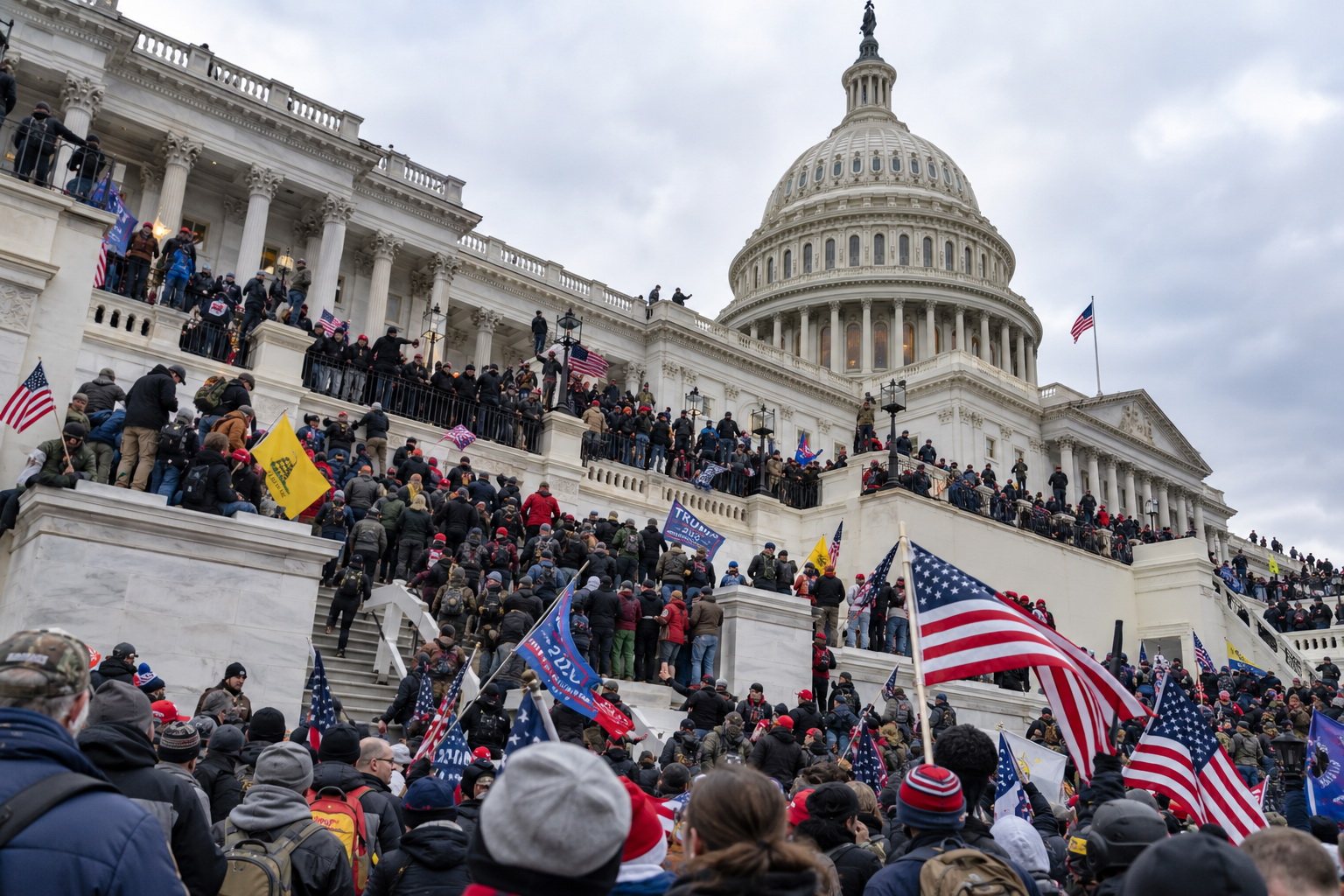
By early afternoon on January 6, thousands of Trump supporters had gathered around the Capitol.
Congress was meeting in a joint session to certify Joe Biden's victory in the 2020 presidential election.
Trump had spent weeks falsely claiming that widespread election fraud had deprived him of victory.
Those claims had been rejected by courts, contradicted by election officials, and unsupported by credible evidence sufficient to overturn the election.
Earlier that day, Trump addressed supporters near the White House and urged them to march toward the Capitol.
He repeated false allegations about the election and demanded that Vice President Mike Pence reject electoral votes, an action Pence had no lawful authority to take unilaterally.
By 1:21 p.m., confrontations between rioters and law enforcement were already underway at the Capitol complex.
The crowd was attempting to breach security barriers, and police officers were struggling to hold their positions.
The newly clarified testimony indicated that Trump had been informed about the rioting during these early stages of the attack.
It did not establish that he knew every detail of the violence at that moment.
But it documented that the president had been explicitly told that rioting was occurring at the Capitol.
Nearly Three Hours Before His Video Message
The timing matters because Trump's most direct public instruction for the crowd to leave did not come until 4:17 p.m.
By then, rioters had breached the Capitol, lawmakers had been evacuated or sheltered, police officers had been assaulted, and the certification of the presidential election had been interrupted.
In the video, Trump finally told his supporters to go home.
But he also repeated the false claim that the election had been stolen.
He told the rioters that he understood their feelings and said:
"We love you. You're very special."
The contrast between the two moments became central to the investigation.
At 1:21 p.m., according to the White House witness, Trump was informed that rioting was taking place.
At 4:17 p.m., he released a video asking people to leave.
The interval was approximately two hours and fifty-six minutes.
During that period, the attack intensified and Congress was forced to suspend its proceedings.
The evidence raised questions about why the president did not act more quickly to issue a clear public demand that the violence stop.
Trump Continued Pressuring Pence
The newly released appendix also formed part of a larger body of evidence concerning Trump's efforts to pressure Vice President Pence.
Pence's constitutional role on January 6 was to preside over the counting of electoral votes.
Trump wanted Pence to reject or delay certification of Biden's victory.
Pence repeatedly told Trump that he did not possess that authority.
At 2:24 p.m. on January 6, while the Capitol was under attack, Trump posted a message criticizing Pence for lacking the courage to do what Trump claimed was necessary.
The message came after rioters had breached the building and as Pence's safety was becoming a serious concern.
Prosecutors and congressional investigators examined the post as part of the broader timeline of Trump's conduct.
The question was not merely whether Trump knew that violence was occurring.
It was how he behaved after receiving that information.
Evidence of a Broader Effort to Overturn the Election
The 1:21 p.m. testimony was only one component of the October 18 document release.
Other materials concerned Trump's attempts to challenge certified election results in states Biden had won.
The appendix included records connected to the effort to create alternative slates of presidential electors.
It also contained material relating to Trump's January 2, 2021, telephone call with Georgia Secretary of State Brad Raffensperger.
During that call, Trump urged Raffensperger to find enough votes to reverse Biden's victory in Georgia.
The president specifically referred to 11,780 votes, one more than Biden's margin in the state.
Georgia election officials did not substantiate Trump's allegations of fraud sufficient to change the outcome.
Smith's prosecutors argued that these episodes were connected parts of an effort to obstruct the lawful transfer of presidential power.
Trump denied criminal wrongdoing and pleaded not guilty to the federal charges.
Trump Tried to Delay the Evidence Release
The timing of the October 18 disclosure was itself controversial.
The presidential election was less than three weeks away.
Trump's attorneys argued that releasing the evidence before Election Day risked influencing voters and unfairly prejudicing their client.
They sought to postpone disclosure until after the election.
Judge Chutkan rejected that request.
She emphasized the legal presumption favoring public access to judicial proceedings and declined to treat the political calendar as sufficient reason to withhold otherwise releasable court materials.
The documents were released with extensive redactions protecting information that remained subject to court restrictions.
The decision allowed the public to examine portions of the evidence while the legal dispute over presidential immunity continued.
The Supreme Court's Immunity Ruling Complicated the Case
The October 18 release followed the Supreme Court's July 2024 decision in Trump v. United States.
The Court held that former presidents possess absolute immunity for certain core constitutional functions and presumptive immunity for other official presidential acts.
Unofficial conduct receives no such immunity.
That ruling required prosecutors to reconsider how their allegations fit within the boundaries established by the Court.
Smith subsequently filed a revised indictment and argued that Trump's efforts to overturn the election involved conduct undertaken as a political candidate rather than as part of his legitimate presidential responsibilities.
The October appendix supported that argument.
Its purpose was not to establish Trump's guilt through a completed trial.
It was to help the court determine which allegations and evidence could proceed under the Supreme Court's immunity framework.
The distinction is important.
The released materials contained sworn testimony, records, and prosecutorial arguments, but the criminal charges remained allegations requiring adjudication.
What the January 6 Committee Had Already Established
The House January 6 committee had previously examined Trump's conduct during the attack.
Its final report described a president who watched television coverage of the violence while advisers, lawmakers, and family members urged him to intervene.
The committee concluded that Trump had failed to take prompt action to stop the attack.
The October 2024 appendix did not introduce an entirely new account of those events.
Instead, it reinforced the existing timeline with additional source material.
The 1:21 p.m. timestamp was especially relevant because it narrowed uncertainty about how early Trump had been informed of the rioting.
The testimony was not an anonymous rumor reported secondhand by the press.
It was a witness account collected during a congressional investigation and later included among the materials submitted in a federal criminal case.
As with any witness testimony, its reliability and significance could be examined and challenged through legal proceedings.
But its consistency with the broader timeline made it a meaningful piece of the historical record.
A Case That Never Reached Trial
The federal election-interference prosecution did not ultimately proceed to trial.
After Trump won the November 2024 presidential election, Smith moved to dismiss the federal case in accordance with the Justice Department's longstanding position that a sitting president cannot be federally prosecuted.
Judge Chutkan dismissed the case without prejudice in November 2024.
The dismissal was not a jury verdict or a judicial finding that the underlying allegations were false.
Nor was the release of the appendix a finding of criminal guilt.
The criminal charges were never resolved through a trial.
The evidence, however, remained part of the public record.
Why October 18 Matters
October 18, 2024, is an important date in the history of January 6 because it made additional evidence available about what Trump knew during the attack and when he knew it.
The documents reinforced a specific timeline:
At 1:21 p.m., a White House employee told Trump that people were rioting at the Capitol.
At 2:24 p.m., Trump publicly criticized Mike Pence while the attack was underway.
At 4:17 p.m., Trump released a video telling his supporters to go home, while continuing to repeat false claims about the election.
Those moments do not, by themselves, resolve every legal question about Trump's responsibility.
They do establish a chronology that can be evaluated against the president's actions and public statements.
The central historical question is why nearly three hours passed between Trump's documented notification of the rioting and his recorded appeal for the crowd to leave.
The October 18 evidence release did not answer every question about January 6.
But it strengthened the public record of what occurred inside the White House as the Capitol came under attack.
And it preserved testimony about a moment when the president was told that rioting had begun at the seat of American democracy, long before he publicly instructed his supporters to go home.