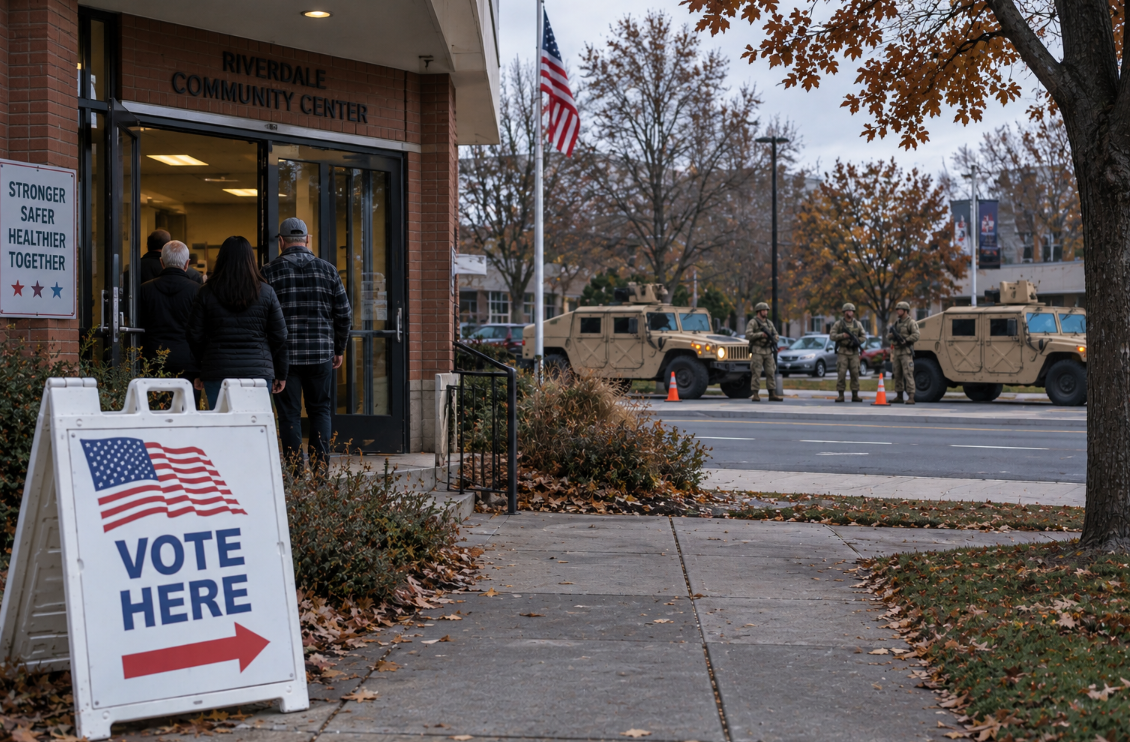
With the November midterm elections approaching, election officials, lawmakers and civil-rights organizations are preparing for a scenario that would once have seemed extraordinary: federal agents or National Guard troops appearing near American polling places.
The Pentagon says that isn't going to happen.
At least, there are no current plans for it.
Gen. Dan Caine, chairman of the Joint Chiefs of Staff, has given lawmakers written assurances that the U.S. military has no plans to deploy federal troops or federalized National Guard members to polling places during the 2026 elections.
He also said the military has no plans to seize ballots, voting machines or other election materials.
But concern about federal involvement in November's election has not disappeared.
Instead, communities around the country are preparing for the possibility anyway.
Trump Opened the Door
The concern did not appear out of nowhere.
Earlier this year, President Donald Trump was asked whether he would consider sending National Guard troops or Immigration and Customs Enforcement agents to voting locations.
Trump responded that he would do “anything necessary to make sure we have honest elections.”
That statement immediately raised questions about what role, if any, armed federal personnel could have in an American election.
Traditionally, very little.
Election administration in the United States is overwhelmingly handled by state and local governments, and federal law sharply restricts military involvement at polling places.
Caine reinforced that principle in his response to Sen. Elissa Slotkin of Michigan.
“Election administration and security remain the fundamental responsibility of state and local officials,” he wrote.
He also said he had neither received nor expected to receive an unlawful order involving the military and the November election.
ICE Adds Another Layer of Concern
The National Guard isn't the only federal force generating questions.
Immigration enforcement has become another focus.
The Department of Homeland Security says ICE is not planning operations targeting polling locations.
But election officials and voting-rights organizations are considering what they would do if immigration agents nevertheless appeared near voting sites while conducting other enforcement activity.
The distinction matters.
There is currently no evidence that ICE has a nationwide plan to station agents at polling places.
But the presence of heavily armed immigration officers near a voting location could create complications even if voting itself were not the purpose of the operation.
Those concerns are particularly acute in communities with large immigrant and naturalized-citizen populations.
Communities Aren't Waiting to Find Out
Some organizations are already building contingency plans.
In Arizona, immigration activists are developing an online system allowing people to report sightings of ICE agents, National Guard personnel and other federal officers near polling places.
Election officials elsewhere are preparing procedures for identifying federal officers and determining what authority they have if they appear at election sites.
Denver officials, for example, have incorporated possible federal immigration activity into their election contingency planning even though there is currently no evidence that ICE intends to target the city's polling locations.
Civil-rights organizations have also gone to court.
The NAACP and other groups filed a lawsuit seeking to prevent federal law-enforcement deployments at voting locations, arguing that the presence of armed federal officers could intimidate voters.
The Trump administration disputes those concerns, and federal agencies have denied that they are planning polling-place operations.
The Pentagon Says No
The clearest assurance so far has come from Caine.
“The Joint Force has no plans to send Federal military personnel or Federalized members of the National Guard to polling places during the 2026 elections,” he wrote.
He went further.
The military has no plans to seize ballots.
No plans to seize voting machines.
And no plans to take possession of other election-related material.
Those are unusually specific assurances from America's highest-ranking military officer.
But they are also assurances about the military's current plans.
They do not prevent political leaders, election officials or civil-rights organizations from asking what would happen if circumstances—or orders—changed.
An Election Contingency Few Expected to Need
Preparing for emergencies is nothing new for election officials.
They plan for power failures.
Severe weather.
Equipment problems.
Security threats.
Cyberattacks.
And disruptions at polling locations.
In 2026, some jurisdictions have added another scenario to that list: federal officers showing up near the polls.
There is an important distinction between preparing for that possibility and claiming it is going to happen.
Right now, the nation's highest-ranking military officer says it isn't planned.
DHS says ICE isn't targeting polling places.
There is no confirmed federal operation to station troops or immigration agents at voting sites in November.
Yet the fact that election officials and civil-rights organizations are preparing for the possibility illustrates just how unusual the political and security environment surrounding the 2026 midterms has become.
For now, the official answer from the Pentagon is clear:
The military isn't going to the polls.
The question being asked across the country is what happens if that answer changes.